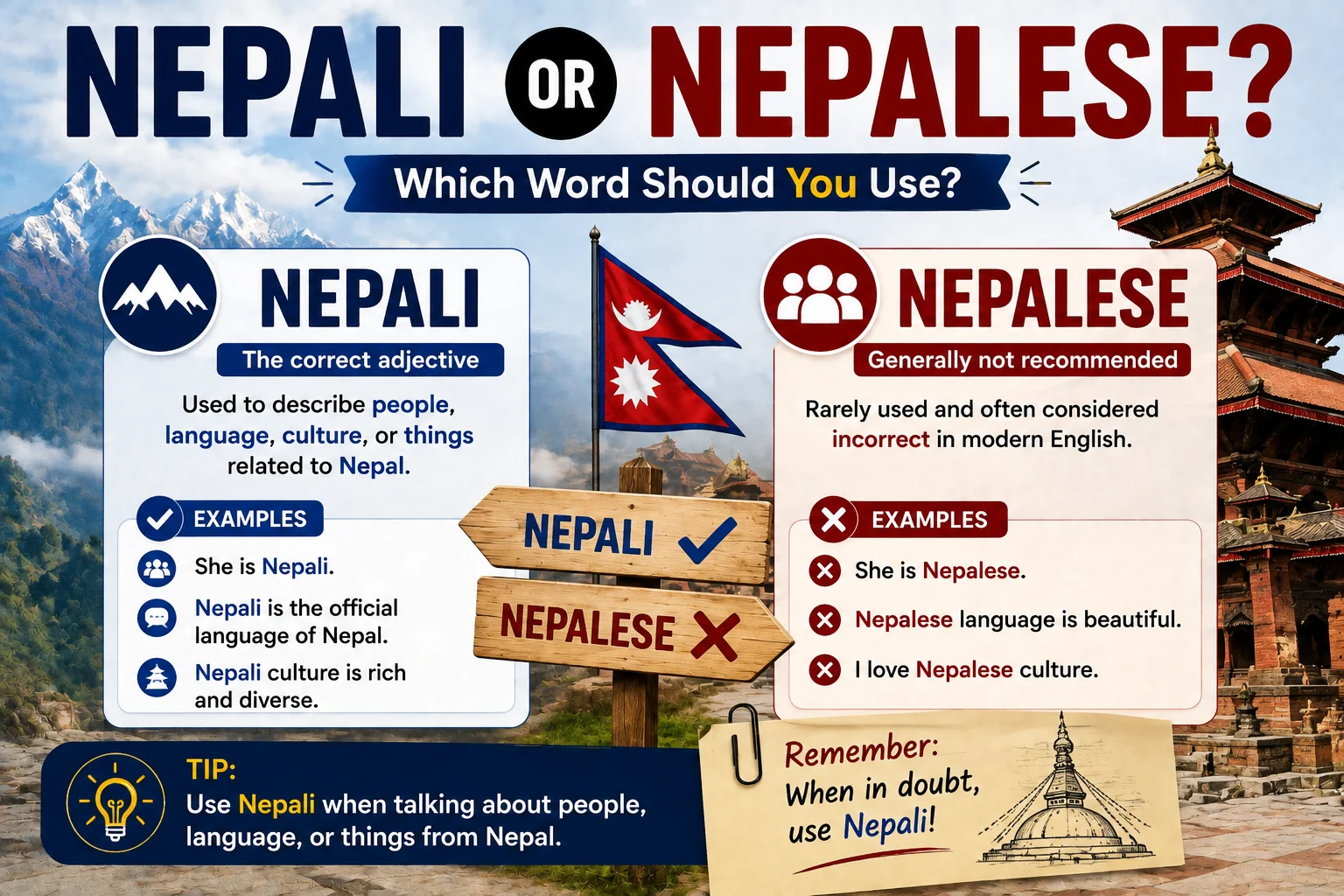
Nepali and Nepalese can both refer to people or things from Nepal, but Nepali is the more common and preferred term in many contexts. Nepali is also the name of Nepal’s main language.
Have you ever written “Nepali” and wondered if “Nepalese” would be better? This is a common question for English learners, students, travelers, and writers. Both words are connected to Nepal, but they are not always used in exactly the same way.
I have seen learners pause over this choice when writing sentences such as “She is ___” or “He speaks ___.” The confusion is understandable. English uses different forms for nationalities, languages, and people, and the rules are not always simple.
Nepali is widely used for the Nepali language, for people from Nepal, and as an adjective for things connected with Nepal. Nepalese can also describe people and things from Nepal, and it is a valid English word.
The best choice depends on what you mean and the style of your sentence. Once you know the difference, the choice becomes much easier. Let us break it down with clear examples.
nepali or nepalese – Quick Answer
Nepali and Nepalese are both English terms associated with Nepal.
The most useful rule is:
- Nepali = the language, people, and things connected with Nepal
- Nepalese = a person from Nepal, or something related to Nepal
Examples with Nepali
She is Nepali.
He speaks Nepali.
We enjoyed Nepali food.
They are studying Nepali culture.
Examples with Nepalese
She is Nepalese.
He is a Nepalese citizen.
The museum has a collection of Nepalese art.
Both Nepali and Nepalese can be correct when describing nationality or things from Nepal.
However, when you mean the language, use Nepali.
He speaks Nepali. ✅
He speaks Nepalese. ❌
That is the key difference many learners need to remember.
The Origin / Background of Nepali and Nepalese
The words Nepali and Nepalese both relate to Nepal, the South Asian country in the Himalayas.
The origin of Nepali
Nepali is the name of the principal language of Nepal. The language belongs to the Indo-Aryan branch of the Indo-European language family.
Nepali developed from earlier forms of Indo-Aryan speech and has a long literary history. It is normally written in the Devanagari script, the same script used for Hindi.
The word Nepali is also used as an adjective and noun in English.
For example:
Nepali literature is rich and varied.
She is Nepali.
The origin of Nepalese
Nepalese is formed from Nepal with the English suffix -ese.
English uses -ese in several nationality words, such as:
- Japanese
- Chinese
- Portuguese
- Nepalese
So Nepalese follows a familiar English pattern.
Why do both words exist?
English has more than one way to form nationality words. Some countries have one common form, while others have several.
For Nepal, both Nepali and Nepalese have established use.
The important point is that Nepali has an additional role. It is also the name of the language.
Nepali or Nepalese Explained — Key Differences
The biggest difference is how the words are used in a sentence.
Nepali
Nepali can function as:
- A noun for the language
- An adjective for something related to Nepal
- A noun or adjective referring to people from Nepal
Examples:
I am learning Nepali.
Here, Nepali is the language.
She is Nepali.
Here, Nepali describes her nationality.
We tried Nepali food.
Here, Nepali describes the food.
Nepalese
Nepalese can describe people, culture, products, history, art, and other things connected with Nepal.
Examples:
He is Nepalese.
We studied Nepalese history.
The gallery displays Nepalese paintings.
But Nepalese is not normally used as the standard name of the language.
Comparison Table: Nepali vs Nepalese
| Term | Meaning | When to Use | Region/Context |
|---|---|---|---|
| Nepali | Related to Nepal or its people | Nationality, culture, food, language | Widely used |
| Nepali | The language of Nepal | When talking about the language | Standard language name |
| Nepalese | From or related to Nepal | People, culture, history, art, etc. | English usage |
| Nepalese person | A person from Nepal | Formal or clear nationality reference | General English |
| Nepali person | A person from Nepal | Common nationality description | General English |
Which Version Should You Use?
The best choice depends on your meaning.
If you mean the language → use Nepali
This is the clearest rule.
I speak Nepali.
She is learning Nepali.
The book is written in Nepali.
Avoid using Nepalese as the name of the language in standard English.
If you mean a person from Nepal → both can work
You can say:
He is Nepali.
or:
He is Nepalese.
You can also say:
He is a Nepalese person.
All can communicate that the person is from Nepal.
However, Nepali is especially common when used directly as a nationality adjective:
She is Nepali.
If you mean food, culture, or traditions → Nepali is very common
For example:
Nepali food is known for dishes such as dal bhat.
We learned about Nepali traditions.
The restaurant serves Nepali cuisine.
Nepalese can also be used:
The museum has a large collection of Nepalese art.
So both forms may appear when describing things connected with Nepal.
For formal writing → follow the context
If you are writing for a university, newspaper, company, or publication, check its style guide.
If no special guide exists, Nepali is often the simplest choice, especially when discussing the language or using the nationality adjective.
Common Mistakes with Nepali or Nepalese
Mistake 1: Using Nepalese for the language
❌ I speak Nepalese.
✅ I speak Nepali.
Why? The standard name of the language is Nepali.
Mistake 2: Thinking Nepalese is always wrong
❌ Nepalese is incorrect.
✅ Nepalese is a valid English word.
For example:
He is Nepalese.
This is a valid way to describe someone from Nepal.
Mistake 3: Using “Nepali” only for the language
❌ Nepali can only describe the language.
✅ Nepali can also describe people, culture, food, art, and other things related to Nepal.
For example:
She is Nepali.
We enjoyed Nepali food.
Mistake 4: Confusing nationality with language
Consider these sentences:
She is Nepali.
This tells us about her nationality.
She speaks Nepali.
This tells us about the language she speaks.
The same word can serve different grammatical roles.
Mistake 5: Writing “a Nepali” without context
You may see:
He is a Nepali.
This construction occurs in English, but a Nepali person is often clearer and more natural for learners.
For example:
He is a Nepali person.
Or simply:
He is Nepali.
Nepali or Nepalese in Real-World Examples
1. Professional Email
Dear Mr. Sharma,
Thank you for sharing the information about Nepali cultural traditions. We would be happy to include it in our project.
Here, Nepali describes the cultural traditions.
2. News Article
The team welcomed several Nepali athletes at the international event.
Here, Nepali describes the athletes.
Another natural example is:
The exhibition features traditional Nepalese art.
Here, Nepalese describes the art.
3. Social Media Post
I started learning Nepali this year, and I love discovering new words!
Here, Nepali is the name of the language.
4. Formal Report
The study examines changes in Nepali society and language.
Here, Nepali describes both society and language.
Another example:
The report examines the history of Nepalese architecture.
Here, Nepalese describes architecture connected with Nepal.
Nepali or Nepalese — Data, Trends & Usage
The search intent behind “Nepali or Nepalese” is mainly informational. People usually search this phrase because they want to know which word is correct for a person, language, culture, or nationality.
The confusion comes from the fact that English has several nationality patterns.
Compare:
- Nepal → Nepali / Nepalese
- Japan → Japanese
- China → Chinese
- India → Indian
- Pakistan → Pakistani
- Bangladesh → Bangladeshi
There is no single suffix that works for every country.
Why does this matter?
Nationality words appear often in:
- School assignments
- Travel writing
- News articles
- Immigration documents
- Business communication
- Language-learning content
- Websites and blogs
Using the right term makes your writing clearer.
For SEO writers, understanding the difference is also useful because readers may search for phrases such as Nepali language, Nepali people, Nepalese culture, or Nepalese food.
The best approach is to write naturally rather than forcing one word into every sentence.
Standalone Comparison Table
| Term/Variant | Meaning | Region/Context | Best Used When |
|---|---|---|---|
| Nepali | Language of Nepal | Language | Always use for the language |
| Nepali | From or related to Nepal | General English | Nationality and cultural references |
| Nepalese | From or related to Nepal | General English | People and things from Nepal |
| Nepali person | A person from Nepal | Clear general English | When you want maximum clarity |
| Nepalese person | A person from Nepal | Clear general English | Formal or descriptive writing |
| Nepali culture | Culture connected with Nepal | General English | Common cultural references |
| Nepalese culture | Culture connected with Nepal | General English | Also acceptable |
7 FAQs About Nepali or Nepalese
Q: What does Nepali mean?
Nepali can describe a person, culture, food, or other thing connected with Nepal. It is also the standard name of the main language of Nepal.
Q: What does Nepalese mean?
Nepalese is an English word used for a person or thing from Nepal. For example, you can say Nepalese art or a Nepalese person.
Q: Which is correct, Nepali or Nepalese?
Both can be correct, depending on the sentence. Use Nepali for the language, while both Nepali and Nepalese can describe people or things connected with Nepal.
Q: Is Nepali the language of Nepal?
Yes. Nepali is the standard name of the language. For example, “She speaks Nepali” is correct.
Q: Can I say “Nepalese language”?
It is better to say Nepali language. Nepali is the established name of the language.
Q: Is Nepali a nationality?
Yes, Nepali can be used as a nationality adjective. For example, “She is Nepali” means she is from Nepal or is a citizen/national of Nepal, depending on context.
Q: Is Nepalese offensive or incorrect?
No. Nepalese is a valid English term. It is used to describe people and things connected with Nepal, although Nepali is often the more common choice in many contexts.
Nepali or Nepalese: Easy Examples to Remember
Here are a few examples you can save:
| Meaning | Best Example |
|---|---|
| Language | She speaks Nepali. |
| Person | He is Nepali. |
| Person | He is Nepalese. |
| Food | We ordered Nepali food. |
| Culture | We studied Nepali culture. |
| Art | The gallery displays Nepalese art. |
| History | We learned about Nepalese history. |
The easiest rule
If you are talking about the language, choose:
Nepali ✅
If you are talking about a person from Nepal, either Nepali or Nepalese can work.
If you are describing something connected with Nepal, Nepali is often a natural choice, while Nepalese is also established English usage.
Conclusion
The difference between Nepali or Nepalese is easier than it first seems. Both words are connected with Nepal, and both can be used to describe people or things from the country.
The most important rule is this: Nepali is the name of the language. Say, “I speak Nepali,” not “I speak Nepalese.” When talking about a person, both Nepali and Nepalese can be correct. You can say, “She is Nepali,” or “She is Nepalese.”
For culture, food, art, history, and other topics, both forms can appear, although Nepali is often a simple and common choice.
Do not worry if you have used the wrong form before. Now you know what each word means and where it fits. Bookmark this guide and share it with someone who is still confused about Nepali or Nepalese.