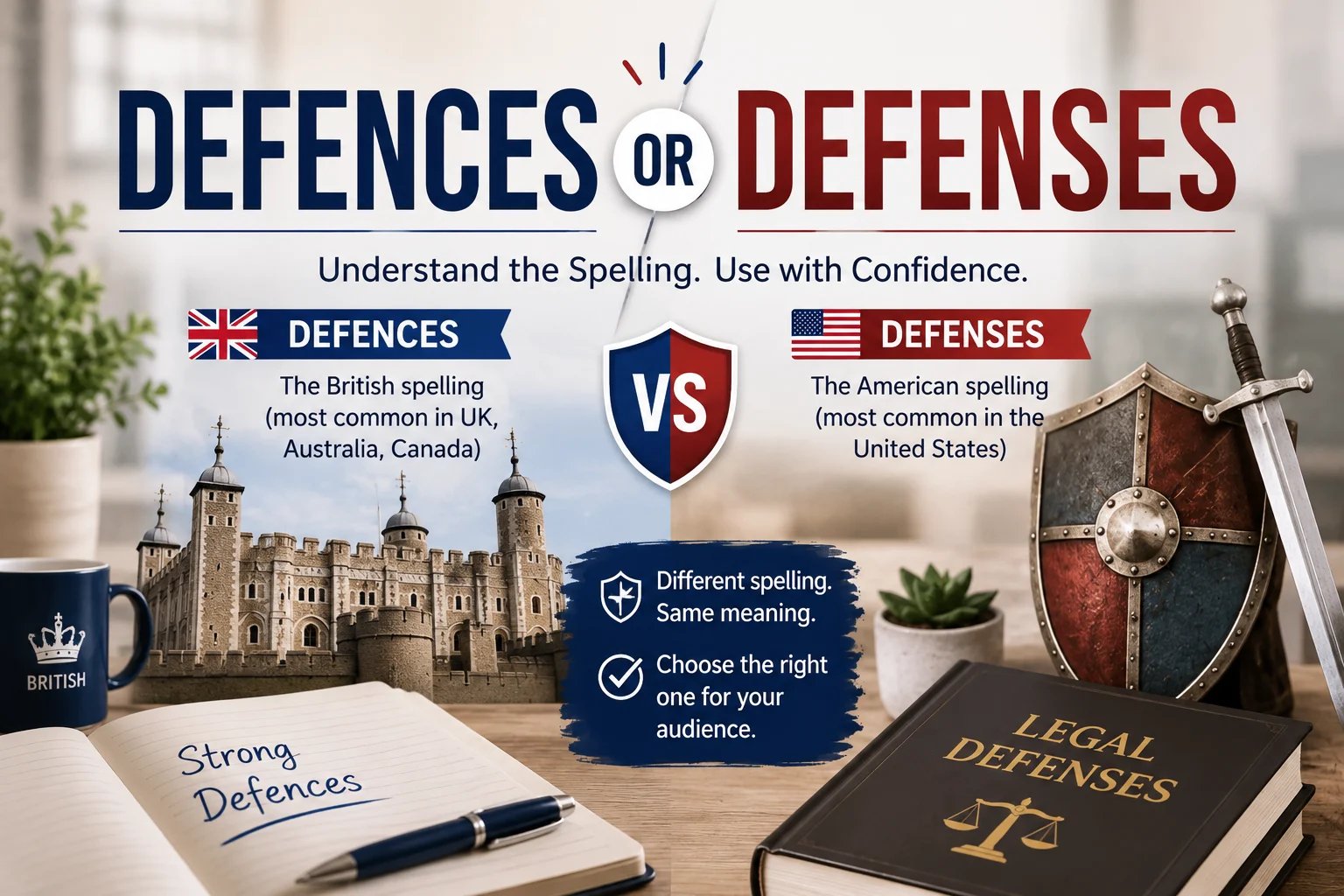
“Defences” is the British spelling, while “defenses” is the American spelling of the same word.
Have you ever wondered whether defences or defenses is the correct spelling? You are not alone. This is a common spelling question because both forms are correct, but they are used in different varieties of English.
The main difference is simple: defences is the standard spelling in British English, while defenses is the standard spelling in American English. The meaning does not change. Both words are the plural form of defence/defense, meaning protection against attack, harm, criticism, or a legal accusation.
For example, a country may build strong defences against an attack in the UK, while an American writer would usually write defenses. In law, sports, and everyday writing, the same spelling rule applies.
If English is not your first language, choosing between these spellings can be confusing. You may also see both forms online, which can make the choice harder.
This guide explains defences or defenses in simple English. You will learn the spelling difference, origin, common mistakes, everyday examples, and which form you should use.
Defences or Defenses – Quick Answer
Both defences and defenses are correct.
The difference is based on regional English:
- Defences = British English
- Defenses = American English
Both words have the same meaning. They refer to ways of protecting someone or something from harm, attack, criticism, or legal claims.
Example 1: British English
The castle has strong defences.
Example 2: American English
The castle has strong defenses.
Example 3: Legal writing
The lawyer prepared several defenses for his client.
A British lawyer would normally write:
The lawyer prepared several defences for his client.
So, neither spelling is wrong. The important thing is to choose the form that matches your audience and keep your spelling consistent.
The Origin of Defences or Defenses
The word defence/defense comes from Old French and Latin roots related to protecting or warding off an attack.
The English word developed from the Old French defens, which came from Latin dēfēnsus, meaning protection or defense.
Over time, English developed regional spelling differences. One important difference is the use of -ce and -se in some words.
British English generally keeps -ce in words such as:
- defence
- offence
- pretence
American English commonly uses -se:
- defense
- offense
- pretense
The difference became more established as American English developed its own spelling conventions. American dictionaries and writers adopted several simplified or standardized spellings, while British English kept many traditional forms.
The meaning of defence and defense has not changed because of the spelling. They are simply regional variants.
British English vs American English Spelling
The main spelling rule is easy to remember:
British English → defence
American English → defense
The plural forms follow the same pattern:
British English → defences
American English → defenses
| Version | Spelling | Region | Example Sentence |
|---|---|---|---|
| British English | defence | UK/Commonwealth | The country needs better defence. |
| American English | defense | US | The country needs better defense. |
| British English | defences | UK/Commonwealth | The castle had strong defences. |
| American English | defenses | US | The castle had strong defenses. |
This difference also appears in related words such as offence/offense.
The important point is that defences is not an incorrect version of defenses. It is the British spelling.
Likewise, defenses is not a spelling mistake when American English is being used.
Which Spelling Should You Use?
Your choice should depend on your audience.
US audience
Use defense for the singular and defenses for the plural.
For example:
The team has a strong defense.
The country improved its defenses.
This is the standard spelling in American English.
UK/Commonwealth audience
Use defence for the singular and defences for the plural.
For example:
The team has a strong defence.
The country improved its defences.
This spelling is also common in countries that generally follow British English conventions, although local style guides can vary.
Global/SEO audience
For a global website, either spelling can work. The best choice depends on your main audience.
If your website mainly targets readers in the United States, use defenses.
If your website mainly targets readers in the United Kingdom, use defences.
If you serve a worldwide audience, you can mention both forms when explaining the spelling difference. However, do not switch randomly between them in the same piece of writing.
Consistency is more important than choosing one spelling as universally “correct.”
Common Mistakes with Defences or Defenses
Mistake 1: Thinking one spelling is always wrong
Incorrect idea:
“Defences is always wrong.”
Correct:
Defences is correct in British English.
And:
Defenses is correct in American English.
Mistake 2: Mixing British and American spelling
A writer may use defences in one paragraph and defenses in another without a reason.
Better:
Choose one English variety and stay consistent.
Mistake 3: Using “defences” for an American audience
If you are writing specifically for US readers, defenses is normally the better choice.
Less suitable for US English:
The team improved its defences.
US English:
The team improved its defenses.
Mistake 4: Using “defenses” for British English
For British English, the preferred spelling is:
The team improved its defences.
Mistake 5: Confusing defense with offence
American English uses:
defense and offense
British English uses:
defence and offence
Remembering these pairs can make regional spelling easier.
Defences or Defenses in Everyday Examples
Emails
British English:
Our legal team is reviewing the possible defences.
American English:
Our legal team is reviewing the possible defenses.
News headlines
British English:
New Defences Planned Along the Border
American English:
New Defenses Planned Along the Border
News organizations usually follow the spelling rules of their region.
Social media
British English:
Our team needs better defences this season.
American English:
Our team needs better defenses this season.
In social media, either spelling is fine as long as it matches your intended English variety.
Formal writing
British English:
The report examines the country’s coastal defences.
American English:
The report examines the country’s coastal defenses.
The same rule applies in academic, business, government, and legal writing.
Defences or Defenses – Google Trends & Usage
Searches for defences and defenses often reflect the regional spelling habits of English speakers.
Defenses is more strongly associated with the United States because American English uses the -se ending. It is common in American news, education, sports, legal writing, and everyday communication.
Defences is more closely associated with the United Kingdom and other regions that use British-style spelling. It appears in British news, government writing, education, sports, and formal documents.
The difference is especially noticeable when people search online for spelling help. Searchers may see one version in a document and another version on a US-based website.
For SEO, it is useful to understand both forms. If your target audience is American, use defenses naturally. If your audience is British, use defences.
You can also mention both forms in a spelling guide, because readers may search for either variation.
Defences vs Defenses: Quick Comparison
| Word | English Variety | Meaning | Example |
|---|---|---|---|
| defence | British English | Protection | The army improved its defence. |
| defense | American English | Protection | The army improved its defense. |
| defences | British English | Multiple forms of protection | The city strengthened its defences. |
| defenses | American English | Multiple forms of protection | The city strengthened its defenses. |
Separate Comparison Table
| Variation | Correct? | Main Usage | Example |
|---|---|---|---|
| defence | Yes | British English singular | The defence was strong. |
| defense | Yes | American English singular | The defense was strong. |
| defences | Yes | British English plural | The city’s defences were strong. |
| defenses | Yes | American English plural | The city’s defenses were strong. |
| defences in US English | Usually not preferred | British spelling | Use defenses for US readers. |
| defenses in UK English | Usually not preferred | American spelling | Use defences for UK readers. |
FAQs About Defences or Defenses
1. Is “defences” or “defenses” correct?
Both are correct. Defences is British English, while defenses is American English.
2. Is “defences” British spelling?
Yes. Defences is the standard British English plural spelling.
3. Is “defenses” American spelling?
Yes. Defenses is the standard American English plural spelling.
4. Do defences and defenses mean the same thing?
Yes. They have the same meaning. The difference is only the regional spelling.
5. Should I use defences or defenses in the US?
Use defenses when writing for an American audience.
6. Should I use defences or defenses in the UK?
Use defences when writing for a British audience.
7. Which spelling is better for SEO?
Neither spelling is universally better. Use the form that matches your target audience. You can mention both variations naturally when explaining the difference.
Conclusion
The choice between defences or defenses is simple once you know the regional spelling rule. Defences is the standard British English spelling, while defenses is the standard American English spelling.
Both forms have the same meaning. They can describe protection from attack, legal claims, criticism, or other forms of harm. The spelling does not change the meaning.
If you write for readers in the United States, choose defenses. If you write for readers in the United Kingdom or audiences that follow British English, choose defences. For a global website, you can explain both forms and then use one consistently based on your main audience.
Remember the easy rule:
British English = defences
American English = defenses
You do not need to worry that one form is a spelling error. Both are correct in the right variety of English. The key is to know your audience and remain consistent throughout your writing.
For SEO content, the same advice applies. Write naturally, avoid unnecessary repetition, and use the spelling that best matches the readers you want to reach.