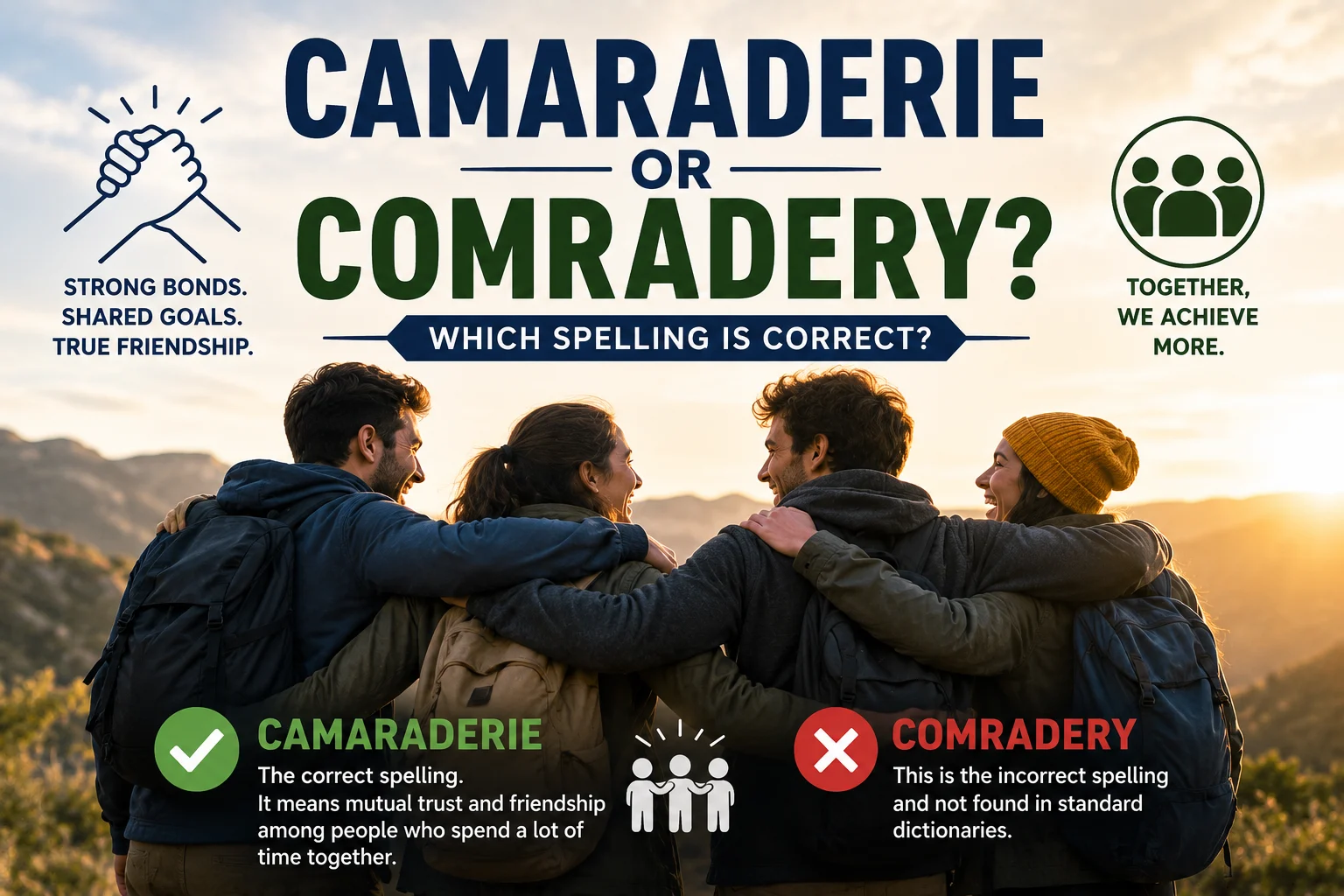
“Camaraderie” is the standard and more widely accepted spelling for friendship and mutual trust, while “comradery” is a less common variant, mainly used in American English.
Have you ever wondered whether you should write camaraderie or comradery? You’re not alone. These two words are often confused because they have similar meanings, nearly identical pronunciation, and both relate to friendship, teamwork, and mutual trust. Many people search for this spelling question when writing emails, workplace documents, school assignments, or blog posts.
The good news is that both camaraderie and comradery are real words. However, one spelling is far more common and widely accepted in modern English. Knowing which one to use will make your writing look more polished and professional.
In this guide, you’ll learn the difference between camaraderie or comradery, where each word comes from, how British and American English treat these spellings, and which version is best for different audiences. You’ll also see real-life examples, common mistakes, and practical tips to help you choose the correct spelling with confidence.
Camaraderie or Comradery – Quick Answer
Both camaraderie and comradery are correct words, but camaraderie is the standard and much more common spelling.
Both words mean:
- Friendship among people.
- Mutual trust and support.
- A strong feeling of teamwork.
Examples
- The team built great camaraderie during the project.
- Years of training created strong camaraderie among the soldiers.
- Although less common, comradery also refers to friendship and team spirit.
The Origin of Camaraderie or Comradery
The word camaraderie comes from the French word camarade, meaning “companion” or “roommate.” It entered English during the nineteenth century and became the preferred spelling for describing friendship, loyalty, and team spirit.
The spelling comradery developed later as an English variation influenced by the word comrade. Because many English speakers naturally connected the noun comrade with the feeling of friendship, the alternative spelling comradery appeared.
Today, dictionaries recognize both spellings. However, camaraderie remains the standard choice in books, newspapers, academic writing, and professional communication.
British English vs American English Spelling
Unlike many spelling differences, this is not a British-versus-American English issue.
| Version | Spelling | Region | Example Sentence |
|---|---|---|---|
| Standard English | Camaraderie | US | Camaraderie helped the team succeed. |
| Standard English | Camaraderie | UK | The club is known for its camaraderie. |
| Alternative English | Comradery | US & UK | Comradery grew during the expedition. |
Both countries strongly prefer camaraderie, although comradery is accepted as a less common variant.
Which Spelling Should You Use?
US Audience
Choose camaraderie for business writing, education, journalism, and professional communication. Use comradery only if you intentionally prefer the less common variant.
UK/Commonwealth Audience
Use camaraderie. It is the standard spelling throughout the UK and most Commonwealth countries.
Global/SEO Audience
Use camaraderie because it is the spelling most readers expect and the one most commonly found in dictionaries, books, and online searches.
Common Mistakes with Camaraderie or Comradery
Here are mistakes people often make.
❌ The company values strong comradery in formal reports. (Less preferred.)
✅ The company values strong camaraderie.
❌ Only comradery is accepted in American English.
✅ Both spellings are accepted, but camaraderie is much more common.
❌ The two words have different meanings.
✅ Both words mean friendship and mutual support.
Camaraderie or Comradery in Everyday Examples
Emails
- Our team’s camaraderie made the project enjoyable.
- The retreat strengthened our camaraderie.
News Headlines
- Community event builds camaraderie among volunteers.
- Sports team celebrates season of camaraderie.
Social Media
- Nothing beats the camaraderie of a great team!
- Grateful for the camaraderie we share every day.
Formal Writing
- Employee camaraderie contributes to workplace satisfaction.
- Strong camaraderie encourages better collaboration and trust.
Camaraderie or Comradery – Google Trends & Usage
In general, camaraderie is searched and used much more often than comradery.
It appears frequently in articles about teamwork, business culture, education, military service, sports, and leadership. Because it is the preferred dictionary spelling, writers naturally choose it for professional and academic work.
Comradery appears less often and is usually found in informal writing or by people who connect the word directly to comrade.
Across English-speaking countries, camaraderie is the clear favorite and is recommended for most readers.
Comparison Table
| Feature | Camaraderie | Comradery |
|---|---|---|
| Correct spelling | ✅ Yes | ✅ Yes |
| Most common | ✅ Yes | ❌ No |
| Preferred by dictionaries | ✅ Yes | Sometimes |
| Professional writing | ✅ Best Choice | Less Common |
| Academic writing | ✅ Yes | Rare |
| Everyday usage | ✅ Very Common | Uncommon |
| Best for SEO | ✅ Yes | No |
FAQs
Is it camaraderie or comradery?
Both are correct, but camaraderie is the standard and more widely used spelling.
Is comradery a real word?
Yes. It is an accepted alternative spelling, although it is much less common.
Which spelling do dictionaries recommend?
Most dictionaries list camaraderie as the preferred spelling.
Is camaraderie used in British and American English?
Yes. Both British and American English mainly use camaraderie.
Can I use comradery in formal writing?
You can, but camaraderie is the better choice for professional and academic writing.
Which spelling is better for SEO?
Camaraderie is usually the better choice because it is more commonly searched and recognized.
Conclusion
Understanding the difference between camaraderie or comradery is easier than it first appears. Both spellings are correct and both describe friendship, trust, teamwork, and mutual support. However, they are not equally common. Camaraderie is the standard spelling found in dictionaries, books, newspapers, academic papers, and professional communication. It is the version that most readers expect to see.
Comradery is also accepted, but it appears much less often. Some writers choose it because it resembles the word comrade, but it is generally considered a secondary spelling rather than the preferred one.
If you want your writing to look polished, professional, and easy to understand, choose camaraderie in almost every situation. Reserve comradery only if you have a specific reason to use the alternative spelling. Following this simple rule will help you communicate clearly and confidently with readers around the world.