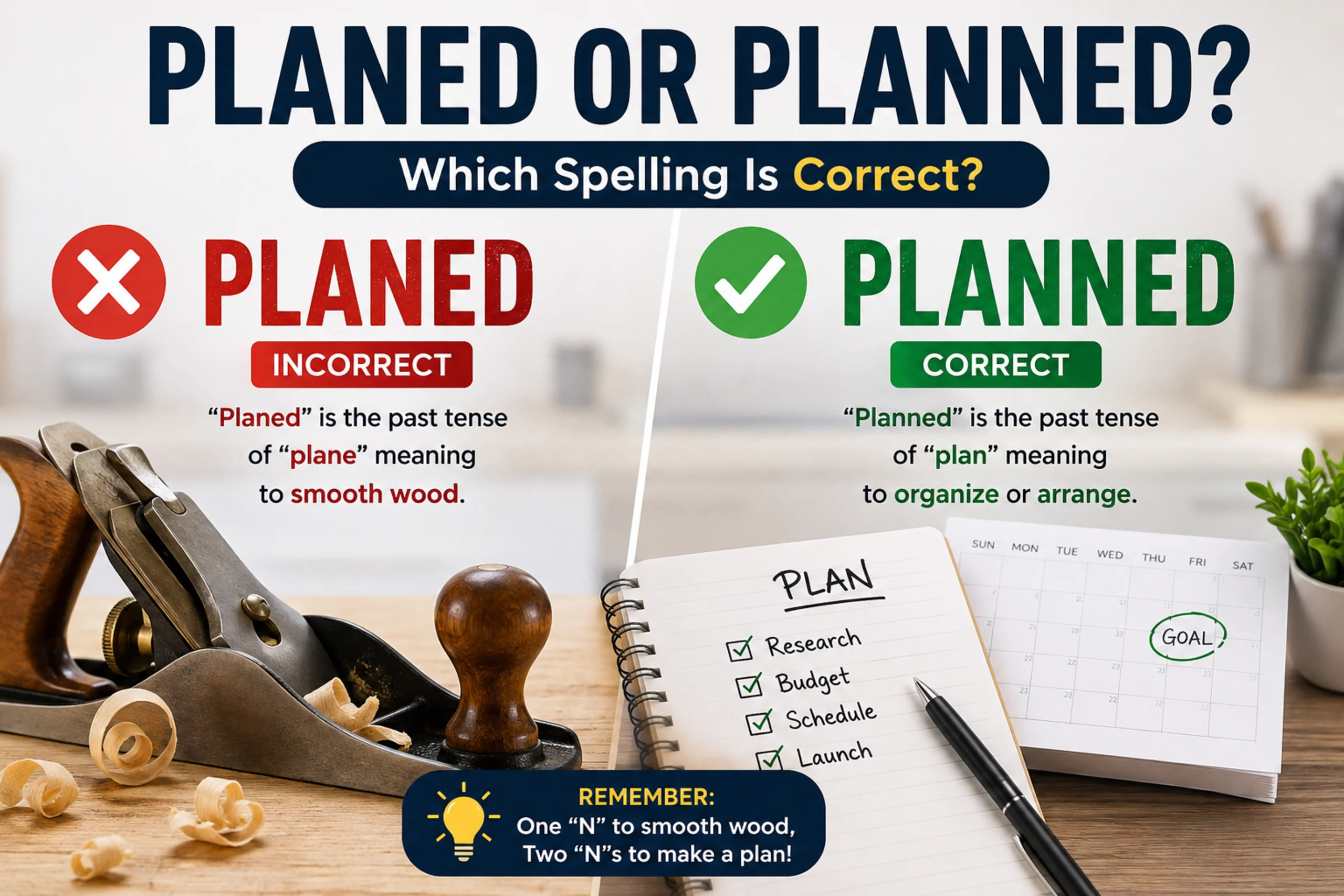
“Planned” is the correct past tense of plan, while “planed” is a different word that means smoothed or shaped with a woodworking plane.
Have you ever typed planed or planned and wondered which spelling is correct? You’re not alone. Many English learners and even native speakers get confused because these two words look very similar. However, they do not have the same meaning. Choosing the wrong one can change the meaning of your sentence completely.
Most people search for planed or planned because they want to write about making arrangements for the future. In that case, only one spelling is usually correct. The other word is real too, but it belongs to woodworking and aviation instead of everyday planning.
This guide explains the difference in simple English. You’ll learn what each word means, where the spellings come from, how British and American English use them, common mistakes to avoid, and which spelling you should choose in different situations. By the end of this article, you’ll confidently know when to use planned and when planed is actually the right word.
Planed or Planned – Quick Answer
Planned is the correct past tense and past participle of plan, meaning to organize, prepare, or decide something in advance.
Planed is the past tense of plane, meaning to smooth wood with a plane tool or to make something flat. In aviation, it can also refer to gliding through the air.
Examples
- We planned our vacation months ago.
- She carefully planned the meeting.
- The carpenter planed the wooden board until it was smooth.
The Origin of Planed or Planned
The word plan comes from the Latin word planum, meaning a drawing or layout. Over time, it came to mean arranging or organizing something before it happens. Because plan ends with a single vowel followed by a consonant, English grammar doubles the final n before adding -ed, giving us planned.
The word plane has a different history. It comes from words meaning flat or level and later became the name of a woodworking tool used to smooth wood. The past tense is planed, following the normal rule of adding -ed.
Although the spellings are similar, they come from different verbs with different meanings.
British English vs American English Spelling
There is no spelling difference between British and American English for these words.
| Version | Spelling | Region | Example Sentence |
|---|---|---|---|
| Standard English | Planned | US | We planned the event carefully. |
| Standard English | Planned | UK | They planned a family holiday. |
| Standard English | Planed | US & UK | The carpenter planed the table. |
Both varieties of English follow the same spelling rules.
Which Spelling Should You Use?
US Audience
Use planned when talking about organizing, preparing, or scheduling something. Use planed only for woodworking or similar technical meanings.
UK/Commonwealth Audience
The same rule applies. Planned is correct in almost all everyday writing, while planed is limited to specific situations.
Global/SEO Audience
Use planned for articles about events, business, travel, education, or personal goals. Use planed only when discussing woodworking, carpentry, or aviation.
Common Mistakes with Planed or Planned
Here are mistakes people often make.
❌ We planed our holiday last month.
✅ We planned our holiday last month.
❌ She planed the birthday party perfectly.
✅ She planned the birthday party perfectly.
❌ The carpenter planned the wood.
✅ The carpenter planed the wood.
❌ They carefully planed the meeting schedule.
✅ They carefully planned the meeting schedule.
Planed or Planned in Everyday Examples
Emails
- We have planned the project timeline.
- The carpenter has planed the wooden shelves.
News Headlines
- City officials planned a new transport system.
- Skilled workers planed historic timber for restoration.
Social Media
- Finally planned my summer trip!
- Dad planed the old table, and it looks brand new.
Formal Writing
- The committee planned the conference months in advance.
- The craftsman planed each piece of wood with precision.
Planed or Planned – Google Trends & Usage
The word planned is much more common than planed because people frequently write about future events, travel, education, work, and personal goals.
The word planed appears mainly in woodworking, construction, carpentry, manufacturing, and some aviation contexts. As a result, it has a much narrower audience.
In English-speaking countries such as the United States, the United Kingdom, Canada, and Australia, the usage patterns are very similar. Most people search for planned, while planed is mainly used by professionals, hobbyists, and people working with wood or technical subjects.
Comparison Table
| Feature | Planned | Planed |
|---|---|---|
| Past tense of plan | ✅ Yes | ❌ No |
| Past tense of plane | ❌ No | ✅ Yes |
| Means organized in advance | ✅ Yes | ❌ No |
| Means smoothed wood | ❌ No | ✅ Yes |
| Common in everyday English | ✅ Very Common | ❌ Rare |
| Used in woodworking | ❌ No | ✅ Yes |
| Best choice for most writing | ✅ Yes | ❌ No |
FAQs
Is it planed or planned?
It depends on the meaning. Planned means organized in advance, while planed means smoothed with a plane tool.
Why does planned have two “n”s?
English doubles the final consonant when forming the past tense of plan, creating planned.
Is planed a real word?
Yes. It is the past tense of plane, usually referring to smoothing wood.
Can I use planed instead of planned?
No. They have different meanings and cannot be used interchangeably.
Which spelling is correct for a meeting?
Use planned, because meetings are organized in advance.
Is planned correct in British and American English?
Yes. Both British and American English use planned in the same way.
Conclusion
The difference between planed or planned is easy to remember once you understand the meaning of each word. Planned is the correct spelling when you are talking about arranging, organizing, scheduling, or preparing something before it happens. It is one of the most common past-tense verbs in English and appears in everyday conversations, business writing, education, travel, and personal planning.
Planed, however, is a completely different word. It is the past tense of plane, which usually means smoothing wood with a woodworking tool or making a surface flat. Outside these technical uses, it is rarely needed in everyday writing.
If your sentence is about making plans, always choose planned. If your sentence is about woodworking or flattening a surface, planed is the correct choice. Remembering this simple difference will help you write more accurately and avoid one of the most common English spelling mistakes.