Specialty or Speciality? Specialty is the preferred American English spelling, while speciality is the standard British English spelling—both refer to a person’s area of expertise or a distinctive product.
Have you ever wondered whether specialty or speciality is the correct spelling? You’re not alone. These two words look almost the same and have the same meaning, but they are used in different parts of the English-speaking world. Many writers become confused when creating business websites, resumes, academic papers, or marketing content because they are unsure which version their audience expects.
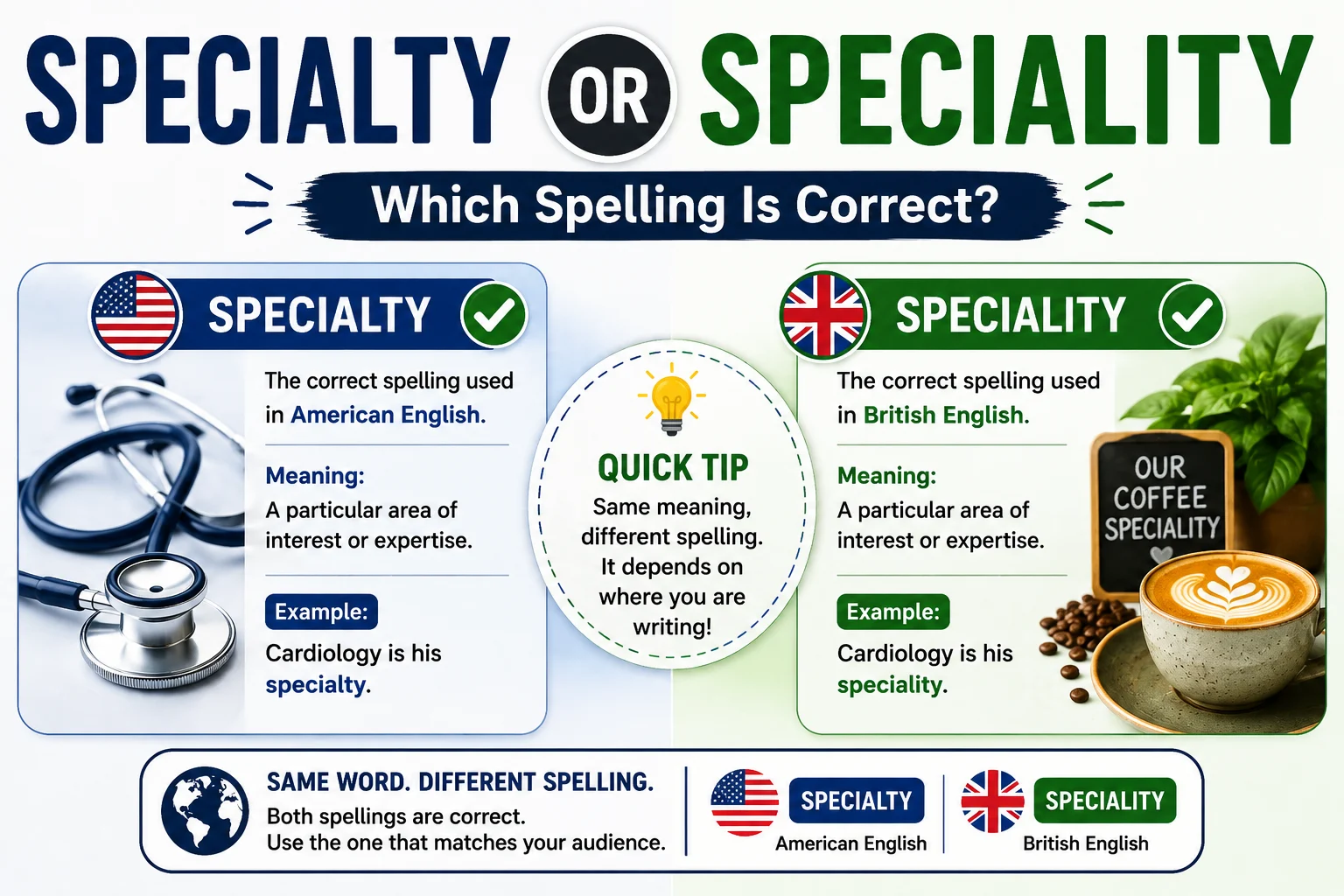
The good news is that both specialty and speciality are correct. The difference is mainly regional. Specialty is the preferred spelling in American English, while speciality is more common in British English and many Commonwealth countries. Both words refer to a person’s area of expertise, a product a business is known for, or something unique and distinctive.
In this guide, you’ll learn the difference between specialty or speciality, where the words come from, how they are used in British and American English, common mistakes to avoid, and practical examples. By the end, you’ll know which spelling best suits your audience.
## Specialty or Speciality – Quick Answer
Both specialty and speciality are correct.
- Specialty is the preferred American English spelling.
- Speciality is the preferred British English spelling.
Both words mean:
- A person’s area of expertise
- A product or service someone is known for
- Something distinctive or unique
Examples
- Italian food is the restaurant’s specialty. (US)
- Italian food is the restaurant’s speciality. (UK)
- Her medical specialty is cardiology.
## The Origin of Specialty or Speciality
Both words come from the adjective special, which comes from the Latin word specialis, meaning “particular” or “distinct.”
The noun developed through French and Middle English, eventually producing two accepted spellings.
Over time, American English favored the shorter form specialty, while British English continued using speciality more often. Despite the spelling difference, both words have the same meaning.
Today, dictionaries recognize both spellings.
## British English vs American English Spelling
This is a regional spelling difference rather than a difference in meaning.
| Version | Spelling | Region | Example Sentence |
|---|---|---|---|
| American English | Specialty | United States | Seafood is the restaurant’s specialty. |
| British English | Speciality | United Kingdom, Australia, New Zealand | Seafood is the restaurant’s speciality. |
Both spellings are correct, but each is preferred in different regions.
## Which Spelling Should You Use?
US Audience
Use specialty. It is the standard American English spelling and is commonly used in education, healthcare, business, and marketing.
UK/Commonwealth Audience
Use speciality. It is the preferred spelling in British English and many Commonwealth countries.
Global/SEO Audience
Choose the spelling that matches your target audience. If your content targets American readers, use specialty. For British or international audiences, speciality may be the better choice. Stay consistent throughout your article.
## Common Mistakes with Specialty or Speciality
Many writers mix both spellings in the same document.
Incorrect vs Correct
❌ Our restaurant’s specialty is fish and chips. (UK article)
✅ Our restaurant’s speciality is fish and chips.
❌ Her medical speciality is neurology. (US article)
✅ Her medical specialty is neurology.
❌ Use specialty and speciality interchangeably in one article.
✅ Choose one spelling based on your audience and use it consistently.
## Specialty or Speciality in Everyday Examples
Emails
“Our specialty is custom software development.”
News Headlines
“Local Bakery Wins Award for Chocolate Cake Speciality“
Social Media
“Homemade pasta is our specialty! Come and try it today.”
Formal Writing
“The physician’s speciality includes pediatric emergency medicine.”
## Specialty or Speciality – Google Trends & Usage
Search trends generally reflect regional spelling preferences.
Specialty is more common in:
- United States
- American business websites
- Medical organizations
- Educational institutions
Speciality is more common in:
- United Kingdom
- Australia
- New Zealand
- British publications
Both spellings are widely understood, but readers usually expect the version used in their country.
## Comparison Table
| Feature | Specialty | Speciality |
|---|---|---|
| Dictionary Word | Yes | Yes |
| Standard American English | Yes | No |
| Standard British English | Less Common | Yes |
| Meaning | Area of expertise or unique product | Area of expertise or unique product |
| Pronunciation | Same | Same |
| Best for SEO | US Audience | UK/Commonwealth Audience |
## FAQs
Is it specialty or speciality?
Both are correct. Specialty is American English, while speciality is British English.
Which spelling is used in the United States?
American English generally uses specialty.
Which spelling is used in the United Kingdom?
British English usually prefers speciality.
Do specialty and speciality have different meanings?
No. Both words mean an area of expertise or something a person or business is known for.
Which spelling should I use for SEO?
Use the spelling that matches your target audience. American websites should usually use specialty, while British websites should use speciality.
Can I use both spellings in one article?
It’s best to choose one spelling and use it consistently throughout your writing.
## Conclusion
Choosing between specialty or speciality depends on your audience rather than the meaning of the word. Both spellings are correct and both describe an area of expertise, a unique product, or something for which a person or business is especially known. The only real difference is regional spelling preference.
If you’re writing for an American audience, specialty is the standard choice and is commonly used in business, medicine, education, and marketing. If your readers are in the United Kingdom or many Commonwealth countries, speciality is the preferred spelling and follows British English conventions.
For international content, decide which audience you want to reach and use the same spelling consistently throughout your article. Remember this simple rule: specialty is American, speciality is British. Following this guideline will make your writing look more natural, professional, and appropriate for your readers