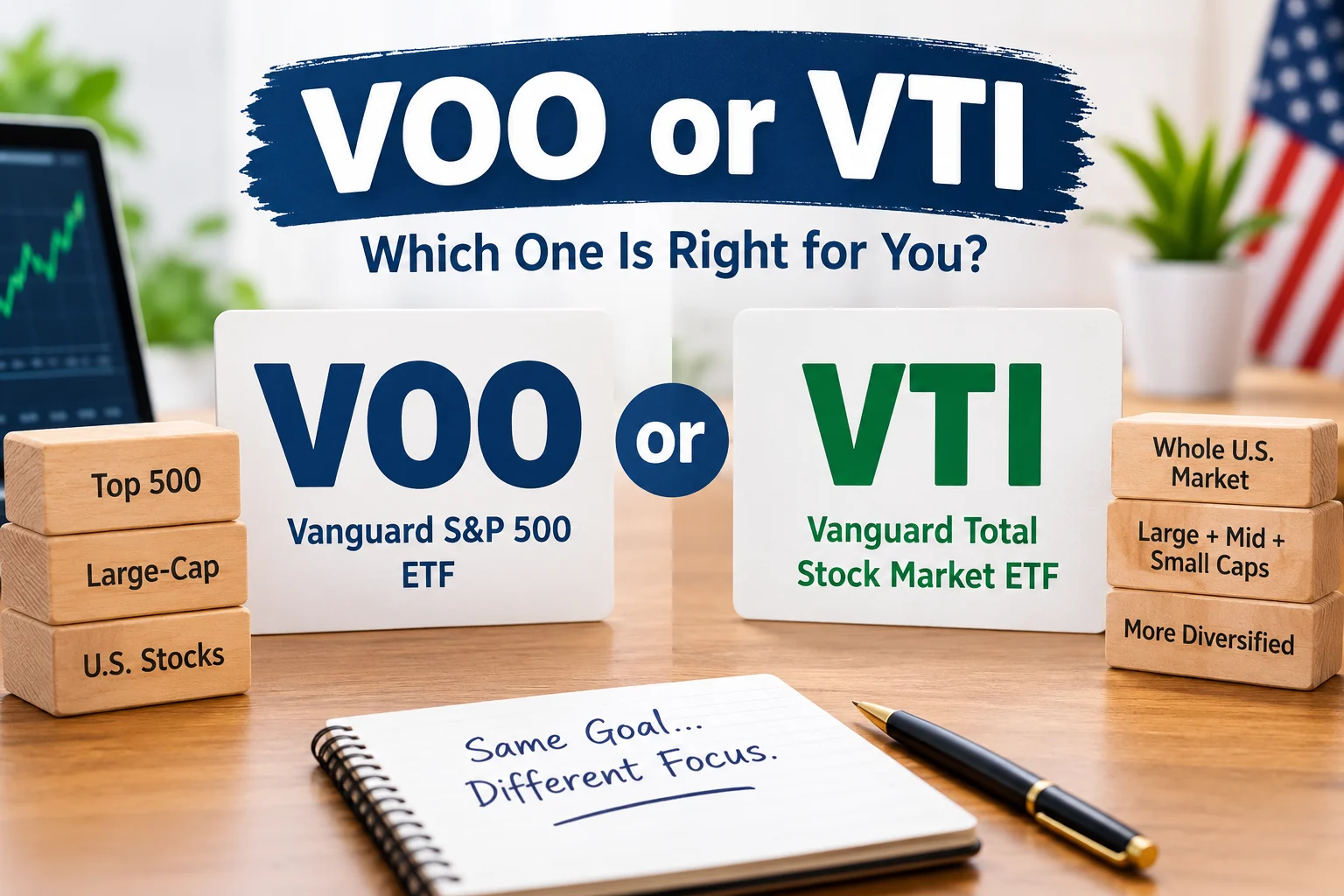
VOO tracks the S&P 500, which focuses on large U.S. companies. VTI covers nearly the entire investable U.S. stock market, including large-, mid-, and small-cap companies. Both offer broad diversification and a low expense ratio of 0.03%. Your choice depends on the market exposure you want.
Imagine you want to invest for the next 20 years. You want to grow your money, keep costs low, and avoid picking individual stocks. You start researching index funds and find two popular options: VOO and VTI.
Both are offered by Vanguard,hold many stocks ,aim to track a market index instead of trying to beat the market through active stock picking. So, which one should you choose?
This question comes up often among new investors. The funds look similar because they own many of the same large companies. Yet they follow different indexes and offer different levels of market coverage.
When comparing ETFs, I focus on what each fund owns, what it costs, how it spreads risk, and how it may fit into a long-term plan. Those details matter more than choosing a fund simply because it performed well last year.
In this guide, you will learn how VOO and VTI differ, where they overlap, what common mistakes to avoid, and how to decide which approach fits your goals. You will also see why owning both does not always give you much extra diversification.
VOO or VTI – Quick Answer
VOO is the Vanguard S&P 500 ETF. It aims to track the S&P 500 Index, which represents about 500 leading U.S. companies.
VTI is the Vanguard Total Stock Market ETF. It aims to track a broad index of the U.S. stock market, including large, medium, and small companies. <Cite refs={[“turn692765search2″,”turn692765search0”]}/>
Here is the simple difference:
- Choose to research VOO if you want exposure focused on large U.S. companies.
- Choose to research VTI if you want broader coverage of the U.S. stock market.
- Consider both only if you have a clear reason to add extra weight to large companies.
For example, a new investor who wants an S&P 500 index fund may study VOO. Another investor who wants large, medium, and small U.S. companies in one fund may study VTI.
Neither fund guarantees a profit. Both invest in stocks, so their prices can fall sharply during a market downturn.
The Origin and Background of VOO and VTI
What Is VOO?
VOO stands for Vanguard S&P 500 ETF. Vanguard launched the fund in September 2010.
Its goal is to track the S&P 500 Index. That index includes large U.S. companies from many parts of the economy. These can include technology, health care, financial services, consumer goods, and industrial businesses.
VOO follows a passive investment approach. It does not try to predict which stocks will rise next. Instead, it seeks to follow the performance of its benchmark index. <Cite refs={[“turn692765search2″,”turn692765search25”]}/>
This approach can appeal to investors who want a simple way to invest in large U.S. companies without buying each stock separately.
What Is VTI?
VTI stands for Vanguard Total Stock Market ETF. Vanguard launched it in May 2001.
Its goal is to track a broad U.S. stock market index. The fund includes companies of different sizes, from large businesses to smaller public companies.
This wider coverage is the main difference between VTI and VOO. VTI lets investors access more of the U.S. equity market through one ETF. <Cite refs={[“turn692765search0″,”turn692765search24”]}/>
Why Do Investors Compare Them?
Investors compare VOO and VTI because both are low-cost ways to invest in U.S. stocks. Their largest holdings overlap heavily, so their returns often move in similar directions.
However, VTI also holds smaller companies that are not part of the S&P 500. Those extra holdings can change its returns, risk profile, and exposure to different parts of the market.
The key question is not which ticker sounds better. It is whether you want to focus on large companies or own a wider range of U.S. businesses.
VOO vs VTI Explained: Key Differences
Here is a side-by-side look at their main features.
| Feature | VOO | VTI |
|---|---|---|
| Full name | Vanguard S&P 500 ETF | Vanguard Total Stock Market ETF |
| Main focus | Large U.S. companies | Broad U.S. stock market |
| Benchmark | S&P 500 Index | Broad U.S. total-market index |
| Company sizes | Mainly large-cap | Large-, mid-, and small-cap |
| Number of holdings | Around 500 companies; exact count may vary | Thousands of stocks; exact count may vary |
| Expense ratio | 0.03% | 0.03% |
| Management style | Passive index tracking | Passive index tracking |
| Main distinction | Focuses on large companies | Adds exposure to smaller companies |
Vanguard’s published fund information lists a 0.03% expense ratio for both ETFs. Their holdings counts can change as indexes and fund portfolios change. <Cite refs={[“turn692765search2″,”turn692765search0”]}/>
1. Market Coverage
VOO focuses on large U.S. companies. It provides exposure to many of the biggest names in the American stock market.
VTI includes those large companies too, but it also holds medium and smaller businesses. This gives VTI broader coverage of the U.S. stock market.
Remember, more holdings do not automatically mean higher returns. They simply give you exposure to more companies.
2. Diversification
Both funds spread your money across many companies and industries. This helps reduce the risk of relying on a single business.
VTI offers wider diversification by company size. VOO provides broad diversification within the large-cap market.
However, both funds remain heavily exposed to the U.S. stock market. Neither gives you a complete global portfolio on its own.
3. Expense Ratios
An expense ratio is the annual fee a fund charges to manage its assets. It is shown as a percentage of your investment.
Both VOO and VTI have an expense ratio of 0.03%. That means the annual fund expense is about $3 for every $10,000 invested, assuming the balance stays constant. This excludes taxes, trading costs, and any broker fees. <Cite refs={[“turn692765search2″,”turn692765search0”]}/>
The difference in cost between these two funds is therefore not a deciding factor for most investors.
4. Performance
VOO and VTI often have similar returns because many of their largest holdings are the same.
Their results can still differ. When large companies outperform smaller companies, VOO may have an advantage. When smaller companies perform well, VTI’s additional holdings may help.
Neither pattern is guaranteed to continue. Past returns cannot tell you which fund will perform better in the future.
Which Fund Should You Choose?
The best starting point is your investment goal, not a recent performance chart.
Consider VOO if:
- You want to focus on large U.S. companies.
- You prefer an S&P 500 index strategy.
- You already have other investments that cover smaller companies.
- You understand that large-cap stocks can still lose value.
Consider VTI if:
- You want broader exposure to the U.S. stock market.
- You prefer one fund that includes companies of different sizes.
- You want small- and mid-cap stocks alongside large companies.
- You are comfortable with the risks of the overall U.S. stock market.
What About Beginners?
Both funds can be useful subjects for long-term investors to research. VTI offers wider U.S. market coverage, while VOO follows a familiar large-company index.
Before investing, consider your time horizon, ability to handle losses, need for cash, and other investments. If you live outside the United States, check local tax rules, broker access, currency conversion costs, and any tax treatment that applies to U.S.-listed ETFs.
A useful rule: Choose the market exposure you want first. Do not choose only because a fund had a stronger return over a short period.
Common Mistakes When Comparing VOO and VTI
Mistake 1: Thinking VTI Includes International Stocks
Incorrect: “VTI gives me exposure to the whole world.”
Correct: VTI mainly covers the U.S. stock market.
VTI holds companies across the United States. It is not the same as a global stock fund. If you want international exposure, you need to research other investments.
Mistake 2: Assuming VOO and VTI Are Completely Different
Incorrect: “Buying both means I own two unrelated portfolios.”
Correct: Their holdings overlap heavily.
VTI already includes many of the large companies held by VOO. Holding both can increase your weight in those large companies rather than add much new diversification.
Mistake 3: Choosing Based Only on Recent Returns
Incorrect: “VOO did better last year, so it will always do better.”
Correct: Future returns are uncertain.
Market leadership changes over time. Large companies may lead during one period, while smaller companies may lead during another.
Mistake 4: Ignoring Investment Risk
Incorrect: “A diversified ETF cannot lose much money.”
Correct: Both funds can fall when the U.S. stock market declines.
Diversification helps spread company-specific risk, but it cannot remove broad market risk. Only invest money you can afford to leave invested for your planned time horizon.
Mistake 5: Forgetting Taxes and Account Rules
Incorrect: “The expense ratio is the only cost I need to consider.”
Correct: Your total cost may include taxes, trading fees, currency conversion, and other charges.
These details are especially important for investors outside the United States. Check the rules that apply to your country and account before buying.
VOO and VTI in Real-World Examples
These examples show how people might discuss the funds. They are illustrations, not personal investment recommendations.
1. Professional Email
Subject: Comparing Two Index ETFs
Hello,
I am reviewing VOO and VTI for a long-term investment plan. VOO focuses on large U.S. companies, while VTI covers a broader range of U.S. stocks.
Could we compare their market exposure, costs, and fit with my current portfolio?
Thank you.
2. News Headline
VOO vs VTI: Investors Compare S&P 500 Exposure With the Total U.S. Stock Market
This headline describes the main difference without claiming that either fund will always perform better.
3. Social Media Post
“Researching VOO or VTI? Both have low expense ratios, but they follow different indexes. Check their holdings, risks, and your own goals before investing.”
4. Formal Report
“The portfolio review compared VOO and VTI based on benchmark coverage, expense ratios, and market exposure. VOO focuses on large-cap U.S. stocks, while VTI includes companies across a wider range of market sizes.”
VOO vs VTI: Data, Trends, and Usage
Interest in these ETFs often comes from people who want a simple way to invest in the stock market. Common searches include “VOO vs VTI,” “VTI or VOO for beginners,” “VOO vs VTI returns,” and “Can I own both VOO and VTI?”
These searches reflect several needs:
- Informational intent: People want to understand how the funds differ.
- Comparison intent: Investors want to compare fees, holdings, risks, and returns.
- Investment intent: People are deciding whether either fund fits their plans.
Both funds have a low expense ratio of 0.03%, based on Vanguard’s published fund information. <Cite refs={[“turn692765search2″,”turn692765search0”]}/>
One useful insight is that broader market coverage does not always mean better performance in every period. VTI includes smaller companies, but their returns can differ from those of large companies. That is why the right comparison should focus on market exposure and your long-term plan rather than a single year’s performance.
Exact search volumes and current rankings change over time. Without verified search-volume data, it would be misleading to claim that one query is more popular than another.
VOO vs VTI: Comparison Table
| Term/Variant | Meaning | Region/Context | Best Used When |
|---|---|---|---|
| VOO | Vanguard S&P 500 ETF | Large U.S. companies | You want S&P 500 exposure |
| VTI | Vanguard Total Stock Market ETF | Broad U.S. stock market | You want exposure to companies of different sizes |
| S&P 500 | Index of leading large U.S. companies | U.S. large-cap market | You want to understand VOO’s benchmark |
| Total stock market | Broad collection of U.S. public stocks | U.S. equity market | You want to understand VTI’s broader coverage |
| Expense ratio | Annual fund operating cost as a percentage | ETF costs | You want to compare fund fees |
| Diversification | Spreading investments across holdings | Portfolio construction | You want to understand how exposure is spread |
Frequently Asked Questions
Q: What is the main difference between VOO and VTI?
A: VOO tracks the S&P 500 and focuses on large U.S. companies. VTI covers a broader portion of the U.S. stock market, including large-, mid-, and small-cap companies.
Q: Is VOO or VTI better for beginners?
A: Both can be reasonable funds to research for long-term investing. VOO focuses on large companies, while VTI offers broader U.S. market coverage. Your choice should depend on your goals and risk tolerance.
Q: Is VTI more diversified than VOO?
A: VTI holds companies across more market sizes, so it has broader diversification by company size. Both funds are still concentrated in U.S. stocks and share many large holdings.
Q: Can I own both VOO and VTI?
A: Yes, an investor can hold both. However, their holdings overlap heavily, so owning both may increase your exposure to large companies rather than add much new diversification.
Q: Do VOO and VTI have the same expense ratio?
A: Vanguard lists a 0.03% expense ratio for both funds. Other costs, such as broker fees, taxes, and currency conversion, may also apply.
Q: Does VTI include international stocks?
A: VTI is designed to cover the U.S. stock market, not the global stock market. Investors seeking international exposure need to research other funds or investments.
Q: Which fund will have higher returns in the future?
A: No one can know for sure. VOO may benefit when large companies lead the market, while VTI also has exposure to smaller companies. Their future results depend on market conditions.
Q: Are VOO and VTI safe investments?
A: Both are diversified stock ETFs, but neither is risk-free. Their values can fall during market downturns, and investors can lose money.
Q: Can investors outside the United States buy VOO or VTI?
A: Access depends on the investor’s country, broker, and applicable regulations. Non-U.S. investors should also check tax treatment, currency risk, and any rules for holding U.S.-domiciled funds.
Conclusion
The choice between VOO or VTI comes down to the type of U.S. stock market exposure you want.
VOO tracks the S&P 500 and focuses on large U.S. companies. VTI covers a wider range of company sizes, including large, medium, and small businesses. Both have low expense ratios, and their holdings overlap heavily.
Neither fund is guaranteed to deliver higher returns. The best fit depends on your investment goals, time horizon, risk tolerance, and existing portfolio. It is also worth checking taxes and trading costs before investing, especially if you live outside the United States.
Do not choose an ETF only because it performed well recently. Understand what it owns and how it fits into your plan.
Your next step: Compare the official fund details, review your overall portfolio, and decide what kind of market exposure you need. Save this guide so you can revisit the key differences before making an investment decision.