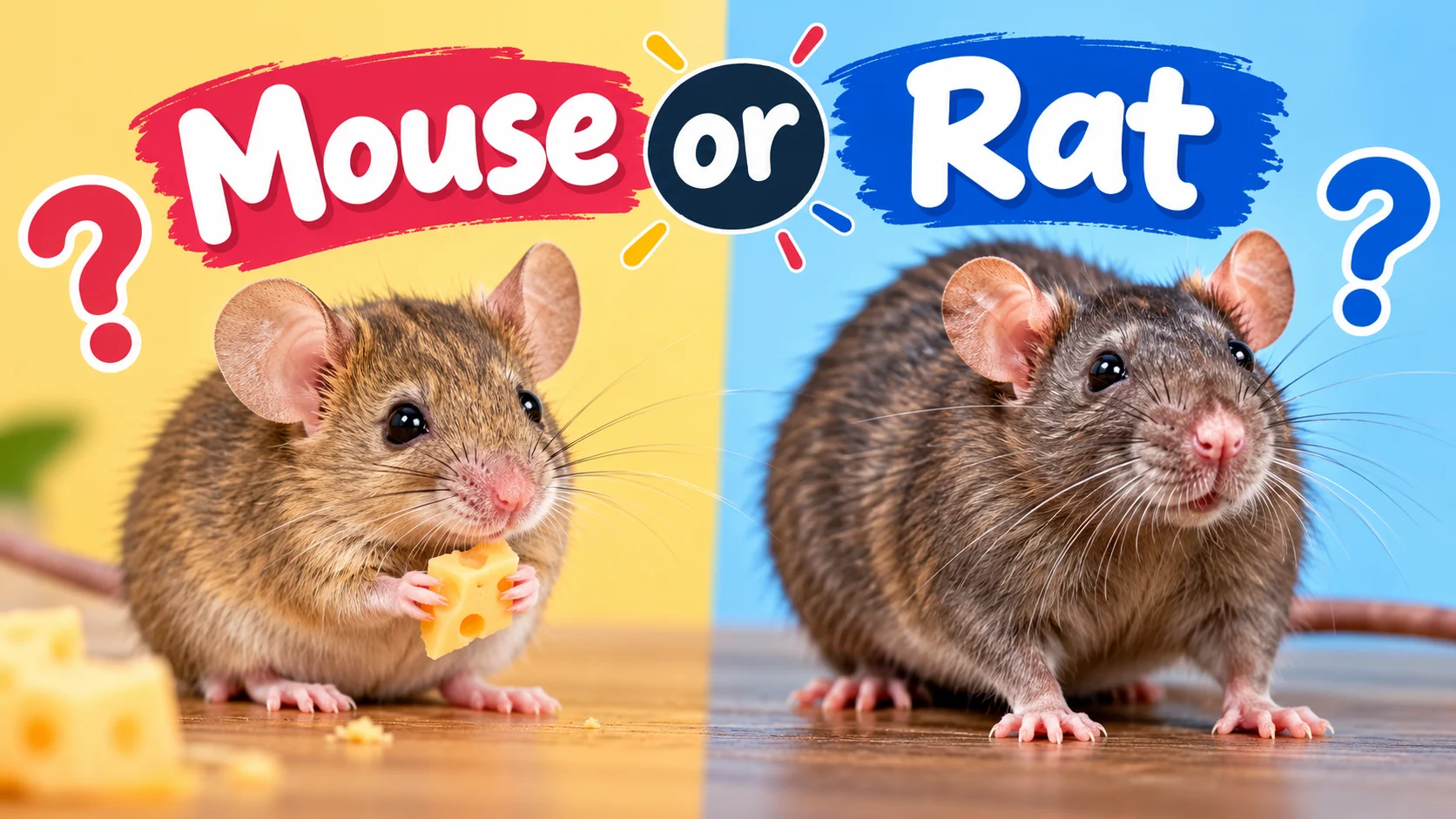
A mouse is usually smaller, with large ears and a thin tail. A rat is usually larger, with a thicker body, smaller ears, and a thicker tail.
Have you ever seen a small rodent run across your kitchen and wondered, “Is that a mouse or a rat?” You may notice its size, tail, or ears, but it can still be hard to tell them apart.
These two animals look alike at first. Both have small bodies, sharp teeth, long tails, and quick movements. They can also enter homes in search of food, water, and shelter. Yet mice and rats have clear differences in size, behavior, droppings, and nesting habits.
As an English writer, I often find that readers search for simple ways to tell similar words and things apart. The phrase mouse or rat is a good example because people may use the terms as if they mean the same animal. In daily life, however, knowing the difference can help you describe what you saw and decide what to do next.
This guide explains how to identify a mouse or rat in simple words. You will learn about their size, looks, habits, common signs, and role in homes and nature. You will also find examples, a comparison table, and answers to common questions.
Mouse or Rat – Quick Answer
A mouse is a small rodent with a slim body, large ears, and a long, thin tail. A rat is usually bigger and heavier, with a thicker body, larger feet, and a thicker tail.
Here are two simple examples:
- Mouse: You see a tiny gray rodent with large ears near a kitchen cupboard.
- Rat: You see a larger brown rodent with a heavy body near a trash bin.
Size can help you make a quick guess. But young rats can be small, so size alone may not be enough to identify the animal.
The Origin and Background of Mouse or Rat
The words mouse and rat have long histories in English. Both refer to rodents, but they are not names for the same animal.
Where Does the Word “Mouse” Come From?
The word mouse comes from Old English mūs. It has roots in older Indo-European languages. Related words appear in several languages, showing that people have known these small animals for a very long time.
Today, mouse can mean a small rodent. It can also mean a computer device used to move a pointer on a screen.
Examples include:
- A mouse ran behind the fridge.
- The field mouse lives in grassy areas.
- I used a computer mouse to click the link.
The meaning depends on the context. When people discuss a mouse or rat in a home, they usually mean the animal.
Where Does the Word “Rat” Come From?
The word rat appeared in English during the Middle Ages. Its exact origin is uncertain, though related forms appear in other European languages.
Today, the word usually refers to medium-sized or large rodents in the rat group. Two well-known species are the brown rat and the black rat.
Rats live in many places. They may be found in cities, farms, forests, sewers, and buildings. Some are wild, while others are kept as pets.
Why Do People Confuse Mice and Rats?
Mice and rats belong to the rodent group. They share several features, including:
- Long tails
- Sharp front teeth
- Fur-covered bodies
- Strong senses of smell and hearing
- A habit of chewing many types of material
Young rats can also look like adult mice. This can make identification harder, especially when you only see the animal for a second.
The best approach is to look at several features together. Check the body shape, ears, feet, tail, and size rather than relying on one clue.
Mouse or Rat Explained: Key Differences
Mice and rats have many features in common, but a closer look can help you tell them apart.
1. Body Size
Most house mice are small and light. Their bodies are often around 2.5 to 4 inches long, not counting the tail.
Many adult rats are much larger. A common brown rat may have a body around 7 to 10 inches long, not counting the tail. These are general ranges, and sizes vary by species and age.
Quick tip: A large rodent may be a rat, but a young rat can still be small.
2. Ears and Eyes
Mice often have ears that look large compared with their heads. Their eyes may also look big for their small faces.
Rats tend to have smaller-looking ears compared with their heads. Their eyes often appear less prominent.
These differences can help, but they are not perfect signs on their own.
3. Tail Shape
A mouse usually has a long, thin tail. It may look almost as long as its body.
A rat often has a thicker tail. Its tail can also look shorter compared with its heavier body, though this depends on the species.
4. Snout and Head
Mice often have a narrow head and a pointed snout. Their face looks small and delicate.
Rats usually have a broader, heavier head. Their snout may look less narrow than that of a mouse.
5. Droppings
Droppings can provide a clue when you do not see the animal.
- Mouse droppings: Usually small, dark, and shaped like tiny grains of rice.
- Rat droppings: Usually larger and thicker. Their shape varies by species.
Do not touch droppings with bare hands. Rodent waste may carry germs. If you find droppings, follow local public health guidance for safe cleanup.
6. Behavior and Movement
Mice are curious and may explore small gaps and new objects. They can squeeze through very narrow openings.
Rats may be more cautious around new objects. They can also climb, swim, and dig, depending on the species and setting.
Both animals can move quickly. Neither behavior alone proves whether you are looking at a mouse or a rat.
Comparison Table: Mouse vs. Rat
| Term | Meaning | When to Use | Region/Context |
|---|---|---|---|
| Mouse | A small rodent, often with large ears and a slim body | Describing a small rodent | Homes, fields, and nature |
| Rat | A rodent that is usually larger and heavier than a mouse | Describing a larger rodent | Cities, farms, homes, and wild areas |
| House mouse | A mouse species often found near people | Discussing common indoor mice | Homes and buildings |
| Brown rat | A large rat species also called the Norway rat | Discussing a common urban rat | Cities, farms, and sewers |
| Black rat | A rat species often linked with buildings and ports | Discussing this specific rat species | Buildings and some warm regions |
| Pet mouse | A mouse kept as a companion animal | Talking about a small pet | Homes and pet care |
| Pet rat | A rat kept as a companion animal | Talking about a social pet rodent | Homes and pet care |
Which One Should You Identify or Use?
The right term depends on what you are describing.
For Students and English Learners
Use mouse when you mean a small rodent that fits the usual description. Use rat when you mean a rodent that is usually larger and heavier.
Examples:
- “A mouse ran under the table.”
- “A rat was seen near the bins.”
If you are not sure which animal you saw, you can say, “I saw a rodent.” This is a broad term that covers both mice and rats.
For Homeowners
If you find signs of rodents at home, do not guess based on one clue. Look for the size of droppings, the location of gnaw marks, and the size of any gaps or holes.
Mice can enter through very small openings. Rats can also squeeze through gaps that look too small for their bodies.
Seal entry points, store food in secure containers, and remove easy sources of food and water. If the problem continues, contact a qualified pest control professional.
For Pet Owners
Mice and rats can both make pets, but their needs are not identical. Rats are often social and benefit from suitable companionship. Mice also need a safe habitat, proper food, clean bedding, and room to move.
Choose a pet based on its needs, not just its size. Ask a vet who treats small animals for care advice.
For Global or General Writing
The words mouse and rat are used in English around the world. There is no major British-versus-American spelling difference for these animal names.
If the species matters, use its full name. For example, house mouse is clearer than simply mouse in a scientific report.
Common Mistakes with Mouse or Rat
People often confuse mice and rats because they share many features. Here are common mistakes and how to avoid them.
Mistake 1: Assuming Every Small Rodent Is a Mouse
Incorrect assumption: “It is small, so it must be a mouse.”
Better approach: “It looks small, but I should check its other features.”
A young rat may be much smaller than an adult rat. Look at the shape of the head, ears, feet, and tail as well.
Mistake 2: Thinking Tail Length Proves the Species
Incorrect assumption: “Its tail is long, so it must be a mouse.”
Better approach: “Tail shape and body size can help me identify it.”
Both mice and rats can have long tails. Consider the tail’s thickness and how it compares with the body.
Mistake 3: Using “Mouse” and “Rat” as Synonyms
Incorrect: “A rat is just another word for a mouse.”
Correct: “A rat and a mouse are different kinds of rodents.”
The words have separate meanings. Using the right term makes your writing clearer.
Mistake 4: Touching Droppings to Identify Them
Incorrect approach: Picking up droppings with bare hands.
Safer approach: Keep your distance and use official safety guidance for cleanup.
Rodent waste can carry germs. Avoid sweeping or vacuuming dry droppings, as this may put contaminated particles into the air. Follow local public health advice or contact a professional if you are unsure.
Mistake 5: Believing Every Rat Is Dangerous or Every Mouse Is Harmless
Incorrect assumption: “Mice are harmless, but rats are always dangerous.”
Correct understanding: Both wild mice and wild rats can damage property and may spread disease. Risk depends on the species, setting, and type of contact.
Avoid handling wild rodents. If you have a rodent problem, focus on safe removal and preventing access to food and shelter.
Mouse or Rat in Real-World Examples
The terms appear in emails, news reports, social media, and formal documents. Here are natural examples.
1. Professional Email
Subject: Possible Rodent Activity in the Storage Room
Hello Facilities Team,
I noticed what may be a mouse or rat near the storage room this morning. I also saw signs of possible gnawing near a food container.
Could someone inspect the area and arrange safe cleaning if needed?
Thank you for your help.
This email uses both terms because the sender is not sure which animal was present.
2. News Headline or Article
Headline: City Team Responds to Reports of Rats Near Waste Bins
Example article text:
“Residents reported seeing rats near several waste bins. Officials asked people to keep rubbish in secure containers and avoid contact with wild rodents.”
The word rats is suitable here because the report specifically identifies rats. If the species has not been confirmed, a headline could use the broader term rodents.
3. Social Media Post
Example post:
“Mouse or rat? I spotted a small rodent near the garden shed. Its size and tail may offer clues, but I am not certain which one it was.”
This post shows how to use the phrase when you are asking others for help with identification.
4. Formal Document or Report
Example report text:
“Signs of rodent activity were found near the food storage area. The species has not yet been confirmed as a mouse or rat. The area will be inspected, cleaned safely, and checked for possible entry points.”
This wording is clear and careful. It avoids claiming that the animal has been identified when there is not enough evidence.
Mouse or Rat: Data, Trends, and Usage
The phrase mouse or rat is linked to several everyday needs. People may search for it after seeing a rodent at home, while studying animal facts, or when deciding how to manage a pest problem.
Where Is This Topic Most Useful?
The topic matters in many settings:
- Homes: People want to identify noises, droppings, or damage.
- Schools: Students compare animals and learn about rodents.
- Gardens and farms: People look for signs of rodent activity around food or plants.
- Pet care: Owners learn about the needs of pet mice and rats.
- Pest control: Professionals identify the rodent before choosing a control plan.
These are common reasons people may look up the difference. Exact search volumes and regional rankings need current keyword research, so it would not be accurate to claim that one country searches for the phrase most often without data.
What Is the Search Intent?
The search intent is mainly informational. Readers want to know how to tell a mouse from a rat.
Some searches also have a practical purpose. A homeowner may want to know whether droppings indicate a mouse or rat. A pet owner may be comparing care needs. A student may be looking for a simple explanation.
Why Does This Topic Matter?
Correct identification can help people describe what they saw and decide what to do next. It can also prevent unsafe actions, such as touching droppings or handling a wild rodent.
For website owners and SEO writers, a helpful article should answer the main question early. It should also explain the limits of visual clues and give readers safe next steps.
Standalone Comparison Table: Mouse or Rat
| Term/Variant | Meaning | Region/Context | Best Used When |
|---|---|---|---|
| Mouse | A generally small rodent | Worldwide | Describing a small rodent |
| Rat | A generally larger rodent | Worldwide | Describing a rat or discussing rat behavior |
| House mouse | A mouse species commonly found near people | Homes and buildings | Identifying a common indoor mouse |
| Brown rat | A rat species also known as the Norway rat | Urban and rural areas | Referring to this specific species |
| Black rat | A rat species also called the roof rat | Buildings and some warm regions | Referring to this specific species |
| Rodent | A mammal group that includes mice and rats | Science and general use | When the exact animal is unknown |
| Pet mouse | A mouse kept as a companion | Pet care | Discussing mouse care |
| Pet rat | A rat kept as a companion | Pet care | Discussing rat care |
The main rule is simple: use “mouse” for a mouse and “rat” for a rat. If you cannot tell which animal it is, use rodent until you have more evidence.
Frequently Asked Questions
Q1: What does “mouse or rat” mean?
The phrase asks which of two similar rodents you are seeing or talking about. A mouse is usually smaller and slimmer, while a rat is often larger and heavier.
Q2: How can you tell a mouse from a rat?
Look at body size, head shape, ears, feet, and tail thickness. Mice often have large ears and slim bodies, while rats usually look heavier. Young rats can resemble adult mice, so appearance may not always give a clear answer.
Q3: What is the main difference between a mouse and a rat?
The main difference is their typical size and build. Mice are generally smaller, while rats are usually larger and heavier. They also differ in features and habits, depending on the species.
Q4: Is “mouse or rat” acceptable in formal writing?
Yes. The phrase is clear and acceptable in formal writing when you are discussing identification or comparing the two animals. In a report, use a specific species name when it has been confirmed.
Q5: Which is correct: mouse or rat?
Both words are correct. Mouse refers to a mouse, while rat refers to a rat. If you cannot identify the animal, rodent is a useful general term.
Q6: Where do the words “mouse” and “rat” come from?
Mouse comes from Old English mūs and has older language roots. The English word rat appeared in the Middle Ages, but its exact origin is uncertain.
Q7: Can a mouse or rat live in a house?
Yes. Both may enter buildings to find food, water, or shelter. Store food securely, remove rubbish, seal gaps, and seek professional help if rodent activity continues.
Conclusion
Knowing the difference between a mouse or rat can help you describe an animal correctly and respond safely if you find one at home. Mice are usually smaller, with slim bodies and large ears. Rats tend to be larger and heavier, with thicker bodies and tails.
Still, size is not a perfect guide. Young rats may look like adult mice, so check several features before making a guess. Droppings, gnaw marks, and other signs may offer clues, but they should be handled with care.
Remember these four points:
- Use mouse and rat for the correct animals.
- Check body shape, ears, feet, and tail together.
- Use rodent when you are unsure of the species.
- Avoid handling wild rodents or touching their waste.
If you find signs of rodents in your home, secure food, seal entry points, and follow safe cleanup guidance. A qualified pest control professional can help when the problem is hard to manage.
Now you know the key differences between a mouse and a rat. Bookmark this guide so you can use these simple tips the next time you need to identify a rodent.