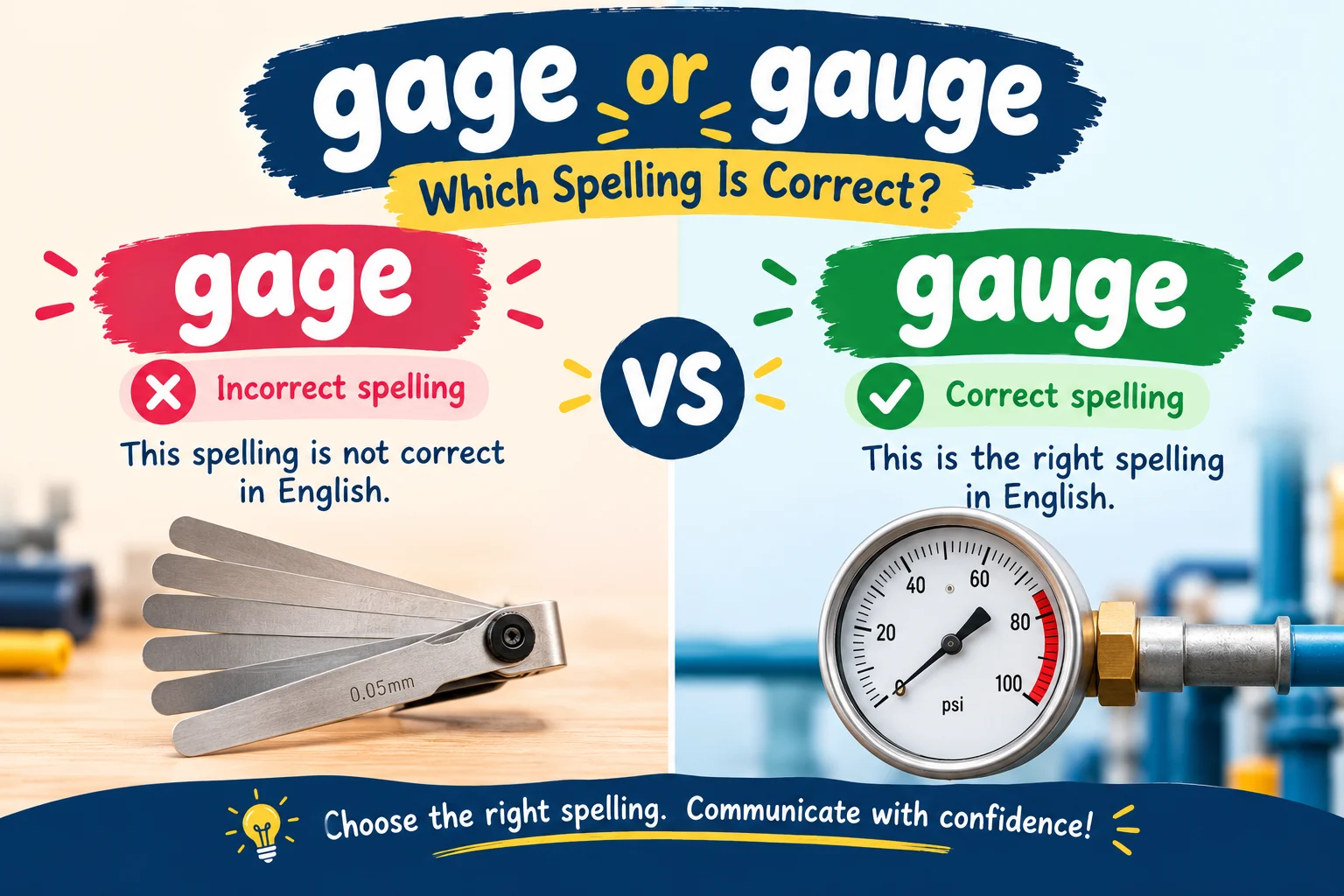
Gauge is the standard spelling in most English writing, while gage is an accepted variant used in some technical and specialized contexts. Both can refer to a measuring device, measurement, or the act of measuring.
Have you ever typed “gage” and wondered if you should have written “gauge” instead? This spelling pair can be frustrating because both forms appear in real English.
Unlike many word pairs, gage is not always simply a spelling mistake. It can be a valid word and is used in some technical fields. However, gauge is much more common in general English.
I have come across this confusion in technical documents, school writing, product descriptions, and everyday sentences. A reader may see pressure gauge in one place and wire gage in another. That can make the spelling seem random.
It is not random.
The two forms have a shared history, similar meanings, and different levels of use. Gauge is the safer choice for most readers. Gage still has a place, especially in certain technical terms and established names.
This guide explains the difference in plain English. You will learn what each word means, where it comes from, when to use it, and how to avoid common mistakes.
Gage or Gauge – Quick Answer
Gauge is the standard and more widely used spelling in modern English.
Gage is also a legitimate spelling in some dictionaries and technical contexts. It can be used as a variant of gauge, but it is less common in general writing.
Examples
Check the gauge to see the pressure.
The mechanic checked the wire gage.
The first example uses the common spelling. The second shows a technical use where gage may be preferred.
For most everyday writing, gauge is the easiest choice.
The Origin and Background of Gage and Gauge
The history of gauge is interesting because English has never had perfectly stable spelling.
The word entered English through French forms related to words meaning a pledge, measure, or standard. Over time, it developed several meanings connected with measuring, judging, and determining size.
English eventually settled on gauge as the common spelling.
However, gage survived as a variant.
This is not unusual in English. Some words keep older or shortened spellings even after another form becomes more common.
The spelling gage is especially visible in technical language. You may see it in expressions involving:
- Wire thickness
- Sheet metal
- Engineering
- Manufacturing
- Mechanical work
- Specialized measurement systems
There is another reason the pair can be confusing.
The pronunciation is generally the same:
gauge → /ɡeɪdʒ/
gage → /ɡeɪdʒ/
Both sound like “gage.”
So when you hear the word, you cannot tell which spelling the writer intends. You need to know the context.
Gage or Gauge Explained — Key Differences
The most useful way to understand gage or gauge is to look at their meanings and typical contexts.
| Term | Meaning | When to Use | Region/Context |
|---|---|---|---|
| gauge | A device used to measure or display something | General and technical writing | Standard English worldwide |
| gauge | To measure, estimate, or judge | General writing | Standard English worldwide |
| gage | Variant spelling of gauge in some meanings | Certain technical or specialized contexts | Mainly found in specialized usage |
| gage | A pledge or security in older/literary use | Historical or literary contexts | Specialized/older English |
1. Gauge as a measuring device
The most common use of gauge is as a noun for an instrument that measures something.
For example:
The fuel gauge is almost empty.
Check the pressure gauge before starting the machine.
The temperature gauge shows 90 degrees.
Here, gauge refers to an instrument or display.
2. Gauge as a measurement
Gauge can also describe a standard or measurement.
For example:
The wire is a heavy gauge.
The thickness of the material is measured by gauge.
In these uses, the word relates to size, thickness, or measurement.
3. Gauge as a verb
Gauge can also be a verb.
It means to measure, estimate, or judge something.
For example:
We need to gauge customer interest.
She tried to gauge his reaction.
The survey helps us gauge public opinion.
Here, you are not using a physical measuring device. You are judging or estimating something.
4. Gage as a variant
Gage can be used as a spelling variant of gauge.
It appears most often in certain technical terms.
For example:
The manufacturer specifies the required wire gage.
You may also encounter gage in established technical names or terminology.
That does not mean gage should replace gauge everywhere.
The context matters.
Why Does Gauge Have a “U”?
One of the biggest spelling questions is simple:
Why is it spelled gauge instead of gage?
The answer comes from its historical development through French and English.
The u is part of the traditional spelling of gauge. It does not create a separate sound.
That is why:
gauge
and
gage
are pronounced alike.
English has many words where spelling preserves older language history.
For learners, the unusual spelling can make gauge hard to remember. The sequence -auge is not common in English.
A useful memory trick is:
A gauge measures.
You can connect the longer spelling with a measuring instrument.
If you are unsure in general writing, choose gauge.
Which Version Should You Use?
Your choice should depend on your audience and context.
For everyday English → use gauge
If you are writing a normal sentence, gauge is the safest option.
Examples:
Check the pressure gauge.
I cannot gauge his reaction.
The fuel gauge is broken.
For academic writing → use gauge
In essays, reports, research papers, and general academic writing, gauge is usually the clearest choice.
Example:
The survey was designed to gauge student satisfaction.
For professional writing → usually use gauge
Business writers, journalists, marketers, and general professionals will normally want gauge.
Example:
We conducted a survey to gauge customer demand.
For technical fields → check the field’s terminology
This is where gage becomes important.
Some industries and technical documents use gage in specific terms, especially when referring to thickness or wire sizes.
If your industry, manufacturer, engineering standard, or technical style guide uses gage, follow that established usage.
For global or neutral writing → use gauge
If you are writing for a broad audience and have no special technical reason to use gage, choose gauge.
It is widely recognized and will cause less confusion.
Common Mistakes with Gage or Gauge
These words create several common problems.
Mistake 1: Treating “gage” as always wrong
❌ Gage is always incorrect.
✅ Gage can be a legitimate variant in certain contexts.
The important point is that gauge is more common in general English, while gage survives in specialized uses.
Mistake 2: Treating both spellings as equally common
❌ You can use either form anywhere without considering context.
✅ Use gauge for most general writing, and use gage when a technical convention or established term calls for it.
The two forms are related, but their frequency and context differ.
Mistake 3: Writing “guage”
A very common spelling error is:
❌ guage
✅ gauge
The letters can be easy to rearrange.
Remember the correct order:
g-a-u-g-e
Not:
g-u-a-g-e
Mistake 4: Confusing “gauge” with “judge”
Gauge can mean judge or estimate, but it does not always mean exactly the same thing.
For example:
I tried to gauge her reaction.
This means you tried to assess or estimate her reaction.
It is not necessarily about making a formal judgment.
Mistake 5: Using “gage” in a general sentence
❌ We need to gage customer interest.
✅ We need to gauge customer interest.
Although gage can be a valid word, gauge is the normal choice for this general meaning.
Gage or Gauge in Real-World Examples
Context makes the difference much easier to understand.
Professional Email
Subject: Pressure Gauge Inspection
Hi James,
Could you please check the pressure gauge before the equipment is shipped? We want to make sure the reading is accurate.
Here, gauge is the natural choice in a general professional email.
News Headline
Experts Gauge the Impact of Higher Energy Costs
Here, gauge is a verb meaning assess or estimate.
Another example:
New Vehicle Uses Digital Fuel Gauge
Here, gauge is a noun for a measuring display.
Social Media Post
Trying to gauge how many people are interested in the new event. Let me know! 👇
The verb gauge works naturally in casual online writing.
Formal Document or Report
The survey was conducted to gauge employee satisfaction with the new workplace policy.
This is a standard formal use.
Technical Example
The machine requires the correct wire gage for safe operation.
Here, gage may appear because it is used as a technical spelling for a measurement of wire thickness.
Always check the terminology used by the relevant industry or standard.
Gage or Gauge — Different Meanings
The word gauge is useful because it can work as both a noun and a verb.
Gauge as a noun
A gauge can be an instrument:
The pressure gauge is broken.
It can also mean a measurement or standard:
The wire has a specific gauge.
Gauge as a verb
Gauge can mean to estimate:
We need to gauge the market.
It can mean to assess:
She watched his face to gauge his reaction.
It can also mean to measure:
The device gauges water pressure.
Understanding these uses helps you recognize the word in many different contexts.
Gage or Gauge — Data, Trends & Usage
The search for “gage or gauge” has a clear informational intent.
People usually search this spelling pair because they have encountered both forms and want to know whether one is wrong.
The question is especially relevant in technical writing. Engineers, mechanics, manufacturers, students, and people working with measurements may see gage in specialized material.
General readers are more likely to encounter gauge in common phrases such as:
- Pressure gauge
- Fuel gauge
- Temperature gauge
- Gauge pressure
- Gauge someone’s reaction
- Gauge customer interest
- Gauge public opinion
This creates an interesting spelling pattern.
Gauge is the broad, familiar form. Gage has a narrower role and can appear in technical or established terminology.
The key lesson is not simply “one is right and one is wrong.”
Instead, ask:
What does the word mean, and what context am I writing for?
For most general readers, gauge is the clearer choice. In a specialized technical setting, gage may be the accepted form.
That distinction is useful today because technical writing often uses industry-specific vocabulary. A spelling that looks unusual may still be correct within a particular field.
Gage vs Gauge: Quick Comparison Table
| Term/Variant | Meaning | Region/Context | Best Used When |
|---|---|---|---|
| gauge | Measuring instrument | General and technical English | Referring to a device that measures something |
| gauge | Measure, assess, or estimate | General English | Talking about measuring or judging something |
| gage | Variant of gauge | Specialized or technical contexts | When an established technical term uses this spelling |
| gage | Pledge or security | Older/literary English | Historical or specialized contexts |
The easiest rule to remember
If you are writing a normal sentence and mean measure, estimate, or measuring device, use:
gauge
If you are working with a technical term that specifically uses gage, follow that terminology.
Gauge in Academic and Professional Writing
For most formal writing, gauge is the better default.
Consider these examples:
The study aims to gauge consumer attitudes.
The researchers used a survey to gauge public response.
The pressure gauge must be checked before operation.
These sentences are clear and standard.
However, technical documents can use gage when it forms part of an established industry term.
This is why writers should not correct every instance of gage automatically.
A technical manual may have a valid reason for using it.
When editing professional content, check the house style, industry terminology, product specifications, or relevant technical standard before changing the spelling.
Gauge vs Measure: Are They the Same?
Gauge and measure are closely related, but they are not always exact synonyms.
Measure is a broad word.
We need to measure the length of the table.
Gauge often suggests measuring or assessing something, sometimes with an instrument.
Check the pressure gauge.
It can also mean making an estimate:
We need to gauge customer interest.
You would not normally replace every use of measure with gauge.
Choose the word that fits the exact meaning.
Frequently Asked Questions
Q: Is gage or gauge correct?
A: Gauge is the standard spelling for most general English uses. Gage is also an accepted variant in some dictionaries and specialized contexts, so it is not always an error.
Q: Is gage a misspelling of gauge?
A: Not always. Gage can be a legitimate variant, especially in some technical uses. However, gauge is much more common in general English.
Q: What does gauge mean?
A: Gauge can mean a device used for measuring something, such as pressure or temperature. As a verb, it can mean to measure, estimate, or assess something.
Q: What does gage mean?
A: Gage can be a variant spelling of gauge. It may also have an older meaning related to a pledge or security, although that use is uncommon in modern everyday English.
Q: Which spelling should I use in formal writing?
A: Use gauge in most formal, academic, business, and general writing. Use gage when a specific technical term, industry convention, or established name calls for it.
Q: Are gage and gauge pronounced the same?
A: Yes. When they are used as variants referring to measurement, both are generally pronounced /ɡeɪdʒ/, like the word “gage.”
Q: Is “guage” correct?
A: No. Guage is a common misspelling. The standard spelling is gauge, with the letters arranged g-a-u-g-e.
Q: Should I write “pressure gage” or “pressure gauge”?
A: Pressure gauge is the standard general form. Pressure gage may appear in specialized technical usage, so check the terminology used by your field or source.
Conclusion
The choice between gage or gauge becomes much easier when you look at context.
For most readers and most types of writing, gauge is the standard spelling. Use it when you mean a measuring device, a measurement, or the act of estimating or assessing something.
For example, you can check a pressure gauge, read a fuel gauge, or gauge someone’s reaction.
Gage is different because it is not simply an incorrect version. It is a legitimate variant that appears in some technical and specialized contexts. You may see it when discussing wire thickness, manufacturing, engineering, or other industry-specific terms.
There is also an older meaning of gage connected with a pledge or security, but this use is much less common today.
If you are unsure which spelling to choose, use gauge for general English. If you are writing technical material, check the accepted terminology for your field.
The spelling may look tricky, but the rule is simple: gauge is the safe general choice; gage has specialized uses.
Bookmark this guide so you never have to second-guess gage or gauge again.