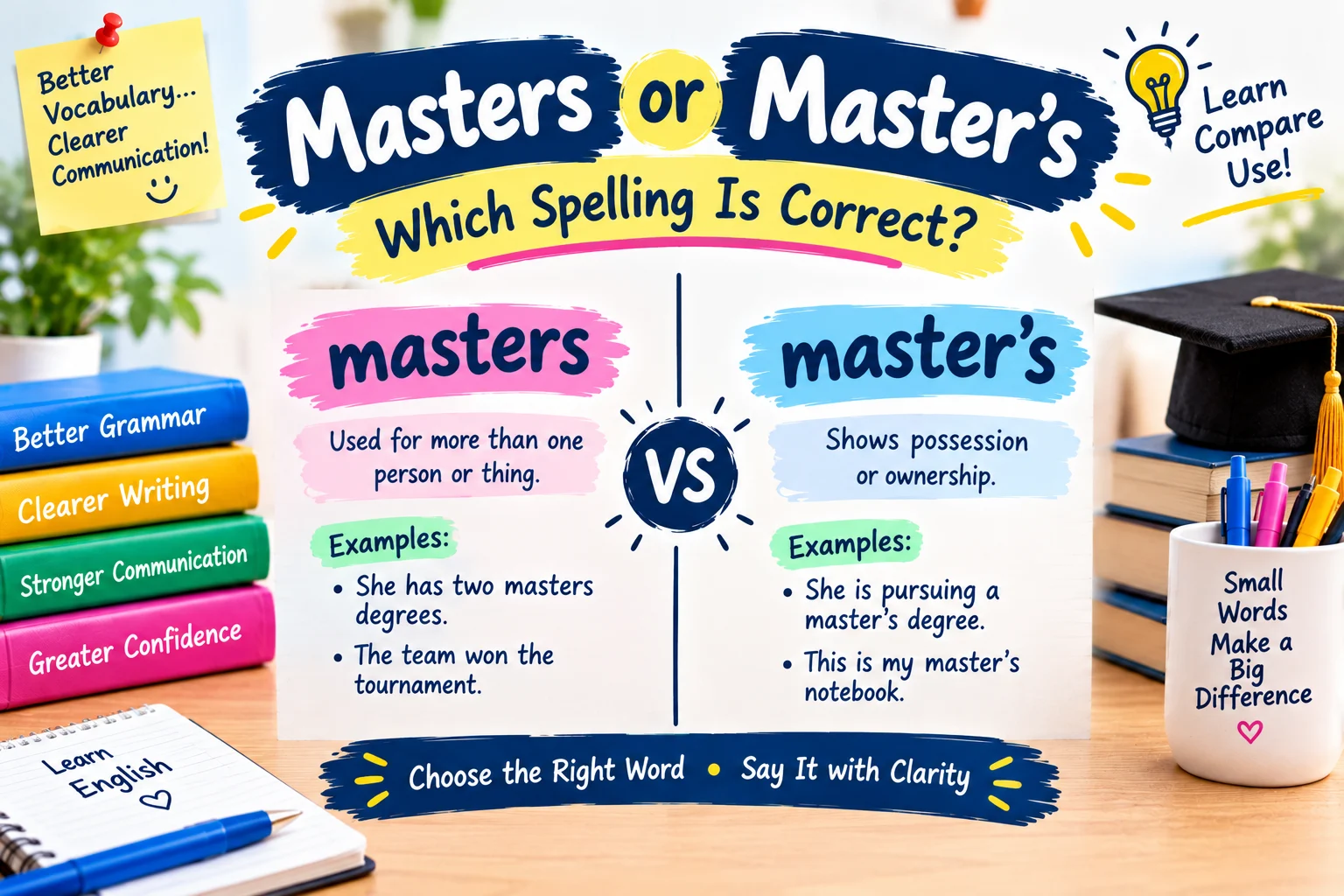
Masters and master’s are both correct, but they have different meanings. Master’s usually means a master’s degree, while masters is normally a plural noun or a verb.
Have you ever typed “masters degree” and stopped because you were not sure whether the apostrophe belongs there? This is a small spelling choice, but it can make a big difference in formal writing.
I have seen this confusion many times when helping students prepare applications, resumes, academic documents, and professional emails. The problem is easy to understand. English uses apostrophes for possession, but master’s is also used as the shortened form of master’s degree.
For example, you may write:
“I am studying for a master’s degree.”
But you may also see:
“The university offers several master’s programs.”
Then there is masters, without an apostrophe. It is not simply a wrong version. It has its own grammatical uses.
So, which form should you use? The answer depends on what you mean. Once you understand the difference, choosing between masters and master’s becomes simple.
Masters or Master’s – Quick Answer
Use master’s when you mean a master’s degree or something belonging to a master.
Use masters when you mean:
- More than one master
- The verb masters, meaning learns or controls something very well
- Certain names or titles, such as Masters in a specific context
Examples
“She has a master’s degree in English.”
Here, master’s refers to the academic degree.
“He masters several programming languages.”
Here, masters is a verb.
“Several masters attended the event.”
Here, masters is the plural form of master.
The apostrophe changes the grammatical function and meaning.
The Origin and Background of Masters or Master’s
The word master has a long history in English. It comes from Old French maistre, which came from Latin magister, meaning a teacher, leader, or person with authority.
Over time, master developed many meanings.
It can refer to:
- A person with authority
- A skilled person
- A teacher
- A person who controls something
- A person who has reached a high level of skill
- An academic degree at the master’s level
The word later became part of the name master’s degree.
The apostrophe in master’s has an important job. It shows the possessive form of master. Historically, the phrase can be understood as a degree associated with a master or a level of study represented by the term.
English often shortens longer expressions in everyday use.
For example:
“I am working toward a master’s.”
The word degree is understood from context.
That is why master’s can stand alone as a noun.
Masters or Master’s Explained — Key Differences
The easiest way to understand the difference is to look at grammar.
| Term | Meaning | When to Use | Region/Context |
|---|---|---|---|
| master’s | A master’s degree or something belonging to a master | Academic writing and possessive phrases | Standard English |
| masters | Plural of master | More than one master | Standard English |
| masters | Third-person singular verb | When someone masters a skill | Standard English |
| master’s degree | A postgraduate academic degree | Education | Standard English |
| master’s program | A course of study leading to a master’s degree | Universities and colleges | Standard English |
| Masters | A proper name in certain titles | Specific names or events | Depends on context |
1. Master’s Degree
This is the most common use for students.
“She earned a master’s degree in psychology.”
The apostrophe is required in the standard form master’s degree.
2. Master’s Program
You also use the apostrophe when talking about a program.
“He applied to a master’s program in computer science.”
The same pattern applies to other academic phrases.
- master’s thesis
- master’s student
- master’s course
- master’s dissertation
- master’s application
- master’s research
3. Master’s as a Short Form
You do not always need to write master’s degree.
For example:
“I am pursuing a master’s in education.”
Here, master’s is short for master’s degree.
This form is common in conversation, university information, and professional writing.
4. Masters as a Plural Noun
Masters can simply be the plural of master.
“The two masters discussed the project.”
Here, you are talking about more than one master.
There is no possessive meaning, so there is no apostrophe.
5. Masters as a Verb
Masters can also be the third-person singular form of the verb master.
“She masters new software quickly.”
Here, masters means learns or becomes highly skilled at something.
Compare:
“He masters difficult tasks quickly.”
with:
“He is studying for a master’s.”
The first is a verb. The second refers to an academic degree.
Which Version Should You Use?
Your choice depends on your sentence.
For Students
Use master’s when you mean the academic degree.
“I am applying for a master’s degree.”
This is the safest form for applications, resumes, and academic documents.
For University Websites
Use master’s in phrases such as:
“Our master’s programs prepare students for advanced careers.”
The apostrophe makes the meaning clear.
For Professional Resumes
You can write:
Master’s Degree in Business Administration
or:
Master of Business Administration (MBA)
The second version is the formal degree name when that is the official title of the qualification.
For General English
Use masters when it is a plural noun or a verb.
“The company has several masters of the craft.”
“She masters new skills quickly.”
For Global or Neutral Writing
Follow the standard form used by your institution or style guide. In general academic English, master’s degree is widely recognized and understood.
Common Mistakes with Masters or Master’s
Mistake 1: Writing “Masters Degree”
Incorrect in standard usage:
“I have a Masters Degree in English.”
Better:
“I have a master’s degree in English.”
The apostrophe is normally used because master’s is the possessive form.
Mistake 2: Writing “Master Degree”
Incorrect:
“She completed her master degree.”
Correct:
“She completed her master’s degree.”
A common exception is when Master is part of the official name of a qualification, such as Master of Arts or Master of Science.
Mistake 3: Using “Master’s” for More Than One Master
Incorrect:
“The three master’s arrived.”
Correct:
“The three masters arrived.”
Here, you mean three people, so you need the plural masters.
Mistake 4: Confusing “Masters” With “Master’s”
Incorrect:
“He is studying for a masters.”
Better:
“He is studying for a master’s.”
The apostrophe matters because the word refers to a master’s degree.
Mistake 5: Adding an Apostrophe to the Plural
Incorrect:
“The master’s discussed their work.”
Correct:
“The masters discussed their work.”
The apostrophe should not be used simply to make a noun plural.
Masters or Master’s in Real-World Examples
1. Professional Email
“I am writing to ask about your master’s programs in business administration.”
This is a natural and professional use of master’s.
2. News Headline
“University Launches New Master’s Program in Data Science”
A news article may use master’s to describe a postgraduate program.
3. Social Media Post
“Excited to share that I have started my master’s in computer science! 🎓”
Here, master’s is a shortened form of master’s degree.
4. Formal Document
“The applicant holds a master’s degree in environmental science.”
This is appropriate in a formal academic or professional document.
5. Using “Masters” as a Verb
“She masters complex tasks with practice.”
Here, masters is a verb. It does not refer to an academic degree.
6. Using “Masters” as a Plural
“The young artists studied the techniques of several masters.”
Here, masters means highly skilled or respected people.
Master’s Degree vs. Master of Arts
These forms are related, but they are not exactly the same.
Master’s Degree
Master’s degree is a general term.
It can refer to many postgraduate qualifications.
“He has a master’s degree in engineering.”
Master of Arts
Master of Arts, often abbreviated MA, is a specific degree title.
“She earned a Master of Arts in History.”
The official name should be written according to the institution’s stated degree title.
Other examples include:
- Master of Science (MS or MSc)
- Master of Business Administration (MBA)
- Master of Fine Arts (MFA)
- Master of Education (MEd)
So, do not automatically replace an official degree title with master’s degree when you need the exact qualification name.
Masters or Master’s — Data, Trends & Usage
The search intent behind “masters or master’s” is mainly informational. People often search the phrase when they are writing academic documents, university applications, resumes, cover letters, or professional profiles.
The confusion is especially common among:
- University students
- Job applicants
- International students
- English learners
- Academic writers
- People preparing resumes and LinkedIn profiles
The key issue is the apostrophe.
When master’s means a degree, the apostrophe helps distinguish it from masters, which can be a plural noun or a verb.
This small punctuation mark can therefore change the meaning of a sentence.
For academic writing, consistency matters. If your university uses master’s degree, follow that form unless you are writing the official title of a qualification.
Standalone Comparison Table
| Term/Variant | Meaning | Region/Context | Best Used When |
|---|---|---|---|
| master’s | A master’s degree or possessive form | Academic/general English | Referring to a degree |
| master’s degree | A postgraduate degree | Academic English | Formal and general education writing |
| master’s program | A postgraduate course of study | University context | Talking about study programs |
| masters | Plural of master | General English | Referring to multiple masters |
| masters | Third-person singular verb | General English | Saying someone gains skill |
| Master of Arts | Specific degree title | Academic context | Naming an official qualification |
| Master of Science | Specific degree title | Academic context | Naming an official qualification |
Frequently Asked Questions
Q: Which is correct, masters or master’s?
A: Both can be correct, but they have different meanings. Use master’s when referring to a master’s degree, and masters for the plural noun or the verb form.
Q: Should I write master’s degree or masters degree?
A: Write master’s degree in standard English. The apostrophe is normally required in this phrase.
Q: Is “master’s” short for master’s degree?
A: Yes. In a sentence such as “She is studying for a master’s,” the word master’s is commonly understood to mean master’s degree.
Q: What is the difference between masters and master’s?
A: Masters can mean more than one master or can be the verb masters. Master’s commonly refers to a master’s degree or shows possession.
Q: Is master’s degree formal writing?
A: Yes. Master’s degree is standard and appropriate in academic and professional writing. It is common in resumes, applications, university documents, and formal correspondence.
Q: Should master’s be capitalized?
A: Usually, master’s degree is lowercase when used as a general term. Capitalize an official degree title, such as Master of Arts or Master of Science, according to the relevant style rules.
Q: Is “Master degree” correct?
A: In general English, master’s degree is the standard form. However, official degree names may use Master of Arts, Master of Science, or another specific title.
Q: Can I say “I have a masters”?
A: In informal speech, people may say this, but in careful writing, “I have a master’s” is better when you mean a master’s degree.
Q: What is the plural of master’s degree?
A: The usual plural is master’s degrees. For example: “The university offers several master’s degrees.”
Conclusion
The difference between masters and master’s is small, but the apostrophe changes the meaning.
Use master’s when you mean a master’s degree:
“She is pursuing a master’s degree.”
You can also use master’s as a shortened form:
“She is pursuing a master’s.”
Use masters when you mean more than one master:
“Several masters attended the meeting.”
You can also use masters as a verb:
“He masters difficult skills quickly.”
For academic applications, resumes, university pages, and formal writing, master’s degree is the standard general form. When naming an exact qualification, use its official title, such as Master of Arts or Master of Science.
The easiest rule is this: degree = master’s; plural people = masters; verb = masters.
Now you know exactly when the apostrophe belongs. Bookmark this guide so you never second-guess masters or master’s again.