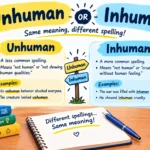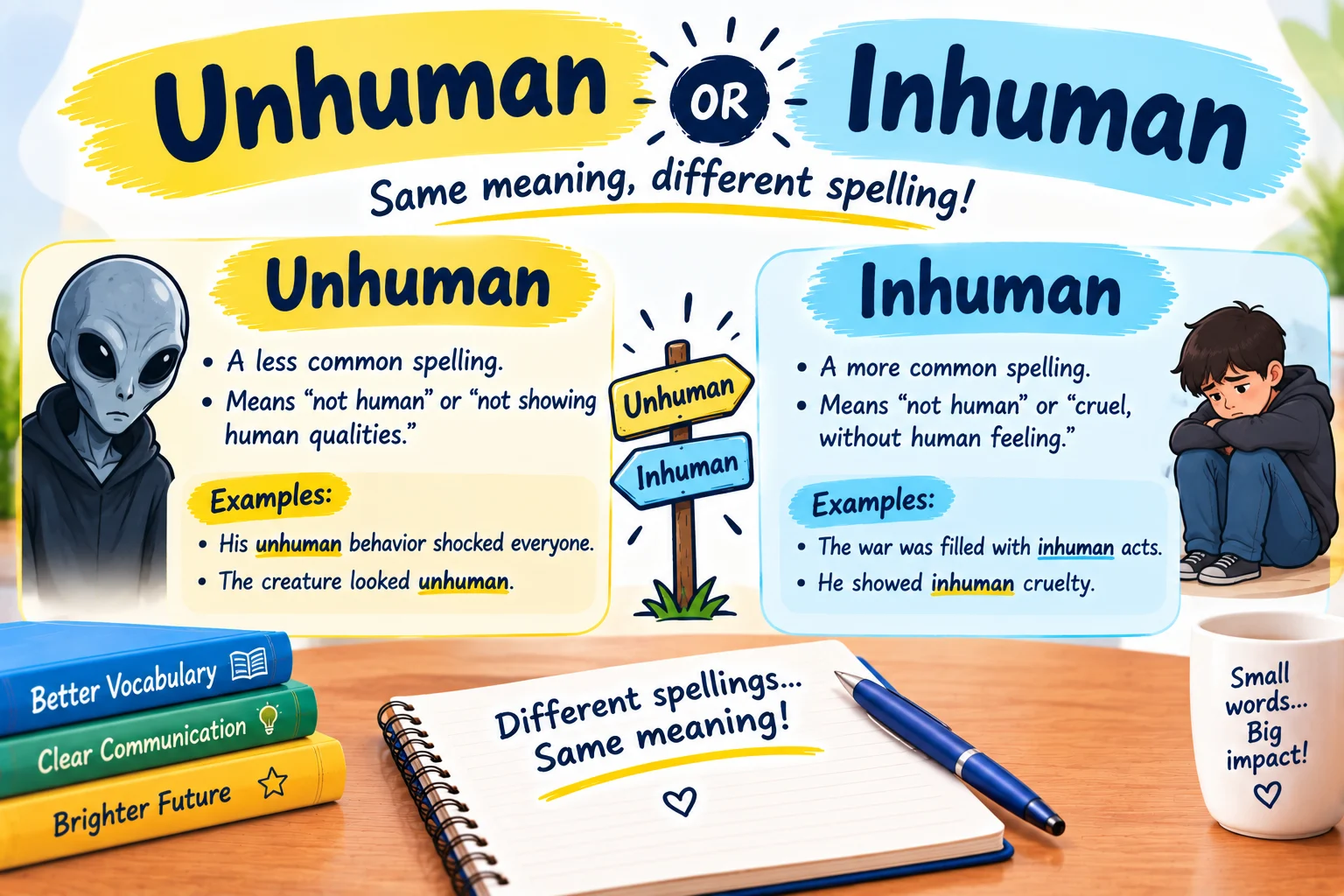
Inhuman is the usual word when you mean cruel, heartless, or lacking human kindness. Unhuman is much less common and usually means not human or outside normal human qualities.
Have you ever stopped while writing and asked yourself, “Should I use unhuman or inhuman?” You are not alone. These two words look almost the same, and both seem to mean “not human.”
The difference becomes clear when you look at how English speakers normally use them.
In my years of helping students improve their English, I have seen this confusion in essays, stories, online posts, and formal writing. A writer may want to describe a cruel act but choose unhuman because the prefix un- seems like the natural choice.
That small choice can change the meaning.
Inhuman is the common word for something cruel, brutal, or lacking human kindness. It can also describe something that seems beyond normal human ability or behavior.
Unhuman is far less common. It can mean not human, especially when talking about something outside the human species or something that does not have normal human qualities.
So which word should you choose? The answer depends on what you want to say. Let’s make the difference simple.
unhuman or inhuman – Quick Answer
If you are describing cruel or heartless behavior, use inhuman.
The prisoners suffered inhuman treatment.
Here, inhuman means cruel and lacking compassion.
Unhuman is a much rarer word. It can be used when something is described as not human or unlike a human being.
The creature had an unhuman appearance.
For most everyday and formal writing, inhuman is the safer and more natural choice.
Quick rule
Remember this:
Inhuman = cruel, brutal, or lacking human kindness.
Unhuman = not human or outside what is normally human.
There is some overlap between the words, but they are not equally common.
The Origin and Background of Inhuman
The word inhuman is built from in- and human.
The prefix in- can mean “not” or “without.” So, at first glance, inhuman seems to mean simply “not human.”
But language often develops beyond a simple word-by-word meaning.
Over time, inhuman became strongly linked with behavior that lacks kindness, pity, or compassion. That is why we commonly use it to describe cruelty.
For example:
The soldiers were accused of inhuman treatment of civilians.
The word does not mean that the soldiers were literally non-human. It means their behavior was so cruel that it seemed to go against basic human kindness.
The history of unhuman
Unhuman follows a more direct pattern.
The prefix un- can also mean “not.” Therefore, unhuman can suggest something that is not human or does not belong to the human world.
However, modern English uses nonhuman much more often when the literal meaning is intended.
For example:
Scientists studied nonhuman primates.
This sounds more natural than:
Scientists studied unhuman primates.
That is one reason unhuman is uncommon in everyday English.
unhuman or inhuman Explained — Key Differences
The easiest way to understand the difference is to focus on context.
| Term | Meaning | When to Use | Region/Context |
|---|---|---|---|
| Inhuman | Cruel, brutal, or lacking kindness | Describing cruel actions or treatment | Standard English |
| Inhuman | Beyond normal human ability or limits | Describing extreme strength, endurance, etc. | Standard English |
| Unhuman | Not human or unlike a human | Rare or specialized descriptions | Literary, philosophical, or unusual contexts |
| Nonhuman | Not belonging to the human species | Animals, machines, creatures, research | Modern standard usage |
1. Inhuman means cruel
This is the most common meaning.
The victims experienced inhuman treatment.
The prisoners lived in inhuman conditions.
In both sentences, inhuman means extremely cruel or lacking basic human care.
2. Inhuman can describe extreme ability
The word can also describe something that seems far beyond normal human limits.
The athlete showed inhuman strength.
She worked with almost inhuman energy.
Here, inhuman does not mean cruel. It means something seems superhuman or beyond ordinary human ability.
3. Unhuman means not human
Unhuman is much less common.
It may appear in literature, philosophy, fantasy, science fiction, or writing that wants to create a special effect.
The monster had an unhuman face.
The writer may be stressing that the creature does not look or behave like a human.
However, in ordinary modern English, nonhuman is often clearer.
The creature had a nonhuman appearance.
4. Nonhuman is often the better literal choice
If you simply mean “not a human being,” use nonhuman in most modern contexts.
Examples include:
- nonhuman animals
- nonhuman species
- nonhuman intelligence
- nonhuman organisms
This avoids confusion with the emotional meaning of inhuman.
Why Do People Confuse Unhuman and Inhuman?
The confusion comes from the prefixes.
Both un- and in- can express a negative idea.
For example:
- happy → unhappy
- visible → invisible
- complete → incomplete
- human → inhuman
A learner may naturally think:
human → unhuman
That looks logical, but English does not always form words in a perfectly logical way.
The established word for cruel or heartless behavior is inhuman.
That is why:
❌ The treatment was unhuman.
is usually better written as:
✅ The treatment was inhuman.
The word inhuman is familiar, natural, and widely accepted.
Which Version Should You Use?
Your choice depends on your meaning.
For students → use inhuman
If you are writing an essay about cruelty, war, abuse, poverty, or suffering, inhuman is usually the right word.
The prisoners faced inhuman conditions.
It is clear and standard.
For professional writers → use inhuman
News articles, reports, essays, and formal documents often use inhuman when discussing cruelty.
The report described the conditions as inhuman.
This sounds natural and professional.
For literal “not human” meanings → use nonhuman
If your meaning is simply that something is not a human being, nonhuman is often the best choice.
The study examined the behavior of nonhuman animals.
It is precise and easy to understand.
For creative or literary writing → unhuman can appear
Unhuman is possible in certain creative contexts.
A writer may choose it to create a strange, eerie, or philosophical feeling.
An unhuman voice came from the dark.
The unusual word choice can make the scene feel less ordinary.
For everyday English, however, inhuman or nonhuman will usually be better.
Common Mistakes with unhuman or inhuman
Mistake 1: Using unhuman for cruelty
❌ The prisoners received unhuman treatment.
✅ The prisoners received inhuman treatment.
Use inhuman when you mean cruel or brutal.
Mistake 2: Using inhuman for every meaning of “not human”
❌ The researchers studied inhuman animals.
✅ The researchers studied nonhuman animals.
Inhuman can sound like you are calling the animals cruel or lacking human compassion.
Mistake 3: Assuming unhuman is always wrong
Unhuman does exist, but it is uncommon.
It can appear in specialized, literary, or philosophical writing. So it is better to say “rare” rather than simply calling it a spelling mistake.
Mistake 4: Confusing inhuman with inhumane
These words are closely related.
Inhumane usually means cruel or lacking compassion.
The animals were kept in inhumane conditions.
Inhuman can also mean cruel, but it has other meanings too.
The runner showed inhuman speed.
You cannot normally replace inhumane with inhuman in every sentence.
Mistake 5: Using a rare word when a clear word exists
Sometimes a writer wants to sound advanced and chooses unhuman.
That can make the sentence less clear.
If you mean “not human,” nonhuman is often easier.
If you mean “cruel,” use inhuman.
Simple words often make stronger writing.
Inhuman vs. Inhumane
This is another useful distinction.
Inhuman
Inhuman can mean:
- cruel
- brutal
- lacking human kindness
- beyond normal human ability
Examples:
The prisoners suffered inhuman treatment.
He showed inhuman strength.
Inhumane
Inhumane mainly means:
- cruel
- lacking compassion
- causing unnecessary suffering
Example:
The organization protested against inhumane treatment of animals.
When talking about cruelty, inhumane is often a very precise choice.
unhuman or inhuman in Real-World Examples
1. Professional email
We are concerned about the inhuman conditions reported at the facility and request an immediate review.
Here, inhuman describes severe and cruel conditions.
2. News headline
Report Reveals Inhuman Conditions at Prison
The headline uses inhuman to show that the conditions were extremely cruel.
3. Social media post
No one should have to live in such inhuman conditions.
This is a natural use in an emotional social media post.
4. Formal report
The investigation found evidence of inhuman treatment of workers.
This is suitable for a formal report because inhuman is standard and clear.
5. Creative writing
An unhuman sound echoed through the empty building.
Here, unhuman creates a strange or supernatural feeling.
The writer is not simply saying that the sound was cruel. The word suggests that it did not sound like something produced by an ordinary human.
Other Words Related to Human
Knowing related words can help you choose the right one.
Human
Something related to people.
Every human deserves respect.
Humane
Kind and caring toward people or animals.
The shelter provides humane care.
Inhuman
Cruel or lacking human kindness.
The prisoners suffered inhuman treatment.
It can also mean beyond normal human ability.
The athlete displayed inhuman speed.
Inhumane
Cruel or without compassion.
The animals were kept in inhumane conditions.
Nonhuman
Not belonging to the human species.
Researchers observed nonhuman animals.
Unhuman
Rarely used to mean not human or unlike humans.
The creature had an unhuman shape.
unhuman or inhuman — Data, Trends & Usage
The search intent for “unhuman or inhuman” is mainly informational and spelling clarification.
People usually search this phrase because they have seen both forms and want to know which one sounds correct.
In everyday English, inhuman is far more familiar.
It appears in contexts such as:
- Human rights
- War and conflict
- Prison conditions
- Animal welfare
- Abuse and cruelty
- Extreme behavior
- Fiction and fantasy
Unhuman appears much less often. It is more likely to show up in creative, literary, philosophical, or specialized writing.
A useful modern writing trend is the growing preference for precise words. When writers mean “not human,” nonhuman often gives a clearer meaning. When they mean “cruel,” inhuman or inhumane is usually better.
That gives you a simple three-word guide:
Cruel → inhuman
Kind → humane
Not human → nonhuman
This distinction can make your writing clearer and easier to understand.
Standalone Comparison Table
| Term/Variant | Meaning | Region/Context | Best Used When |
|---|---|---|---|
| Inhuman | Cruel or lacking human kindness | Standard English | Describing cruel treatment |
| Inhuman | Beyond normal human limits | Standard English | Describing extreme ability |
| Inhumane | Cruel or lacking compassion | Standard English | Talking about suffering or cruelty |
| Nonhuman | Not belonging to the human species | Scientific and general English | Animals, organisms, machines, etc. |
| Unhuman | Not human or unlike humans | Rare, literary, specialized | Creative or unusual descriptions |
| Human | Relating to people | Standard English | General human references |
| Humane | Kind and compassionate | Standard English | Kind treatment of people or animals |
FAQs About unhuman or inhuman
Q: Which is correct, unhuman or inhuman?
A: Both words can be found in English, but inhuman is much more common. Use inhuman when you mean cruel, brutal, or lacking human kindness.
Q: What does inhuman mean?
A: Inhuman usually means cruel, brutal, or lacking compassion. It can also describe something that seems far beyond normal human ability.
Q: What does unhuman mean?
A: Unhuman is a rare word that can mean not human or unlike normal humans. It is more common in literary, philosophical, or unusual contexts than in everyday English.
Q: Is unhuman a real word?
A: Yes, unhuman can be found in English, but it is uncommon. Do not automatically replace inhuman with unhuman.
Q: What is the difference between inhuman and nonhuman?
A: Inhuman often means cruel or lacking human qualities. Nonhuman simply means something is not a human being or does not belong to the human species.
Q: Is inhuman acceptable in formal writing?
A: Yes. Inhuman is a standard English word and is commonly used in formal writing, especially when discussing cruel treatment or extreme conditions.
Q: Should I use inhuman or inhumane for cruelty?
A: Both can describe cruelty, but inhumane is often more direct when you mean lacking compassion or causing suffering. Inhuman can also carry other meanings.
Q: Is unhuman a better word for something that is not human?
A: Usually, nonhuman is clearer in modern English. Use unhuman only when its unusual or literary tone fits your context.
Q: Can inhuman describe strength or speed?
A: Yes. Inhuman can describe something that seems far beyond normal human ability. For example, “He ran at an inhuman speed.”
Q: Are inhuman and unhuman interchangeable?
A: Not usually. Inhuman commonly describes cruelty or extreme qualities, while unhuman is rare and focuses more on something being unlike or outside the human.
Conclusion
The choice between unhuman or inhuman becomes easy once you know the meaning you want.
Use inhuman when you mean cruel, brutal, or lacking human kindness. For example, you can talk about inhuman treatment, inhuman conditions, or inhuman cruelty.
You can also use inhuman for something that seems far beyond normal human limits, such as inhuman strength or inhuman speed.
Unhuman is a real but uncommon word. It can mean not human or unlike a human, especially in creative or literary writing. In many modern contexts, nonhuman is a clearer choice for the simple meaning “not human.”
One simple memory trick can help:
Inhuman = cruel.
Nonhuman = not human.
Humane = kind.
If you are writing an essay, email, report, article, or everyday message, choose the word that matches your exact meaning. When describing cruelty, inhuman is the safe and natural choice.
Bookmark this guide so you never second-guess “unhuman or inhuman” again. Share it with a student or writer who may have the same question.