Or vs. Nor: “Or” presents a choice, while “nor” connects negative alternatives.
Choosing between or and nor can be confusing, especially when you are learning English. Both words help connect ideas, but they do not work in the same way. The choice depends on whether you are giving a choice, adding a negative option, or connecting two negative ideas.
If you have searched for “or or nor,” you may be asking questions like: Should I write or after a negative sentence? When should I use nor? Is neither…nor always correct? These are common English grammar questions.
The good news is that the basic rule is simple. Or usually connects alternatives or choices. Nor usually connects another negative idea, often after neither, not, never, or another negative expression.
For example, you can say, “Would you like tea or coffee?” But after neither, you normally say, “I want neither tea nor coffee.”
This guide explains or or nor in simple English. You will learn the difference, common mistakes, British and American usage, everyday examples, and easy rules to remember.
Or or Nor – Quick Answer
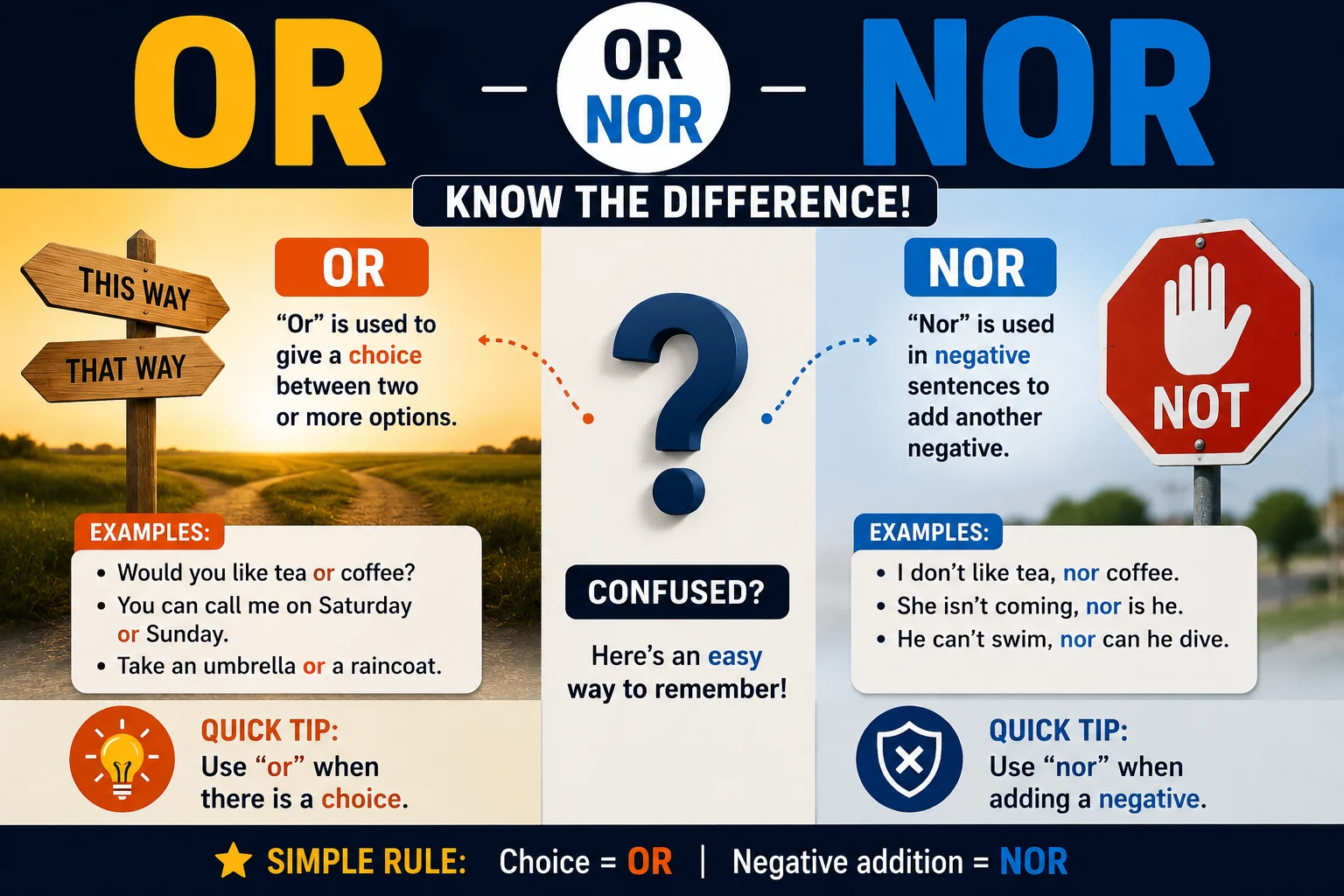
Or is used to show a choice or alternative.
Nor is used to introduce another negative choice or idea. It is often used with neither.
Examples with or
- Would you like tea or coffee?
- You can call me or send me an email.
- Is the meeting today or tomorrow?
Examples with nor
- I like neither tea nor coffee.
- She did not call, nor did she send a message.
- He can neither read nor write.
Easy rule
Think of it this way:
or = choice
nor = negative choice or addition
So:
Do you want pizza or pasta?
But:
I want neither pizza nor pasta.
The Origin of Or or Nor
Or and nor are both old English words. They have been used for many centuries to connect alternatives and ideas.
The word or comes from Old English “oþþe,” which meant “or” or “otherwise.” Over time, its form became shorter and changed into the modern word or.
Nor is related to older forms that expressed a negative alternative. It developed as a way to connect another negative idea. Its use became especially common with neither, creating the familiar structure neither…nor.
The two words are different in meaning and grammar. They are not simply two spellings of the same word.
English also has different grammar traditions in different regions. British and American English may sometimes differ in sentence style, but the basic distinction between or and nor remains the same.
The important point is that or normally presents alternatives, while nor normally continues a negative idea.
British English vs American English Spelling
There is no British vs American spelling difference between or and nor.
Both British English and American English use the same spellings:
| Version | Spelling | Region | Example Sentence |
|---|---|---|---|
| Standard English | or | UK, US, Commonwealth | Do you want tea or coffee? |
| Standard English | nor | UK, US, Commonwealth | She likes neither tea nor coffee. |
| Negative construction | neither…nor | UK, US, Commonwealth | He is neither tired nor hungry. |
Unlike words such as colour/color or centre/center, or and nor do not change spelling between British and American English.
There can be differences in style and sentence structure, especially with formal uses of nor, but the spelling stays the same.
Which Spelling Should You Use?
The answer is easy: use both words when the grammar calls for them.
US audience
For American readers, use or for alternatives and nor for negative alternatives.
- Would you like tea or coffee?
- I don’t want tea or coffee.
In formal writing, you may also use:
- I want neither tea nor coffee.
UK/Commonwealth audience
British English follows the same basic rule.
- Is it Monday or Tuesday?
- She is neither tired nor worried.
The spelling is exactly the same.
Global/SEO audience
If you are writing for a global audience, do not change or or nor based on location. Focus on correct grammar and clear sentences.
For SEO content, natural usage is best. Do not repeat or or nor unnecessarily. Write for people first.
Common Mistakes with Or or Nor
Here are some common mistakes learners make.
1. Using nor for every choice
Incorrect:
Do you want tea nor coffee?
Correct:
Do you want tea or coffee?
Use or when you are simply giving a choice.
2. Forgetting nor after neither
Incorrect:
She likes neither cats or dogs.
Correct:
She likes neither cats nor dogs.
The common paired structure is:
neither…nor
3. Using or when continuing a negative structure
Incorrect:
He can neither swim or run.
Correct:
He can neither swim nor run.
4. Thinking nor means “or”
Although both words can connect alternatives, nor normally carries a negative meaning.
Compare:
You can have tea or coffee.
with:
You can have neither tea nor coffee.
5. Forgetting inversion after formal nor
When nor starts a new clause after a negative statement, formal English can use subject-verb inversion.
She did not complain, nor did she ask for help.
Not:
She did not complain, nor she did ask for help.
Or or Nor in Everyday Examples
Emails
Or:
Please let me know if you would like to meet Monday or Tuesday.
Nor:
We received neither a reply nor a confirmation.
News headlines
Or:
Government Faces Choice: Reform or Delay
Nor:
No Evidence Found, Nor Any Witnesses Identified
Headlines often shorten sentences, so the grammar can look different from normal writing.
Social media
Or:
Movie night: comedy or horror?
Nor:
I have neither time nor energy today.
Simple forms are usually best on social media.
Formal writing
Or:
The applicant may submit the form online or by mail.
Nor:
The report provides neither evidence nor a clear explanation.
In formal writing, neither…nor is especially useful for presenting two negative alternatives.
Or or Nor – Google Trends & Usage
Search interest for or is naturally much higher because or is one of the most common words in English. It appears in everyday conversations, questions, instructions, websites, books, and business writing.
Nor is less common in everyday speech. It appears more often in formal writing, academic text, legal language, and structures such as neither…nor.
Usage is broadly consistent across English-speaking countries, including the United States, United Kingdom, Canada, Australia, and New Zealand. However, the frequency of nor can change depending on the type of writing.
For global SEO, both words are important because people search for grammar explanations when they are unsure which connector to use. A clear explanation should focus on meaning and sentence structure, rather than treating or and nor as spelling variations.
Or vs Nor: Quick Comparison
| Word | Main Use | Positive/Negative | Example |
|---|---|---|---|
| or | Shows a choice | Usually neutral | Tea or coffee? |
| nor | Adds another negative idea | Negative | Neither tea nor coffee |
| neither…nor | Connects two negative choices | Negative | Neither John nor Mary came |
| either…or | Connects two alternatives | Usually neutral | Either John or Mary will come |
Separate Comparison Table
| Variation | Correct? | Meaning | Example |
|---|---|---|---|
| or | Yes | Alternative or choice | Call me or text me. |
| nor | Yes | Another negative alternative | Neither call nor text me. |
| either…or | Yes | One of two choices | Either call or text me. |
| neither…nor | Yes | Not one and not the other | Neither John nor Mark came. |
| neither…or | Usually incorrect | Incorrect pairing | Neither tea or coffee. |
| either…nor | Usually incorrect | Incorrect pairing | Either tea nor coffee. |
FAQs About Or or Nor
1. What is the difference between or and nor?
Or usually shows a choice or alternative. Nor usually adds another negative idea, especially after neither.
2. Should I use or or nor after neither?
Use nor.
I like neither tea nor coffee.
3. Is “neither or” correct?
In the standard paired construction, no. The normal form is neither…nor.
Neither John nor Sarah came.
4. Is “either or” correct?
Yes. Either…or is a common structure used to show two alternatives.
You can either walk or take the bus.
5. Is nor used in American English?
Yes. Nor is standard in American English. It is often used in formal writing and with neither.
6. Is nor used in British English?
Yes. British English also uses nor. The spelling is the same as in American English.
7. Can nor start a sentence?
Yes. In formal English, nor can begin a clause or sentence after a negative statement.
She did not call. Nor did she send a message.
Conclusion
Understanding or or nor is easier when you remember their basic jobs. Or is mainly used to show a choice, alternative, or possibility. Nor is mainly used to connect another negative idea.
The most useful pair to remember is neither…nor. For example, “I like neither tea nor coffee.” Another useful pair is either…or, as in “You can either stay or leave.”
There is no British or American spelling difference. Both countries use or and nor in the same way. The main difference is how the words function in a sentence.
If you are writing for a US, UK, Commonwealth, or global audience, you can safely use the same spellings. Focus on the meaning and grammar of the sentence.
When you are showing a normal choice, choose or. When you are continuing a negative idea, especially after neither, choose nor. Once you learn this simple rule, choosing between or and nor becomes much easier.