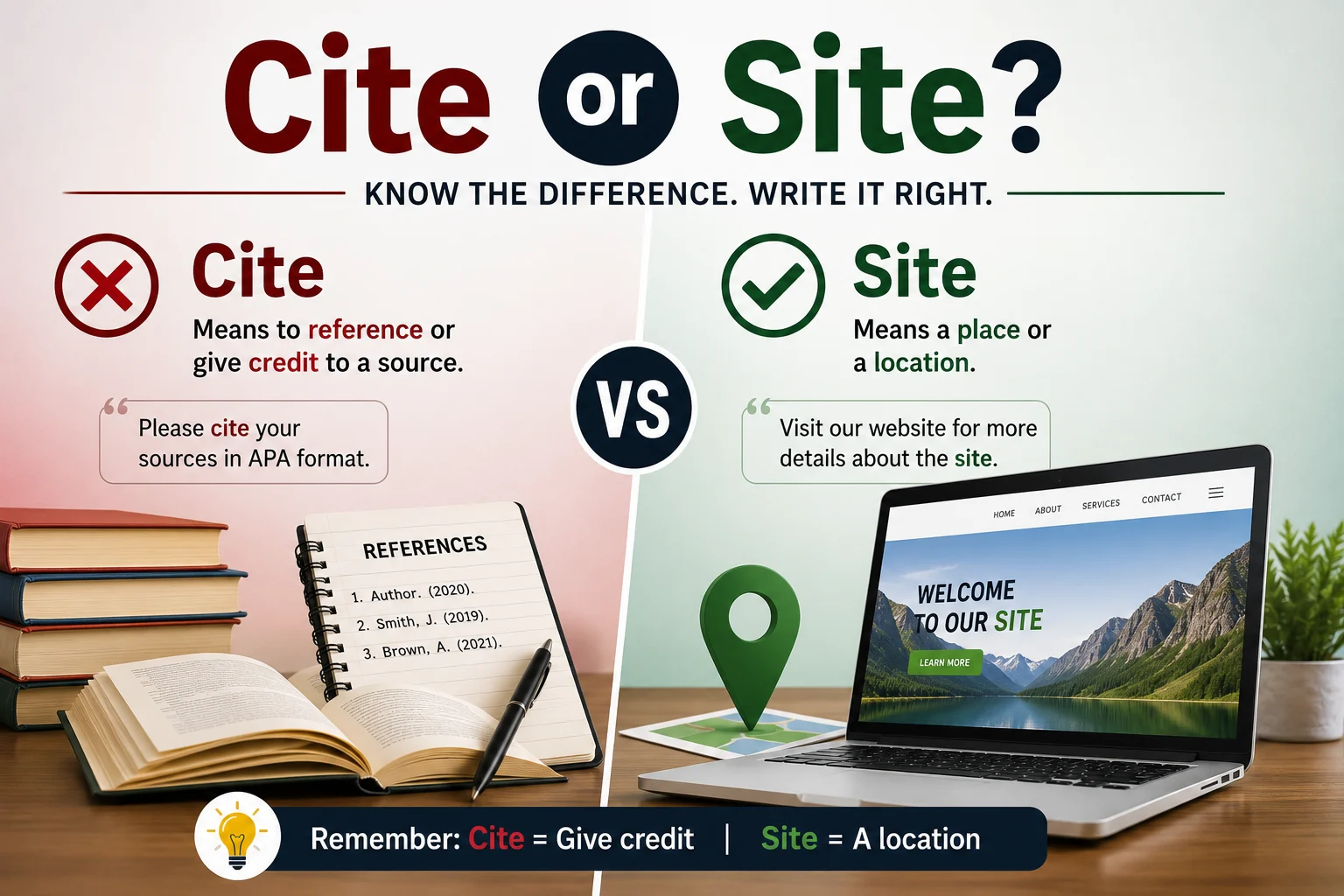
Cite means to quote or reference a source, while site refers to a place, location, or website.
Do you often wonder whether to use cite or site? You’re not alone. These two words sound exactly the same, making them a pair of common homophones in English. Because they have different meanings but identical pronunciation, many people accidentally use the wrong one in emails, school assignments, websites, and everyday writing.
The good news is that the difference is easy to remember. Cite means to quote, mention, or refer to a source. It is commonly used in academic writing, research papers, and legal documents. Site, on the other hand, means a place or location. It can describe a building site, a historical site, or a website on the internet.
In this guide, you’ll learn the difference between cite or site, where these words come from, how they are used in British and American English, common mistakes to avoid, and practical examples. By the end, you’ll know exactly which word to choose in every situation.
## Cite or Site – Quick Answer
Both cite and site are correct words, but they have different meanings.
- Cite means to quote, mention, or refer to a source or example.
- Site means a place, location, or area, including a website.
Examples
- Please cite your sources in the report.
- The construction site is closed today.
- I found the article on a news site.
## The Origin of Cite or Site
Although cite and site sound the same, they come from different Latin roots.
Cite comes from the Latin word citare, meaning “to summon” or “to call.” Over time, it came to mean referring to a source, quotation, or authority in writing.
Site comes from the Latin word situs, meaning “position” or “location.” Today, it refers to a physical place, an area, or a website on the internet.
Since both words are pronounced the same way, many writers confuse them, especially when typing quickly.
## British English vs American English Spelling
There is no spelling difference between British and American English.
Both varieties use cite and site with the same meanings.
| Version | Spelling | Region | Example Sentence |
|---|---|---|---|
| Standard English | Cite | United States & United Kingdom | Please cite your references. |
| Standard English | Site | United States & United Kingdom | The new office site is ready. |
The meanings remain the same worldwide.
## Which Spelling Should You Use?
US Audience
Use cite when referring to sources or quotations. Use site when referring to locations or websites.
UK/Commonwealth Audience
The same rule applies. Both spellings are standard and have different meanings.
Global/SEO Audience
Choose the word that matches your meaning:
- Cite = mention a source.
- Site = place or website.
## Common Mistakes with Cite or Site
These homophones are often mixed up because they sound identical.
Incorrect vs Correct
❌ Please site your sources.
✅ Please cite your sources.
❌ I visited the historical cite.
✅ I visited the historical site.
❌ This cite has useful articles.
✅ This site has useful articles.
❌ The professor asked us to site the book.
✅ The professor asked us to cite the book.
## Cite or Site in Everyday Examples
Emails
“Please cite all references before submitting your report.”
News Headlines
“New Construction Site Opens in Downtown Area”
Social Media
“I found a great recipe on this cooking site!”
Formal Writing
“Researchers must cite all sources accurately to avoid plagiarism.”
## Cite or Site – Google Trends & Usage
Both cite and site are commonly searched because they are frequently confused.
People usually search for cite when they need help with:
- Academic writing
- Research papers
- Citations
- Referencing styles
People search for site when looking for:
- Websites
- Construction sites
- Historical sites
- Tourist attractions
- Business locations
Because both words are used in different contexts, neither replaces the other.
## Comparison Table
| Feature | Cite | Site |
|---|---|---|
| Dictionary Word | Yes | Yes |
| Means Reference or Quote | Yes | No |
| Means Place or Location | No | Yes |
| Refers to a Website | No | Yes |
| Common in Academic Writing | Yes | Sometimes |
| Common in Everyday Writing | Yes | Yes |
## FAQs
Is it cite or site?
Both are correct, but they have different meanings. Cite means to refer to a source, while site means a place or location.
What does cite mean?
Cite means to quote, mention, or give credit to a source of information.
What does site mean?
Site means a place, location, area, or a website.
Is there a British and American spelling difference?
No. Both British and American English use cite and site with the same spellings and meanings.
How do I remember the difference between cite and site?
Think of cite as referring to citations. Think of site as referring to a location or website.
Can site mean a website?
Yes. In modern English, site commonly refers to a website on the internet.
## Conclusion
Understanding the difference between cite or site is easy once you know what each word means. Cite is the correct choice when you are referring to a source, quotation, or reference in writing. It is commonly used in schools, universities, research papers, and professional documents. Site, however, refers to a place or location, whether it is a construction site, a historical landmark, or a website on the internet.
Because cite and site are homophones, they sound exactly alike but have completely different meanings. Choosing the correct word depends on the context of your sentence, not the pronunciation.
A simple way to remember the difference is this: cite is for citations, while site is for places and websites. Keeping this rule in mind will help you avoid a common English mistake and make your writing clearer, more accurate, and more professional.