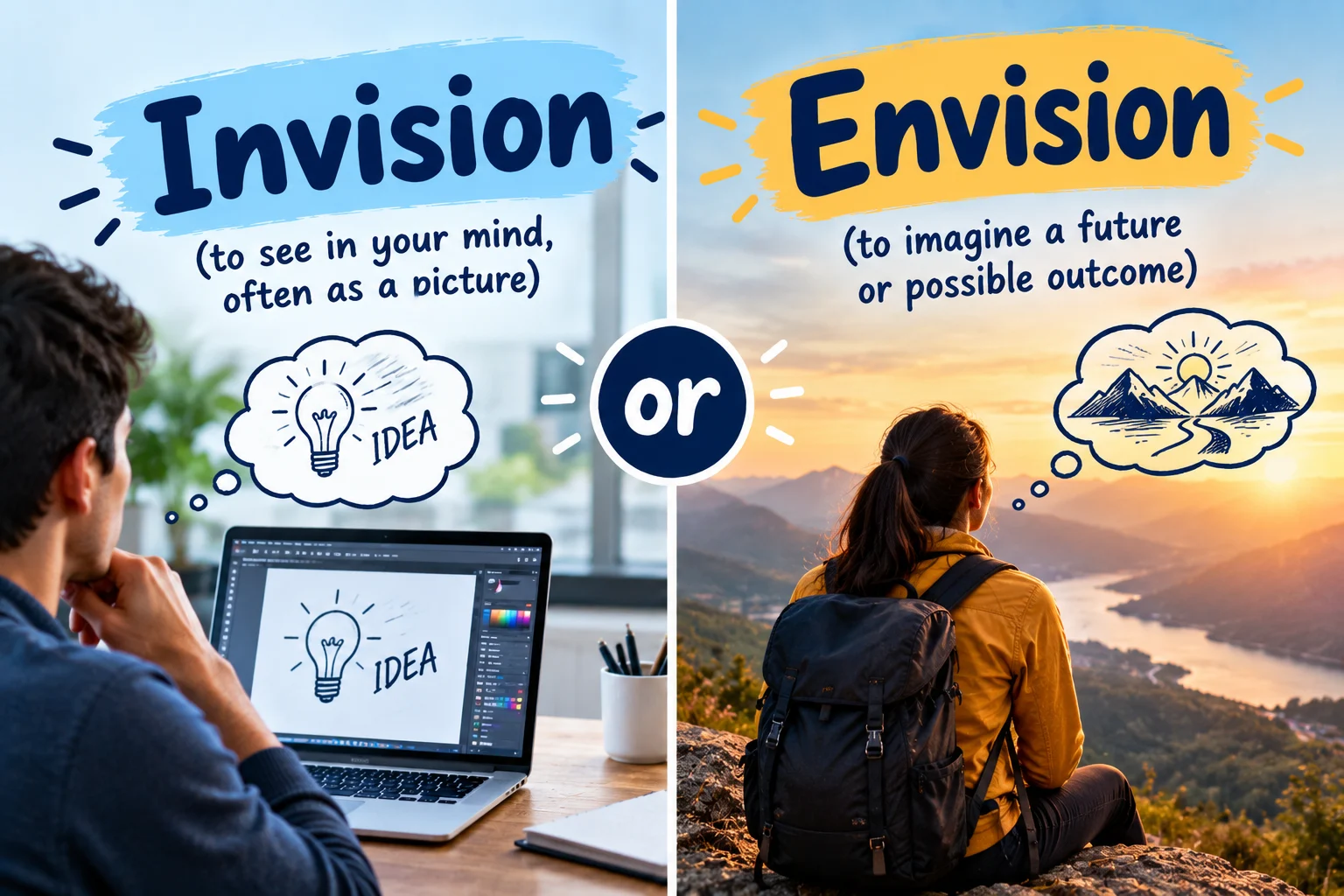
Envision is the standard English spelling when you mean to imagine, picture, or see something in your mind. Invision is generally not the standard spelling for this meaning.
Have you ever typed a word that looks right, only to wonder if one small letter has ruined it? Invision or envision is a good example. The two forms look almost the same, but only one is the normal spelling for the verb meaning “to imagine.”
I have seen this confusion many times in emails, student writing, business plans, and online posts. The mistake is easy to make because in- and en- are both common beginnings in English words. Your brain may also connect invision with words such as visualize or vision.
The correct word is envision.
When you envision something, you imagine it clearly or think about how it may look or happen in the future. It works well in everyday writing, professional communication, academic work, and creative writing.
So, why does invision look so believable? The answer becomes much clearer when you look at the word’s history, meaning, and common uses.
Invision or Envision – Quick Answer
Envision is the standard English verb. It means to imagine, picture, or form an idea of something in your mind.
Invision is generally not the standard spelling when you want to use this verb.
Simple examples
- I envision a better future for the company.
- She envisioned a quiet life by the sea.
- Can you envision what the finished house will look like?
Easy rule
Use “envision” when you mean “imagine” or “picture in your mind.”
For example:
We envision a world where every child has access to education.
Not:
We invision a world where every child has access to education.
The Origin and Background of Envision
The word envision is closely connected to the idea of vision.
The noun vision relates to seeing. It can describe physical sight, but it can also describe an idea of what something could become.
The prefix en- can help form verbs that mean “to put into” or “to cause to be.” In envision, the word developed around the idea of forming a picture or image in the mind.
This makes the meaning quite logical:
envision → form a mental picture
The word is especially useful when talking about the future.
For example:
She envisions herself running her own business.
She is not physically seeing that future. She is imagining it.
The incorrect form invision is easy to create because English has many words beginning with in-. Writers may also see the word vision and naturally add in- before it.
That spelling feels logical, but standard modern English
Invision or Envision Explained — Key Differences
The main difference is simple.
| Term | Meaning | When to Use | Region/Context |
|---|---|---|---|
| envision | To imagine or picture something | Standard verb for imagining a situation | Standard English |
| invision | Generally not the standard spelling for “imagine” | Avoid in normal English writing | Nonstandard usage |
| vision | Sight or an imagined future idea | Used as a noun | Standard English |
Envision
Use envision when you imagine something before it happens.
Examples:
- I envision a larger office in the future.
- They envisioned a new approach to education.
- Can you envision yourself working there?
Vision
Do not confuse envision with vision.
Vision is a noun.
Her vision for the company is clear.
Envision is a verb.
She envisions a successful company.
The words are related, but they have different grammatical roles.
Invision
In ordinary modern English, invision should not replace envision.
If you mean “imagine,” choose envision.
Which Version Should You Use?
Choosing the correct form is easy once you know your purpose.
For students
Use envision in essays, assignments, presentations, and exams.
Example:
Students can envision different career paths after graduation.
This is the standard form your teacher or examiner will expect.
For professional writers
Use envision in reports, proposals, business plans, emails, and presentations.
Example:
Our team envisions a major expansion over the next five years.
It sounds natural and professional.
For formal or academic writing
Envision is acceptable in formal writing when the meaning fits.
For example:
Researchers envision new methods for reducing energy use.
You can also use alternatives such as:
- imagine
- picture
- foresee
- anticipate
- conceive
Choose the word that best matches your exact meaning.
For global English
If you want a spelling that works clearly across standard English varieties, use envision.
Common Mistakes With Invision or Envision
1. Writing “invision” instead of “envision”
Mistake:
I invision a better future.
Correction:
I envision a better future.
The standard verb is envision.
2. Confusing “envision” with “vision”
Mistake:
I vision a better future.
Better:
I envision a better future.
Vision can sometimes be used as a verb in special contexts, but envision is the clearer standard choice when you mean “imagine.”
3. Using “envision” when you mean “expect”
These words can overlap, but they are not always interchangeable.
I envision a larger office.
This means I can imagine or picture it.
I expect a larger office.
This suggests I believe it is likely to happen.
4. Using “envision” for physical seeing
Envision usually describes mental pictures.
Less suitable:
I envisioned the sign with my eyes.
Better:
I saw the sign.
Use envision for imagination or a mental picture.
5. Adding the wrong prefix
Because English has many words beginning with in-, writers may create invision by mistake.
When in doubt, remember:
envision = imagine
Invision or Envision in Real-World Examples
1. Professional Email
Our team envisions a stronger partnership between the two departments. We believe this plan can improve communication and save time.
Here, envisions means “imagines” or “sees as a possible future.”
2. News Headline or Article
Company Envisions Major Changes for Its Digital Services
The headline uses envisions because the company has a future plan or picture in mind.
3. Social Media Post
I envision a future where learning is easier and more accessible for everyone.
This use is natural and conversational.
4. Formal Report
The organization envisions a long-term strategy focused on sustainable growth.
This is a common professional use of the word.
5. Everyday Conversation
Can you envision living in a small town?
Here, the speaker is asking someone to imagine that situation.
Envision vs. Similar Words
Several words are close to envision, but each has a slightly different feel.
Envision vs. Imagine
Imagine is broader and more common.
Imagine living near the ocean.
Envision often sounds more purposeful or future-focused.
We envision opening three new stores.
Envision vs. Visualize
Visualize often means creating a mental picture.
Visualize yourself crossing the finish line.
Envision can involve a broader idea, plan, or future state.
We envision a stronger education system.
Envision vs. Foresee
Foresee means to expect or recognize something that may happen.
We foresee higher demand next year.
Envision focuses more on imagining or picturing a possibility.
We envision a larger market in the future.
Invision or Envision — Data, Trends & Usage
The search intent behind invision or envision is mainly informational. People usually search the phrase because they have seen both spellings and want to know which one is correct.
The confusion is understandable. English contains many pairs where prefixes change the spelling or meaning of a word. Writers may also connect invision with the familiar noun vision.
The important usage pattern is simple:
- Envision is the standard spelling.
- Envision appears in academic and professional writing.
- Envision is common when discussing goals and future plans.
- Invision should generally be avoided when you mean “imagine.”
You may also encounter InVision as a branded or proper name. A brand name is a different matter from the standard English verb. Proper names should keep their official spelling.
Invision vs. Envision: Quick Comparison
| Term/Variant | Meaning | Region/Context | Best Used When |
| envision | Imagine or picture mentally | Standard English | Describing an imagined future or idea |
| invision | Generally nonstandard for “imagine” | Usually a spelling error | Avoid in ordinary writing |
| vision | Sight or a future idea | Standard English | Using the noun form |
| visualize | Create a mental picture | Standard English | Focusing on mental imagery |
| imagine | Form an idea or picture in the mind | Standard English | General everyday use |
Frequently Asked Questions
Q: Is “invision” or “envision” correct?
A: Envision is the standard spelling when you mean “to imagine” or “to picture something mentally.” Invision should generally not be used for this meaning.
Q: What does envision mean?
A: Envision means to imagine or picture something in your mind. It is often used for future plans, goals, possibilities, and ideas.
Q: Is envision formal English?
A: Yes. Envision is suitable for professional, academic, business, and formal writing. It is also natural in everyday conversation.
Q: Is envision the same as imagine?
A: They are similar, but imagine is broader. Envision often suggests forming a clear mental picture of a possible situation, plan, or future.
Q: Is “invision” ever correct?
A: It is generally not the standard spelling of the verb meaning “imagine.” However, InVision may appear as a proper name or brand, which is separate from ordinary English spelling.
Q: What is the difference between envision and visualize?
A: Both can involve mental pictures. Visualize often focuses on creating a mental image, while envision can describe imagining a broader future, plan, or possibility.
Q: Can I use envision in a business plan?
A: Yes. Envision works very well in business writing when describing future goals or plans. For example, “We envision expanding into new markets.”
Conclusion
The choice between invision or envision becomes easy when you remember one simple rule: envision is the standard English verb meaning to imagine or picture something in your mind.
Use envision when you talk about future goals, plans, possibilities, or mental pictures. It works in student essays, business documents, professional emails, reports, social media posts, and everyday conversation.
Avoid invision when you mean “imagine.” The spelling may look natural because of the word vision, but standard English uses envision.
Also remember that vision is a noun, while envision is a verb. This small grammar difference can help you choose the right word.
When writing, ask yourself: Am I imagining something? If the answer is yes, envision is usually the word you need.
Now you know the difference. Bookmark this guide and use “envision” confidently in your next piece of writing.