Either is the correct standard English word. Ither is not the standard spelling of either and should not be used in formal writing.
Have you ever written a word that looked right, only to stop and wonder, “Wait, is this really how it is spelled?” ither or either is one of those small spelling questions that can make you pause.
As an English teacher, I have seen learners drop the first e from either because the word may sound different in fast speech. When people speak quickly, the first vowel can be weak or hard to hear. That can make ither look like a possible spelling.
But English spelling does not always follow pronunciation.
The correct word is either. It has an e at the beginning. The spelling ither is generally a misspelling when you mean either.
There is also a second reason learners search for this pair. Either has several uses. It can mean one of two choices, and it can also appear in negative sentences such as “I don’t like it either.” It is also part of the common pair either … or.
Let’s make all of this simple.
ither or either – Quick Answer
When choosing between ither or either, use either.
✅ Either is correct.
❌ Ither is not the standard spelling.
Either can mean one of two choices.
You can choose either tea or coffee.
It can also be used at the end of a negative sentence.
I don’t like coffee either.
The word ither is not the standard spelling for these meanings.
Quick spelling tip
Remember:
E + ither = either
Do not drop the first e.
The Origin and Background of Either
The spelling either has a long history.
The word comes from older forms of English that were linked to the idea of each of two or one or the other. Over time, its spelling changed as English developed.
The modern spelling is either.
Its history also helps explain why the word has more than one common use.
Either as a choice
The first major use is to talk about one of two possibilities.
You can take either road.
This means one road or the other.
Either in a negative sentence
Either can also mean that something applies to one additional person or thing after a negative statement.
I don’t like the movie either.
This means the speaker also does not like the movie.
Why does “ither” appear?
The spelling ither often comes from pronunciation.
English has many words where the sound does not make every letter easy to hear. Learners may write what they think they hear.
This is called phonetic spelling.
For example, someone may hear a weak beginning sound and write:
ither
instead of:
either
But standard spelling requires the initial e.
ither or either Explained — Key Differences
There is a very simple difference between these two forms.
| Term | Meaning | When to Use | Region/Context |
|---|---|---|---|
| Either | One of two choices | Choosing between two things | Standard English |
| Either … or | One choice or another | Giving alternatives | Standard English |
| Either | Also, after a negative statement | Agreeing with a negative idea | Standard English |
| Ither | Nonstandard spelling of either | Avoid in standard writing | Usually a spelling error |
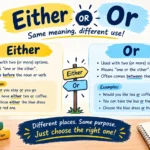
1. Either means one of two
Either answer could be correct.
This means one answer or the other could be correct.
You can sit on either side.
There are two sides, and either one is possible.
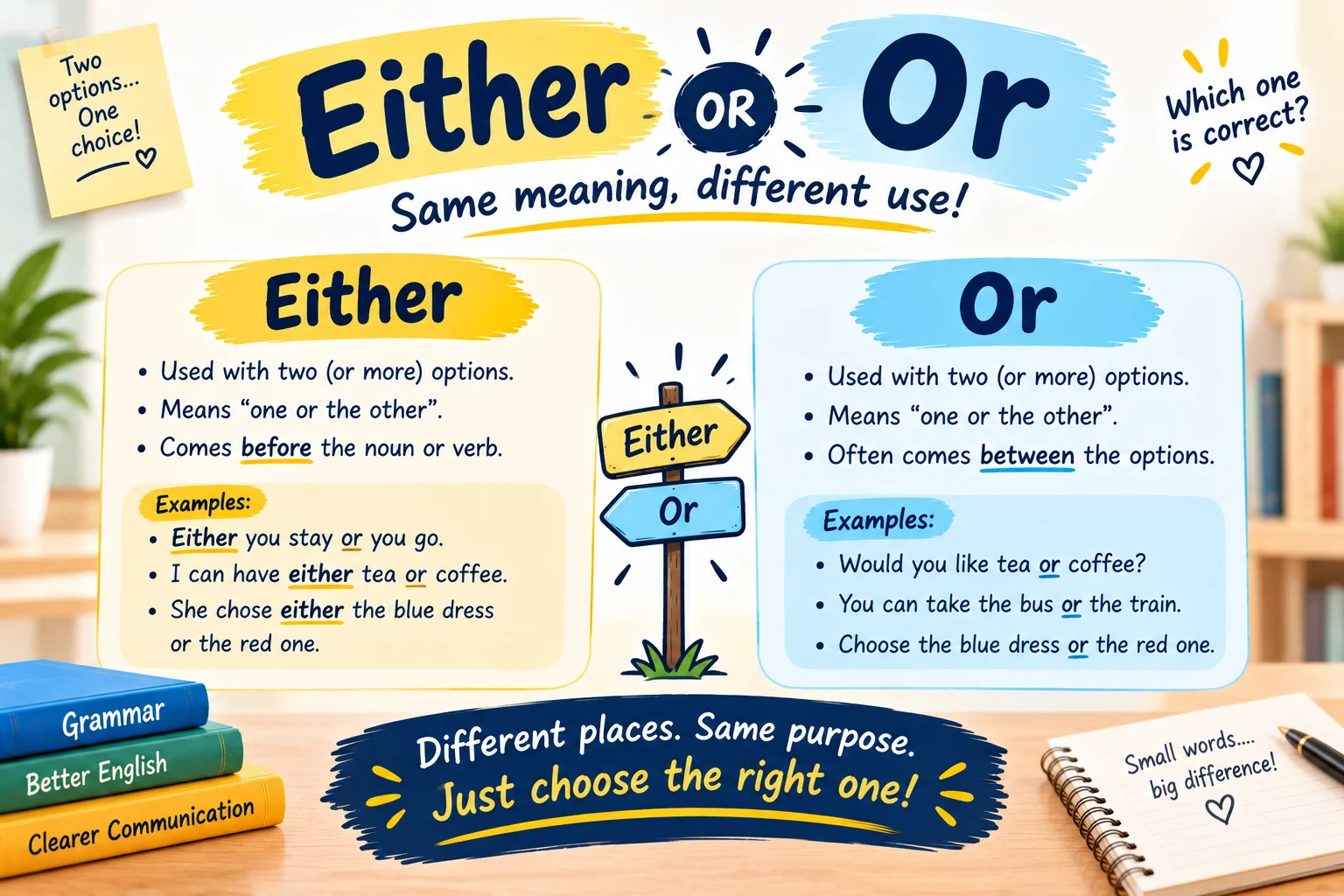
2. Either … or gives two choices
This is one of the most common structures.
You can either walk or take the bus.
There are two choices.
Another example:
We can meet either Monday or Tuesday.
The sentence presents two possible days.
3. Either can appear in negative sentences
You can also put either at the end of a negative sentence.
I don’t want pizza either.
She doesn’t know the answer either.
He didn’t call me either.
Here, either means something like “also not.”
4. Ither is not the standard spelling
If you mean the common English word, do not write:
❌ ither
Write:
✅ either
This rule applies to school work, business writing, websites, emails, and formal documents.
Either vs. Neither
Learners often confuse either with neither.
The two words are closely related, but their meanings are different.
Either
Either usually presents two possibilities.
Either answer is acceptable.
This means one answer or the other can be acceptable.
Neither
Neither means not one and not the other.
Neither answer is acceptable.
This means both answers are rejected.
Compare these:
Either John or Mark will come.
One of them will come.
Neither John nor Mark will come.
Both will not come.
The matching pairs are:
Either → or
Neither → nor
This is a useful rule to remember.
Which Version Should You Use?
There is one clear choice when you are deciding between ither or either.
For students → use either
Always use either in essays, homework, tests, and assignments when you mean the standard English word.
Either answer is acceptable.
Do not write:
❌ Ither answer is acceptable.
For professional writers → use either
Business emails and reports should use the standard spelling.
Please choose either option.
You may contact us by either phone or email.
For non-native English speakers → remember the first e
If spelling is difficult to remember, break the word into two parts:
E + ither
Then write:
either
The first e is easy to forget, so make it part of your memory trick.
For global English → use either
Either is the standard form across major varieties of English, including British and American English.
There is no need to change the spelling to ither.
Common Mistakes with ither or either
Mistake 1: Dropping the first e
❌ Ither answer is fine.
✅ Either answer is fine.
The first e is part of the correct spelling.
Mistake 2: Using ither in formal writing
❌ You can choose ither option.
✅ You can choose either option.
Even if you see or hear nonstandard forms in casual communication, use either in standard writing.
Mistake 3: Confusing either with neither
❌ Neither choice means one of the two choices.
✅ Either choice means one of the two choices.
Neither has a negative meaning. It rejects both choices.
Mistake 4: Mixing either and nor
❌ You can choose either tea nor coffee.
✅ You can choose either tea or coffee.
The standard pair is either … or.
Mistake 5: Forgetting the negative use
Some learners think either can only appear before a choice.
But it can also appear after a negative statement.
I don’t want it either.
That sentence is completely correct.
ither or either in Real-World Examples
1. Professional email
You may send the document by either email or post.
Here, either … or gives two choices.
Another example:
I cannot attend the meeting either.
Here, either adds agreement with a negative statement.
2. News headline or article
Either Team Could Reach the Final
The word either means one of the two teams.
Another example:
The policy could affect either group.
Again, the word refers to one of two possible groups.
3. Social media post
You can either stay home or join us tonight!
This is a natural informal use.
Another example:
I don’t have time for that either. 😅
Here, either follows a negative statement.
4. Formal report
The applicant may use either method to complete the test.
This tells the reader that two methods are available.
Another example:
The study did not support either explanation.
Here, either works with the negative idea.
British English vs. American English
The spelling either is standard in both British and American English.
The main difference you may notice is pronunciation, not spelling.
Some speakers pronounce it with a sound like:
EE-ther
Others pronounce it with a sound like:
EYE-ther
Both pronunciations are widely recognized.
The spelling remains:
either
Not:
❌ ither
This is a useful lesson for English learners: different pronunciation does not always mean different spelling.
How to Remember the Spelling of Either
If you often forget the first e, try one of these simple tricks.
Trick 1: E comes first
Say:
Either = E at the beginning.
Write the first letter before thinking about the rest.
Trick 2: Remember “either/or”
The phrase is:
either … or
Seeing the complete pair can make the spelling easier.
Trick 3: Compare it with neither
Both words start with a vowel:
either
neither
Neither one is spelled ither.
Trick 4: Think “E for either”
When you are unsure, remember:
E for Either
It is a simple trick, but it works well for beginners.
Either in Common English Phrases
You will often see either in these structures:
- either one
- either way
- either side
- either option
- either answer
- either choice
- either day
- either person
- either … or
- not … either
Examples
Either way, we need to leave now.
You can choose either one.
There is a store on either side of the road.
I don’t want either option.
These phrases are useful in both everyday and professional English.
ither or either — Data, Trends & Usage
The search intent behind “ither or either” is mainly informational and spelling clarification.
People who search this phrase usually want a fast answer to a simple question:
Which spelling is correct?
The answer is either.
This type of spelling question is common among:
- English learners
- Students
- ESL writers
- Bloggers
- Content writers
- People writing emails
- People checking grammar before publishing
The confusion can be especially strong because pronunciation varies. A learner may hear either spoken quickly and believe the first vowel is missing.
That makes either a good example of why English learners should not rely only on sound.
Spelling, meaning, grammar, and pronunciation all work together.
If you remember the word’s common structures, you can also check your spelling more quickly:
either … or
either one
either way
not … either
Standalone Comparison Table
| Term/Variant | Meaning | Region/Context | Best Used When |
|---|---|---|---|
| Either | One of two | Standard English | Referring to two choices |
| Either … or | One choice or another | British & American English | Giving alternatives |
| Either after a negative | Also not | Standard English | Adding a negative agreement |
| Either one | One of two items | Standard English | Referring to two options |
| Either way | One way or the other | Standard English | Discussing two possible outcomes |
| Neither | Not one and not the other | Standard English | Rejecting both choices |
| Neither … nor | Not this and not that | Standard English | Rejecting two alternatives |
| Ither | Nonstandard spelling | Avoid in standard English | Generally a spelling mistake |
FAQs About ither or either
Q: Which is correct, ither or either?
A: Either is the correct standard English spelling. Ither is generally a misspelling and should be avoided in formal writing.
Q: What does either mean?
A: Either usually means one of two people or things. For example, “You can choose either option.”
Q: Is either used in “either or”?
A: Yes. The standard structure is either … or. For example, “You can either stay or leave.”
Q: What is the difference between either and neither?
A: Either can refer to one of two choices. Neither means not one and not the other. Their common pairs are either … or and neither … nor.
Q: Is either acceptable in formal writing?
A: Yes. Either is a standard English word and is fully acceptable in formal writing, academic work, business documents, and professional emails.
Q: Why do people spell either as ither?
A: The mistake often comes from pronunciation. The first vowel in either may sound weak in some speech, so learners sometimes write what they think they hear.
Q: Is ither a word in English?
A: Ither is not the standard spelling of either in modern English. If you mean the common word for one of two choices, use either.
Q: Is either spelled the same in British and American English?
A: Yes. The spelling is either in both varieties. The pronunciation may differ between speakers, but the spelling does not change.
Q: Can either be used at the end of a sentence?
A: Yes. It is common after a negative statement. For example, “I don’t like that movie either.”
Q: What is an easy way to remember either?
A: Remember “E for either.” You can also remember the common pair either … or.
Conclusion
The answer to ither or either is simple: either is the correct standard spelling.
Use either when you mean one of two choices:
You can choose either option.
Use either … or when presenting two alternatives:
You can either call me or send an email.
You can also use either after a negative statement:
I don’t like it either.
The spelling ither is generally a mistake when you mean either. The missing first e is the main problem.
One final memory trick can save you from this error:
E for Either.
Also remember the two useful pairs:
Either → or
Neither → nor
Once these patterns become familiar, you will not need to stop and guess. Use either with confidence, and bookmark this guide so you never second-guess the spelling again.