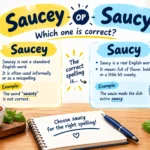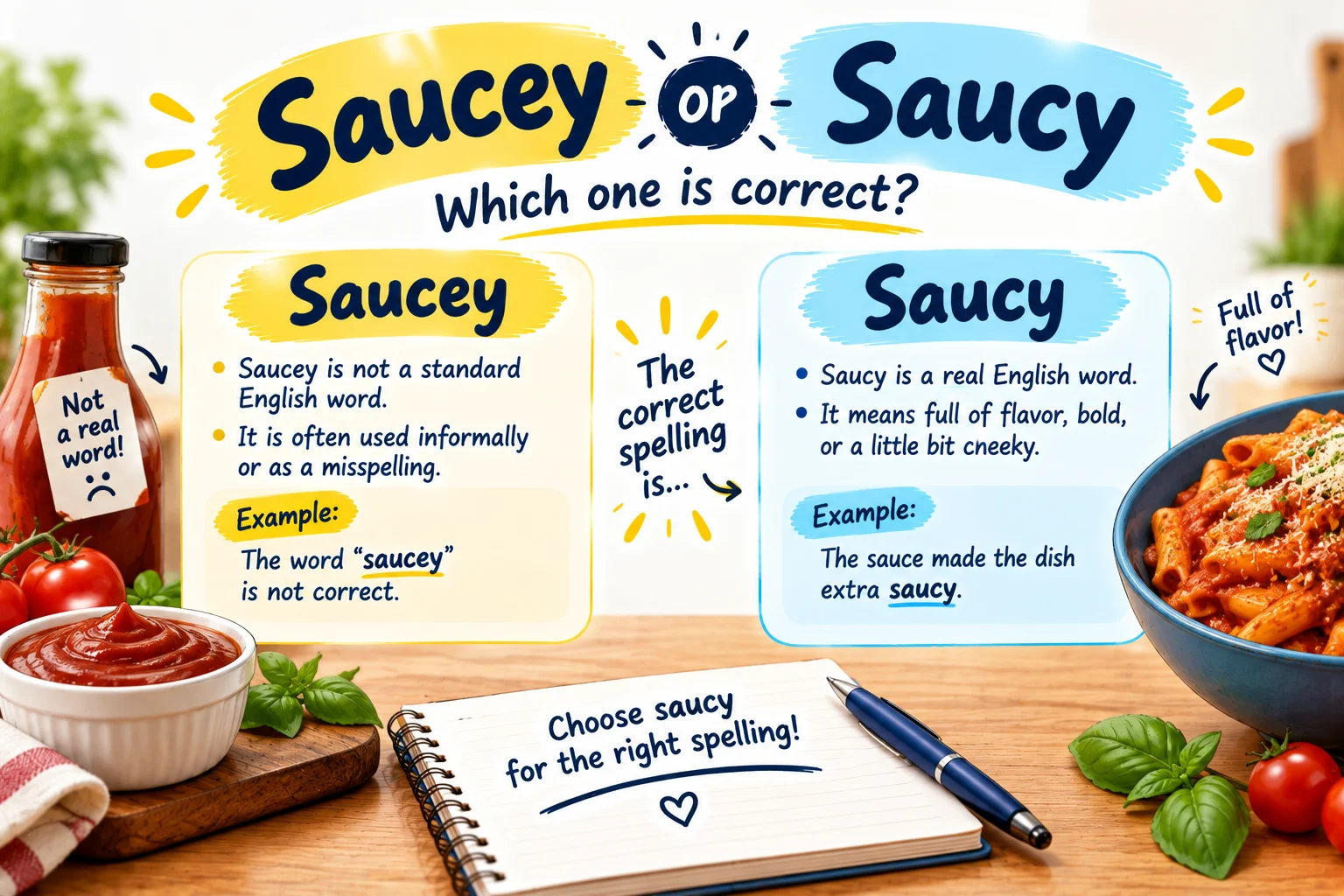
Saucy is the correct modern English spelling. Saucey is an uncommon and generally incorrect spelling when you mean full of sauce or playfully bold.
Have you ever written a word and suddenly wondered if one small letter is wrong? Saucey or saucy is a good example. The two forms look almost identical, but only one is the normal spelling used in modern English.
I have seen this type of spelling mistake often in food writing, social media posts, recipes, and casual messages. The word sounds simple, so it is easy to guess the spelling instead of checking it. Some writers add -ey because many English words end that way.
The correct spelling is saucy.
The word saucy has two main uses. It can describe food that contains a lot of sauce or has a strong sauce flavor. It can also describe a person or comment that is bold, cheeky, or slightly rude in a playful way.
So, should you write saucey or saucy? The answer is simple: choose saucy in standard English. Let’s look at the meaning, spelling, history, examples, and common mistakes so you can use it with confidence.
saucey or saucy – Quick Answer
Saucy is the standard and correct spelling in modern English.
The pasta has a saucy tomato topping.
Here, saucy means containing or covered with sauce.
The word can also describe someone’s behavior:
That was a saucy reply!
Here, saucy means cheeky, bold, or slightly disrespectful.
What about saucey?
Saucey is not the normal modern spelling of the adjective. If you are writing an essay, recipe, article, email, product description, or social media post, use saucy.
❌ The chicken is very saucey.
✅ The chicken is very saucy.
The main spelling rule is easy:
Sauce + y = saucy
The final e in sauce is dropped before adding -y.
The Origin and Background of Saucy
The word saucy comes from the noun sauce.
Sauce entered English through Old French and ultimately traces back to Latin salsa, meaning something salted or seasoned.
English later formed the adjective saucy from sauce.
The spelling follows a common English pattern. When a word ending in a silent e takes the suffix -y, the final e is often removed.
For example:
- sauce → saucy
- spice → spicy
- juice → juicy
- ice → icy
That gives us a useful spelling pattern.
sauce + y → saucy
Not:
❌ sauce + ey → saucey
How did the meaning change?
At first, saucy was closely connected with food and sauce.
Over time, it gained a figurative meaning. A saucy person could be bold, cheeky, or disrespectful.
For example:
The child gave his teacher a saucy answer.
Today, the word can still describe food, behavior, language, or even a person’s style.
saucey or saucy Explained — Key Differences
The main difference is spelling.
| Term | Meaning | When to Use | Region/Context |
|---|---|---|---|
| Saucy | Full of or covered with sauce | Food and recipes | Standard English |
| Saucy | Cheeky, bold, or playful | People, comments, behavior | Standard English |
| Saucey | Nonstandard spelling in most modern use | Generally avoid | Informal/misspelled form |
Saucy for food
This is one of the most common meanings.
I ordered a saucy chicken dish.
The noodles were rich and saucy.
Add the pasta to the saucy mixture.
In these examples, saucy describes food with plenty of sauce.
Saucy for behavior
The word can also describe a person who is bold or cheeky.
The child gave a saucy answer.
She made a saucy joke.
This meaning can be playful. It can also suggest mild disrespect.
Saucy for language
You can use saucy to describe words or comments that are slightly bold or suggestive.
He made a saucy comment.
The exact meaning depends on context and tone.
Saucy vs. Sauce
It helps to understand the difference between the noun sauce and the adjective saucy.
Sauce
Sauce is a noun.
I added tomato sauce to the pasta.
It names a food substance.
Saucy
Saucy is an adjective.
The pasta was saucy.
It describes the pasta.
Compare:
This is a spicy sauce.
This is a saucy dish.
The first sentence names the sauce.
The second describes the dish.
Why Is “Saucey” Often Spelled Incorrectly?
The mistake makes sense if you think about how English words are formed.
A writer may see:
sauce
and then try to add:
-y
They may think:
sauce + y = saucey
But standard spelling changes the ending:
sauce → saucy
The final e disappears.
This same pattern appears in several familiar words:
| Base Word | Correct Adjective |
|---|---|
| sauce | saucy |
| spice | spicy |
| juice | juicy |
| ice | icy |
| noise | noisy |
Learning the pattern is better than memorizing one word.
Which Version Should You Use?
When deciding between saucey or saucy, choose saucy.
For students → use saucy
School assignments should use the standard spelling.
The restaurant served a saucy pasta dish.
Avoid:
❌ The restaurant served a saucey pasta dish.
For food bloggers → use saucy
Food writing often uses saucy to make dishes sound rich and appealing.
This saucy chicken recipe takes only 30 minutes.
It is natural and familiar to readers.
For professional writers → use saucy
Use saucy in product descriptions, articles, menus, reports, and marketing copy.
Our new burger comes with a saucy barbecue topping.
For casual social media → use saucy
Social media users may sometimes spell words creatively. However, if you want correct standard English, saucy is still the best choice.
For global English → use saucy
Saucy is the safest spelling for international readers.
It is the standard form in both British and American English.
Common Mistakes with saucey or saucy
Mistake 1: Keeping the final e
❌ The wings are saucey.
✅ The wings are saucy.
The final e is removed before -y.
Mistake 2: Confusing sauce with saucy
❌ This is a very sauce meal.
✅ This is a very saucy meal.
Sauce is a noun. Saucy is an adjective.
Mistake 3: Using saucey in formal writing
❌ The restaurant offers a saucey pasta dish.
✅ The restaurant offers a saucy pasta dish.
Use the standard spelling when writing for school, work, or publication.
Mistake 4: Thinking saucy only describes food
Saucy can also describe behavior, language, or a person.
He gave a saucy reply.
She made a saucy joke.
The meaning changes with the context.
Mistake 5: Assuming pronunciation decides spelling
The ending of saucy sounds like -see. That does not mean you should spell it saucey.
English spelling often needs to be learned by pattern, not sound alone.
saucey or saucy in Real-World Examples
1. Professional email
We recommend the saucy chicken dish for customers who prefer a richer flavor.
Here, saucy describes the food.
Another example:
The new menu includes several saucy pasta options.
2. News headline or article
New Saucy Burger Becomes Popular With Local Diners
Here, saucy describes the burger.
In a lifestyle article, you might see:
The restaurant is known for its saucy wings and bold flavors.
3. Social media post
Just made the most saucy pasta ever! 🍝
This is a natural casual use.
Another example:
These wings are seriously saucy! 🔥
4. Formal document or report
The product was tested with a range of saucy food preparations.
Here, saucy works as a normal adjective.
5. Describing behavior
The student gave a saucy response, but the teacher remained calm.
Here, saucy does not relate to food. It means cheeky or bold.
Saucy in Different Contexts
Context can change the meaning of saucy.
Food
The burger has a saucy filling.
Meaning: it contains plenty of sauce.
Personality
He is a saucy little boy.
Meaning: he is cheeky or bold.
Comment
That was a saucy comment.
Meaning: the comment was cheeky, bold, or slightly suggestive.
Style
She wore a saucy outfit.
Depending on context, this can suggest a playful, bold, or slightly provocative style.
The tone matters. Saucy can be positive, humorous, teasing, or mildly negative.
Related Words You Should Know
Understanding related forms can make the spelling easier.
Sauce
A liquid or thick food mixture served with food.
The tomato sauce tastes fresh.
Saucy
An adjective meaning full of sauce or cheeky.
The pasta is saucy.
Saucing
The act of adding sauce.
We are saucing the wings now.
Sauced
Usually means covered or prepared with sauce in food contexts.
The chicken was lightly sauced.
It can also have another informal meaning related to being drunk, so context matters.
saucey or saucy — Data, Trends & Usage
The search intent behind “saucey or saucy” is mainly informational and spelling clarification.
People searching this phrase usually want a quick answer to one question:
Which spelling is correct?
For standard English, the answer is saucy.
The word appears often in food-related content. You may see it in:
- Recipes
- Restaurant menus
- Food blogs
- Product descriptions
- Cooking videos
- Social media posts
- Food reviews
Its second meaning also keeps it useful outside food writing. Saucy can describe a cheeky remark, bold behavior, or playful style.
This makes the word interesting for English learners. One spelling can have several meanings, and context tells you which meaning is intended.
The most useful spelling lesson is the word formation:
sauce → saucy
Once you know this pattern, saucey becomes much easier to spot as a spelling mistake.
Standalone Comparison Table
| Term/Variant | Meaning | Region/Context | Best Used When |
|---|---|---|---|
| Saucy | Full of or covered with sauce | British & American English | Describing food |
| Saucy | Cheeky or bold | British & American English | Describing behavior |
| Saucy | Playful or slightly suggestive | Informal contexts | Describing comments or style |
| Sauce | A liquid or thick food mixture | Standard English | Naming a food ingredient |
| Sauced | Covered with sauce | Food context | Describing prepared food |
| Saucing | Adding sauce | Food context | Describing a cooking action |
| Saucey | Usually a misspelling of saucy | Nonstandard | Avoid in standard writing |
FAQs About saucey or saucy
Q: Which is correct, saucey or saucy?
A: Saucy is the standard spelling. Saucey is generally considered a misspelling when you mean the adjective related to sauce.
Q: What does saucy mean?
A: Saucy can mean full of or covered with sauce. It can also mean cheeky, bold, playful, or slightly rude, depending on the context.
Q: Is saucey an English word?
A: Saucey is not the standard modern spelling of the adjective. For normal English writing, use saucy.
Q: Why is saucy spelled without the e?
A: The word is formed from sauce plus -y. The final e is dropped, giving saucy, much like spice → spicy.
Q: Is saucy acceptable in formal writing?
A: Yes. Saucy is a standard English adjective. It can be used in formal writing when its meaning fits the context.
Q: Is saucy only used for food?
A: No. It can describe food, but it can also describe a cheeky person, bold behavior, or a playful comment.
Q: Is saucy spelled the same in British and American English?
A: Yes. Saucy is the standard spelling in both British and American English. The spelling does not change between these varieties.
Q: What is the difference between sauce and saucy?
A: Sauce is a noun that names a food mixture. Saucy is an adjective that describes something as containing or covered with sauce.
Q: Can saucy have a negative meaning?
A: Yes, depending on context. A saucy comment can be playful, but it can also sound cheeky or disrespectful.
Q: How can I remember saucy?
A: Think of the spelling pattern sauce → saucy. Drop the final e before adding -y.
Conclusion
When choosing between saucey or saucy, the answer is clear: saucy is the standard spelling.
Use saucy to describe food that has plenty of sauce:
The chicken wings are saucy.
You can also use it to describe someone who is cheeky, bold, or playful:
The child gave a saucy answer.
The spelling saucey is usually a mistake. The reason it looks tempting is easy to understand. Writers often see sauce and simply add -y. But English spelling changes the ending:
sauce → saucy
This pattern is similar to spice → spicy and juice → juicy.
Remember the simple rule: drop the final e before adding -y in this word. Whether you are writing a recipe, school assignment, menu, blog post, or professional document, choose saucy.
Bookmark this guide so you never have to second-guess “saucey or saucy” again.