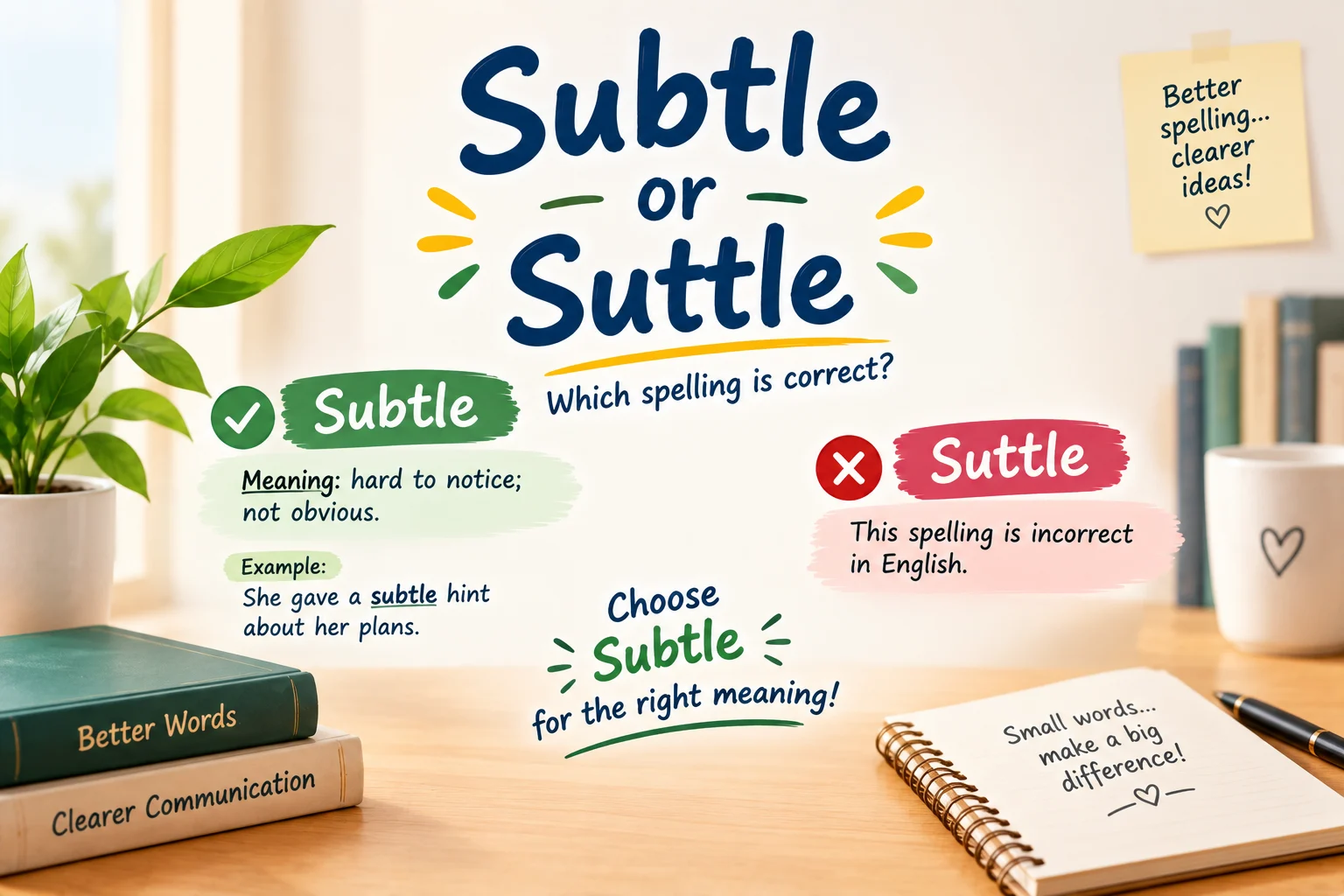
Subtle is the correct spelling. Suttle is not the standard spelling of the word when you mean something slight, delicate, or not easy to notice.
Have you ever written a word that looks perfectly normal, only to wonder later, “Wait, is that spelling right?” Subtle is one of those words. The silent b makes it even more confusing.
I have seen learners pause over this word many times. They often write suttle because that is close to how the word sounds. It feels natural. After all, we do not pronounce the b in subtle. So why should it be there?
That small silent letter causes a big spelling problem.
The answer is simple: subtle is the standard English spelling. It means something that is not obvious, strong, or easy to notice. You might talk about a subtle change, a subtle smell, or a subtle difference.
In this guide, you will learn why the b appears, what subtle means, how to use it, and why suttle is usually wrong. Once you see the pattern, you will not need to guess again.
subtle or suttle – Quick Answer
Subtle is the correct spelling in standard English.
The word subtle means not obvious, very slight, delicate, or difficult to notice.
For example:
There was a subtle change in her voice.
The painting uses subtle shades of blue.
Suttle is generally a misspelling when you are trying to write subtle.
How do you pronounce subtle?
This is where the confusion starts.
Subtle is pronounced roughly like:
SUT-ul
The b is silent.
You do not say “sub-tle.”
So remember:
Spelling: subtle
Pronunciation: sut-ul
Meaning: slight or not obvious
That silent b is the key detail.
The Origin and Background of subtle
The spelling of subtle comes from an interesting part of English history.
The word entered English through Old French, from a form related to the Latin word subtilis. It originally carried ideas such as fine, delicate, or refined.
Over time, the word developed several related meanings.
It could describe something:
- Fine or delicate
- Hard to understand
- Clever or indirect
- Difficult to detect
- Slight rather than obvious
The spelling changed as the word moved between languages.
Why is the “b” silent?
The b was added to the spelling because of the word’s Latin origin and later spelling changes.
English spelling often keeps letters that are no longer clearly heard in speech. Subtle is a good example.
Other English words also contain silent letters:
- debt — the b is silent
- doubt — the b is silent
- island — the s is silent
- knife — the k is silent
- listen — the t is silent
So the silent b in subtle is not a mistake. It is part of the standard spelling.
Why does “suttle” look correct?
If you hear the word before seeing it, suttle seems logical.
The pronunciation gives you almost no clue that a b belongs there.
That is why learners often spell it phonetically. But English spelling does not always match pronunciation.
The safest rule is:
Write subtle, even though you say “sut-ul.”
subtle or suttle Explained — Key Differences
The difference between the two forms is simple.
Subtle
Subtle is the standard English word.
It describes something that is:
- Slight
- Delicate
- Not obvious
- Hard to notice
- Indirect
- Clever or finely judged
Examples of subtle
She gave me a subtle smile.
The smile was small or hard to notice.
There is a subtle difference between the two designs.
The difference is small.
The room had a subtle floral scent.
The smell was light, not strong.
Suttle
Suttle is not the standard spelling for this meaning.
If you want to say that something is slight or difficult to notice, write subtle.
❌ The difference was very suttle.
✅ The difference was very subtle.
The wrong spelling often happens because the writer spells the word according to its pronunciation.
Comparison table
| Term | Meaning | When to Use | Region/Context |
|---|---|---|---|
| Subtle | Slight, delicate, or hard to notice | Standard English | All major varieties of English |
| Suttle | Not the standard spelling for this meaning | Avoid in normal writing | Usually a spelling error |
What Does Subtle Mean?
The meaning of subtle depends a little on context.
1. Not easy to notice
There was a subtle change in the weather.
The change was small.
2. Slight or delicate
The dish has a subtle lemon flavor.
The lemon flavor is present, but not strong.
3. Indirect
He gave her a subtle hint.
He did not say something directly.
4. Clever or carefully planned
The writer used a subtle joke.
The joke may not be obvious at first.
5. Hard to understand
The book makes some subtle points about human behavior.
The ideas require careful thought.
This makes subtle a useful word in many types of writing.
Which Version Should You Use?
The recommendation is direct:
For students → use subtle
Use subtle in essays, assignments, exams, and school work.
The author makes a subtle comparison between the two characters.
For professional writers → use subtle
It works well in reports, articles, emails, and business writing.
We noticed a subtle change in customer behavior.
For everyday English → use subtle
You can use it in normal conversation.
I noticed a subtle difference in the color.
For global English → use subtle
Subtle is the standard spelling in both American and British English.
There is no normal British-versus-American spelling difference here.
Use subtle. Avoid suttle.
Common Mistakes with subtle or suttle
Mistake 1: Writing the word as it sounds
❌ The change was suttle.
✅ The change was subtle.
The mistake happens because the b is silent.
Mistake 2: Pronouncing the b
❌ “SUB-tle”
✅ “SUT-ul”
Do not pronounce the b in standard English pronunciation.
Mistake 3: Adding an extra syllable
Some learners try to pronounce every letter.
The word does not sound like:
sub-tul
It sounds closer to:
sut-ul
Mistake 4: Confusing subtle with similar words
Subtle is not the same as:
- small
- weak
- secret
- simple
- hidden
These words can overlap in some situations, but subtle often suggests something that is not obvious or is presented in a delicate way.
For example:
She gave me a subtle hint.
This does not mean the hint was necessarily secret. It means she did not make it very direct.
Mistake 5: Using “subtle” for everything
Although subtle is useful, it should not replace every word meaning “small.”
Compare:
There was a small crack in the wall.
This is not always a subtle crack. The focus is on size.
But:
There was a subtle change in his expression.
Here, the focus is on how difficult the change was to notice.
subtle or suttle in Real-World Examples
Professional email
We noticed a subtle improvement in customer response after the update.
Here, subtle means the improvement was small but noticeable with careful review.
News article
Experts Point to Subtle Changes in Consumer Behavior
The word works well because the changes are not dramatic or obvious.
Social media post
Sometimes a subtle change in your routine can make a big difference.
This sounds natural and conversational.
Formal report
The survey showed a subtle shift in customer preferences during the second quarter.
The change was not large, but the data showed a shift.
Everyday conversation
I noticed a subtle difference in the taste.
The difference is small and not strong.
Related Words You Should Know
Learning related words can help you use subtle with more confidence.
Subtly
Subtly is the adverb form.
She subtly changed the subject.
It means she changed it in a way that was not obvious.
Subtlety
Subtlety is the noun form.
The painting is full of subtlety.
It describes the quality of being subtle.
Subtler
Subtler is the comparative form.
The second design has a subtler pattern.
Subtlest
Subtlest is the superlative form.
That was the subtlest detail in the painting.
Notice something important: the spelling keeps the b.
- subtle
- subtly
- subtlety
- subtler
- subtlest
subtle or suttle — Data, Trends & Usage
The main search intent behind “subtle or suttle” is spelling clarification.
People often search this pair because the pronunciation creates uncertainty. The word sounds like it begins with sut-, so suttle can seem reasonable.
But standard English uses subtle.
The word is common in many areas, including:
- Education
- Business
- Psychology
- Art
- Literature
- Food writing
- Marketing
- News
- Everyday conversation
It is especially useful when describing small differences, quiet signals, delicate flavors, indirect messages, and changes that are easy to miss.
Why this matters for writers
A spelling mistake can make otherwise strong writing look less polished.
Using subtle correctly is easy once you remember one fact:
The b is silent, but it still belongs in the spelling.
That is the part worth memorizing.
Standalone Comparison Table
| Term/Variant | Meaning | Region/Context | Best Used When |
|---|---|---|---|
| Subtle | Slight or difficult to notice | Standard English | Describing small or indirect things |
| Suttle | Usually a misspelling of subtle | Nonstandard | Avoid in normal English |
| Subtly | In a subtle way | Standard English | Describing an indirect action |
| Subtlety | The quality of being subtle | Standard English | Discussing delicate details |
| Subtler | More subtle | Standard English | Comparing two things |
| Subtlest | Most subtle | Standard English | Comparing three or more things |
FAQs About subtle or suttle
Q: Which is correct, subtle or suttle?
A: Subtle is the correct standard spelling. Suttle is normally a spelling mistake when you mean something slight or difficult to notice.
Q: What does subtle mean?
A: Subtle means slight, delicate, indirect, or difficult to notice. For example, “There was a subtle change in her voice.”
Q: Is the b silent in subtle?
A: Yes. The b is silent. The word is pronounced roughly like “sut-ul,” not “sub-tul.”
Q: Is suttle an English word?
A: Suttle is not the standard spelling of the common word meaning slight or hard to notice. In normal English writing, use subtle.
Q: Is subtle used in formal writing?
A: Yes. Subtle is fully acceptable in formal writing. It is common in academic papers, reports, articles, business writing, and professional communication.
Q: What is the difference between subtle and obvious?
A: Subtle describes something that is not easy to notice or understand. Obvious describes something that is easy to notice or understand.
Q: What is the noun form of subtle?
A: The noun is subtlety. For example, “The artist used great subtlety in the painting.”
Q: What is the adverb form of subtle?
A: The adverb is subtly. For example, “She subtly changed the topic.”
Q: Is subtle spelled the same in British and American English?
A: Yes. Subtle has the same spelling in both British and American English.
Q: Why is there a b in subtle?
A: The spelling reflects the word’s history and connection to Latin and French forms. The b is no longer pronounced, but it remains part of the standard spelling.
Conclusion
The choice between subtle or suttle is simple: subtle is correct when you mean something slight, delicate, indirect, or difficult to notice.
The word can describe a subtle change, a subtle smell, a subtle hint, or a subtle difference. It is common in both everyday and formal English.
The main reason people make this mistake is pronunciation. The b is silent, so the word sounds like “sut-ul.” That can make suttle look like the natural spelling.
Do not let the sound fool you.
Remember this easy rule:
Write “subtle.” Say “sut-ul.”
The same spelling works in British and American English. Once you remember the silent b, this spelling becomes much easier.
Bookmark this guide so you never second-guess “subtle” again, and use the correct spelling confidently in your next piece of writing.