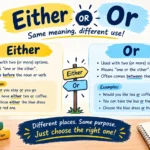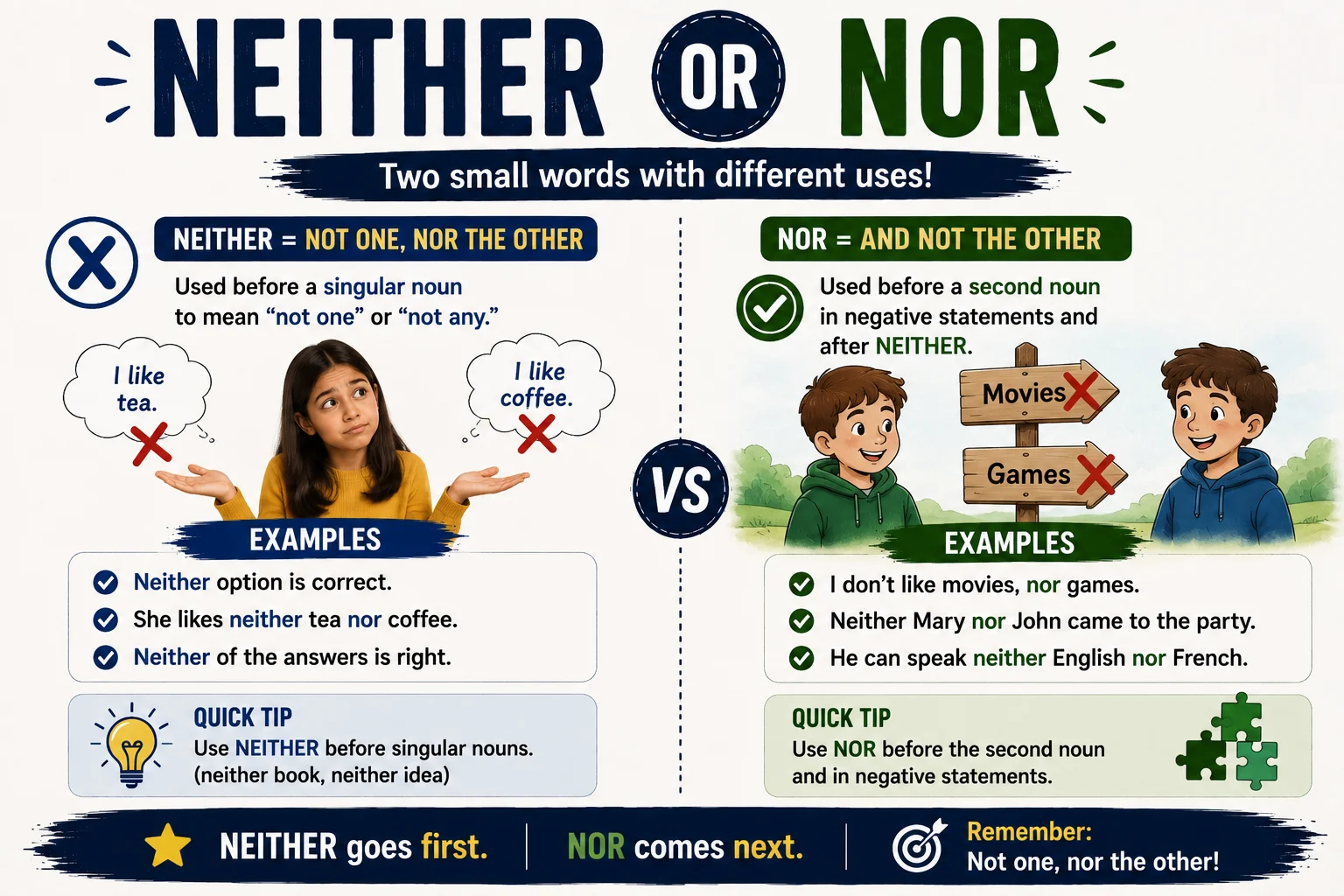
Neither means “not one and not the other,” and it is usually used with nor, not or, when rejecting two choices. The common structure is neither…nor.
Have you ever written a sentence like “I like neither tea or coffee” and wondered if it sounds right? This tiny grammar choice causes a surprising amount of confusion. The problem usually comes from the fact that either commonly goes with or, while neither commonly goes with nor.
I have seen this mistake often in student writing, emails, and everyday conversation. It is easy to understand why. The words either, neither, or, and nor all work with choices. Their meanings are closely connected, but their sentence patterns are not always the same.
The good news is that the basic rule is simple.
Use either…or when you mean one choice or the other. Use neither…nor when you mean not one and not the other.
For example, you can say:
I want either tea or coffee.
But if you want neither choice:
I want neither tea nor coffee.
Once you see the pattern, neither or becomes much easier to handle.
Neither or – Quick Answer
The standard paired structure is:
neither…nor
It means not one and not the other.
For example:
I like neither tea nor coffee.
This means I do not like tea, and I do not like coffee.
The opposite structure is:
either…or
For example:
You can choose either tea or coffee.
This means one of the two choices is available.
So, when you are deciding between neither or and neither nor, remember:
Neither normally pairs with nor.
Quick Examples
Correct:
She speaks neither French nor Spanish.
Incorrect in standard paired construction:
She speaks neither French or Spanish.
Another example:
He is neither angry nor upset.
The meaning is that he is not angry and not upset.
The Origin / Background of Neither or
The word neither has a long history in English.
It developed from older forms meaning “not either” or “not one of two.” The word is closely related to either, which comes from an old Germanic language family.
The connection makes sense:
- either = one or the other
- neither = not one or the other
The word nor is also an old English conjunction. It is traditionally used to connect negative alternatives.
This gives us the familiar pair:
neither…nor
English has used this pattern for centuries.
The confusion comes partly from the fact that modern English is flexible. In everyday speech, people sometimes use structures that do not follow the traditional paired pattern. You may hear neither…or in casual conversation or informal writing.
However, if you want clear, standard English, neither…nor is the safest choice.
Why Does “Neither or” Cause Confusion?
The main reason is probably the familiar pair:
either…or
English learners often remember the pattern and then transfer it to neither.
That creates:
neither…or
But neither traditionally pairs with nor.
Think of the two pairs as opposites:
| Positive Choice | Negative Choice |
|---|---|
| either…or | neither…nor |
This simple comparison solves much of the confusion.
Neither or Explained — Key Differences and Variations
Neither…Nor
Use neither…nor when both choices are rejected.
Example:
I want neither pizza nor pasta.
Meaning:
I do not want pizza, and I do not want pasta.
Another example:
Neither John nor Sarah attended the meeting.
This means John did not attend, and Sarah did not attend.
Either…Or
Use either…or when there are two possible choices.
Example:
You can either call me or send me a message.
This gives two options.
Another example:
We can meet either Monday or Tuesday.
The speaker is presenting alternatives.
Neither…Or
In careful standard English, neither…or is generally avoided as the paired structure.
Instead, write:
Neither Ali nor Ahmed came.
rather than:
Neither Ali or Ahmed came.
However, or can appear later in a sentence with neither when it is not functioning as the paired conjunction.
For example:
Neither answer is correct, so we need another option.
The important point is not that the word or can never appear anywhere near neither. The key issue is the paired construction.
Comparison Table
| Term | Meaning | When to Use | Region/Context |
|---|---|---|---|
| Neither…nor | Not one and not the other | Rejecting two choices | Standard English |
| Either…or | One choice or the other | Giving two alternatives | Standard English |
| Neither | Not either one | Talking about two choices | Standard English |
| Nor | Negative alternative | Connecting negative choices | Formal and standard English |
| Or | Alternative or choice | Offering options | All English varieties |
Neither vs Either: What Is the Difference?
This is one of the most useful comparisons to learn.
Either
Either is often used when one of two choices is possible.
You can choose either option.
It can also appear in the pair:
either…or
Example:
We can either stay home or go out.
Neither
Neither means not one and not the other.
Neither option is suitable.
It commonly appears in:
neither…nor
Example:
We can neither stay home nor go out.
The meanings are almost opposites.
Either opens a choice.
Neither rejects both choices.
Which Version or Approach Should You Use?
Your best choice depends on what you want to say.
For Students
Use neither…nor when you want to reject both choices.
Neither answer is correct.
Neither Tom nor James was present.
This structure is safe for schoolwork and exams.
For Professional Writing
Use neither…nor for clear, formal writing.
The company will accept neither cash nor personal checks.
This sounds precise and professional.
For Academic Writing
The same rule applies.
The study found that neither group showed significant improvement.
If you connect two negative choices, use nor:
The results were neither clear nor reliable.
For Casual Conversation
Native speakers sometimes use less formal constructions. You may hear variations that do not follow the traditional neither…nor pattern.
Still, if you are learning English or want to avoid mistakes, stick with:
neither…nor
It is clear and widely accepted.
For Global or Neutral English
Use neither…nor.
It works well across British and American English and is easy for international readers to understand.
Common Mistakes with Neither or
1. Using “Neither…Or”
Mistake:
I like neither tea or coffee.
Correction:
I like neither tea nor coffee.
Why?
The standard paired structure is neither…nor.
2. Confusing “Either…Or” With “Neither…Nor”
Mistake:
You can neither choose tea or coffee.
Correction:
You can either choose tea or coffee.
If you are offering two choices, use either…or.
If you reject both choices, use neither…nor.
3. Using a Double Negative
Mistake:
I don’t like neither tea nor coffee.
Better:
I like neither tea nor coffee.
Or:
I don’t like either tea or coffee.
The first sentence uses neither…nor to express the negative idea once.
The second uses not…either.
Avoid adding unnecessary negatives.
4. Mixing the Structures
Mistake:
Neither John or Sarah came.
Correction:
Neither John nor Sarah came.
The word after neither should be connected with nor in the standard paired construction.
5. Forgetting Parallel Structure
Mistake:
She likes neither swimming nor to run.
Better:
She likes neither swimming nor running.
Both parts should normally have the same grammatical form.
This is called parallel structure.
Compare:
neither swimming nor running
Both are -ing forms.
That makes the sentence balanced and easy to read.
Neither or in Real-World Examples
Professional Email
Subject: Meeting Options
Unfortunately, neither Monday nor Tuesday works for our team. Could we arrange the meeting for Wednesday instead?
This sounds natural and professional.
News Headline
Neither Team Nor Coach Comments on Final Decision
The headline clearly tells readers that both sides have chosen not to comment.
Social Media Post
I tried both restaurants, but neither the food nor the service impressed me.
This is an everyday use of neither…nor.
Formal Report
The review found that neither the current system nor the proposed system met all required standards.
This structure works well in reports because it is direct and precise.
Everyday Conversation
Neither option sounds good to me.
I want neither pizza nor burgers tonight.
These sentences sound natural in normal conversation.
Neither…Nor With Singular and Plural Subjects
This is another area that can confuse learners.
Consider:
Neither John nor Sarah is available.
Both subjects are singular, so is is natural.
Now consider:
Neither the teachers nor the students are ready.
The second subject, students, is plural.
In many constructions, the verb agrees with the subject closest to it.
For example:
Neither the manager nor the employees are responsible.
But:
Neither the employees nor the manager is responsible.
This can sound formal or awkward to some readers. In complex sentences, you can often avoid the issue by rewriting.
For example:
The manager and the employees are not responsible.
Clear writing is often better than forcing a complicated structure.
Neither or — Data, Trends & Usage
People who search for neither or are usually trying to solve a grammar or usage problem.
The search intent is strongly informational.
Common questions include:
- Should I say neither or or neither nor?
- Is neither or grammatically correct?
- What comes after neither?
- Does neither always go with nor?
- What is the difference between either or and neither nor?
These questions are common because English uses several related words for choices and negatives.
The most useful pattern to remember is:
Either…or = choice
Neither…nor = rejection of both choices
This matters in school writing, professional communication, and everyday English because a small conjunction can change the structure and meaning of a sentence.
For learners, memorizing the two patterns together is more effective than learning neither alone.
Neither or: Standalone Comparison Table
| Term/Variant | Meaning | Region/Context | Best Used When |
|---|---|---|---|
| Neither…nor | Not one and not the other | Standard English | Rejecting two choices |
| Either…or | One choice or the other | Standard English | Presenting two choices |
| Neither | Not either one | Standard English | Referring to two rejected options |
| Nor | And not; negative alternative | Formal and standard English | Following neither or another negative idea |
| Either | One of two choices | Standard English | Presenting alternatives |
An Easy Memory Trick for Neither or
You do not need to memorize a long grammar rule.
Just remember:
Either Chooses
Either A or B
Example:
I will choose either tea or coffee.
One option is selected.
Neither Rejects
Neither A nor B
Example:
I want neither tea nor coffee.
Both options are rejected.
A simple memory sentence is:
Either goes with or. Neither goes with nor.
This is not the only way these words can appear in English, but it is an excellent rule for the common paired structures.
FAQ: Neither or
Q: Should I use neither or nor?
A: In the standard paired structure, use neither…nor. For example, say I like neither tea nor coffee, not I like neither tea or coffee.
Q: What does neither mean?
A: Neither means not one and not the other when talking about two people or things. For example, Neither answer is correct means both answers are incorrect.
Q: What is the difference between either and neither?
A: Either presents one of two choices, while neither rejects both choices. Compare either A or B with neither A nor B.
Q: Is “neither or” grammatically correct?
A: Neither…or is generally not the standard paired construction. In careful writing, use neither…nor instead.
Q: Is neither nor formal English?
A: Yes. Neither…nor is standard English and works well in formal, academic, professional, and everyday writing.
Q: Can neither be used without nor?
A: Yes. Neither can stand alone when the meaning is clear. For example, Neither answer is correct. The word nor is mainly needed when connecting two negative alternatives.
Q: Can I use neither with more than two choices?
A: Traditionally, neither refers to two choices or people. If you are rejecting three or more items, none is usually more suitable. For example, None of the three answers is correct.
Conclusion
The difference between neither or and neither nor is much easier once you understand the pattern.
The standard paired form is neither…nor. Use it when you mean not one and not the other.
For example:
Neither Ali nor Sara attended the meeting.
This means Ali did not attend, and Sara did not attend.
On the other hand, use either…or when you are presenting a choice:
Either Ali or Sara will attend the meeting.
The easiest rule to remember is:
Either goes with or. Neither goes with nor.
Also watch for double negatives. Instead of I don’t like neither option, write I like neither option or I don’t like either option.
For students, professionals, and English learners, neither…nor is the safest choice in careful writing. It is clear, correct, and widely understood.
Now you know exactly how to use neither or. Bookmark this guide so you never second-guess neither…nor again.