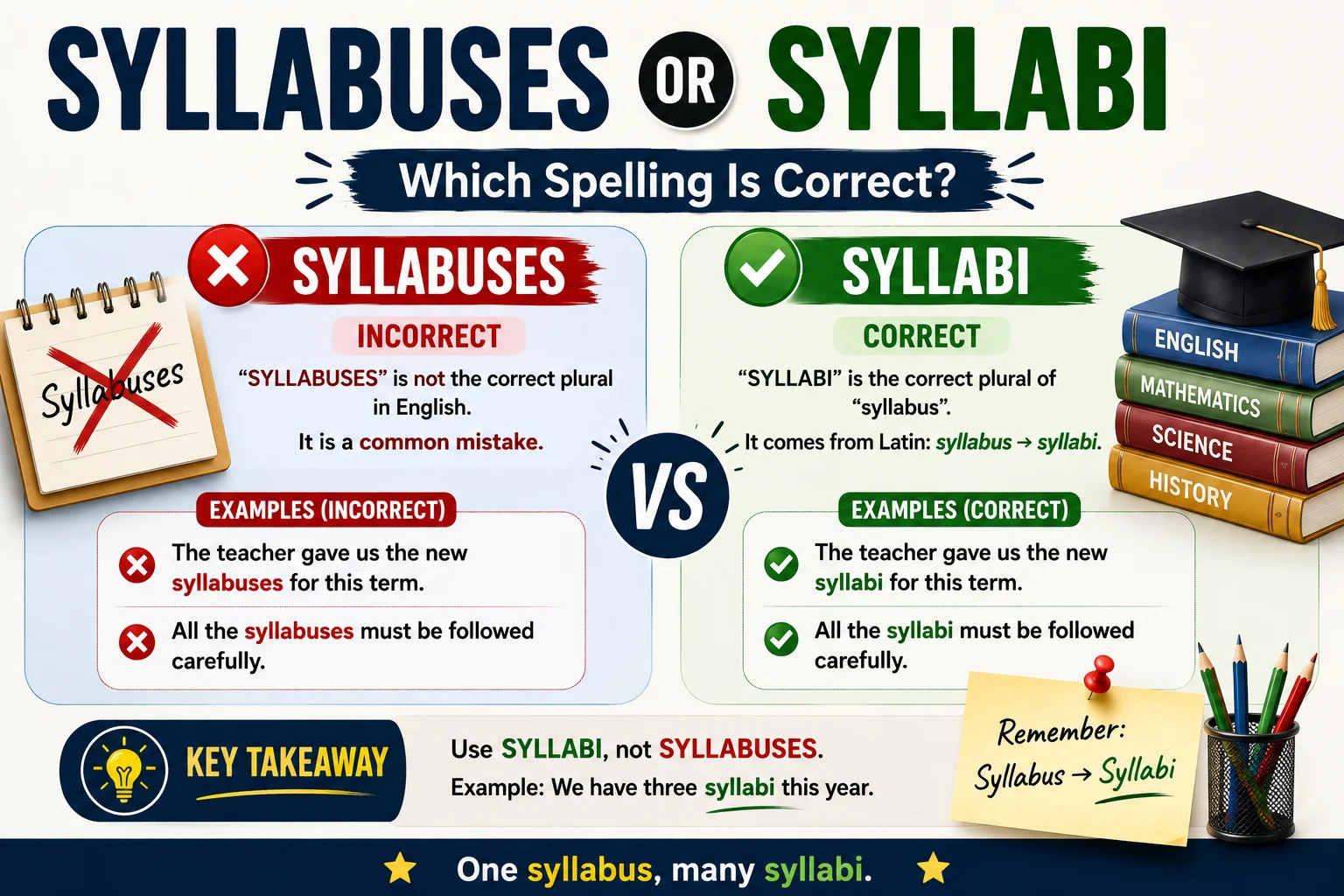
Syllabuses and syllabi are both correct plural forms of syllabus. Syllabi is the traditional Latin-based plural, while syllabuses is a regular English plural and is often clearer for beginners.
Have you ever typed “syllabuses” and then stopped to wonder if “syllabi” would be better? You are not alone. I have seen this small plural-form question cause confusion in student essays, school documents, and even professional writing.
The reason is simple. Syllabus comes from a Latin-based tradition, so English has more than one way to make it plural. One form follows the older pattern: syllabi. The other follows a normal English rule: syllabuses.
Both forms are accepted. The real question is not simply, “Which one is correct?” It is, “Which one sounds natural and fits my audience?”
In this guide, we will break down syllabuses or syllabi, explain their history, show real examples, and help you choose the right form. You will also learn why syllabi may sound more formal while syllabuses can be easier to understand.
Let’s settle the confusion once and for all.
Syllabuses or Syllabi – Quick Answer
Both syllabuses and syllabi are correct plural forms of syllabus.
- Syllabus = singular
- Syllabi = plural
- Syllabuses = plural
For example:
- Singular: The teacher gave us a new syllabus.
- Plural: The teacher gave us several syllabi.
- Plural: The teacher gave us several syllabuses.
The meaning does not change.
Syllabi comes from the traditional plural pattern associated with Latin words. Syllabuses treats syllabus as an English word and adds the usual -es ending.
Which is more common?
You will see syllabi often in academic settings.
However, syllabuses is also standard English. It can be especially useful when you want your writing to be simple and clear.
The Origin and Background of Syllabuses or Syllabi
The word syllabus has an interesting history.
It refers to an outline of a course. A syllabus usually tells students what they will study, when they will study it, and what work they must complete.
The plural question exists because syllabus looks like many words that came into English from Latin.
For a long time, English writers often used Latin-style plural forms for words borrowed from Latin or Greek.
That is why you may see forms such as:
- syllabus → syllabi
- alumnus → alumni
- cactus → cacti
- stimulus → stimuli
But English does not always keep older foreign plural rules.
Over time, many borrowed words became fully naturalized in English. Speakers then began adding normal English endings.
That gives us:
syllabus → syllabuses
So the two forms developed from two different approaches to English plurals.
Why does “syllabi” sound more formal?
The ending -i has a strong academic feel.
Words such as alumni, stimuli, and syllabi are common in education and formal writing. As a result, syllabi may sound more traditional or scholarly.
That does not make syllabuses wrong.
It simply reflects a different plural pattern.
Syllabuses or Syllabi Explained — Key Differences
The most important point is this:
There is no major difference in meaning between syllabuses and syllabi.
Both refer to more than one syllabus.
The main difference is form and style.
| Term | Meaning | When to Use | Region/Context |
|---|---|---|---|
| Syllabus | One course outline | When referring to one course | All English varieties |
| Syllabi | More than one syllabus | Academic or traditional writing | Common in academic English |
| Syllabuses | More than one syllabus | Clear, general English | Used across English varieties |
Example with “syllabi”
The university published the syllabi for all first-year courses.
Here, the writer is talking about several course outlines.
Example with “syllabuses”
The department reviewed the syllabuses before the new semester began.
Again, the writer means several course outlines.
The meaning is the same.
Syllabi can sound more academic
A university professor might naturally write:
“Students should read the course syllabi carefully.”
That sounds polished and academic.
Syllabuses can sound more direct
A school website might say:
“You can download the course syllabuses below.”
This is also correct. The regular -es ending is easy for most readers to understand.
Which Version Should You Use?
Choosing between syllabuses or syllabi depends mainly on your audience and writing style.
For academic writing
Use syllabi if it fits the style of your institution.
For example:
The department updated the syllabi for all undergraduate courses.
This sounds natural in university settings.
For students and beginners
Syllabuses can be a good choice because it follows a familiar English plural pattern.
For example:
The teacher shared the syllabuses for the new classes.
There is nothing incorrect about this sentence.
For formal documents
Either form can work.
The best choice is often the one used by your school, university, company, or publication.
Consistency matters more than choosing the “fancier” form.
If your document uses syllabi, keep using it throughout. If it uses syllabuses, do not switch between the two without a reason.
For global or general English
Syllabuses is a safe and clear choice.
It follows a standard English plural pattern and avoids the need for readers to know a traditional Latin-style plural.
Common Mistakes with Syllabuses or Syllabi
The plural forms are easy to confuse. Here are some common mistakes.
1. Using “syllabi” as a singular noun
❌ The professor gave us a new syllabi.
✅ The professor gave us a new syllabus.
Syllabi is plural. Use syllabus for one course outline.
2. Writing “syllabuses” as if it were wrong
❌ “Syllabuses is an incorrect plural.”
✅ “Syllabuses is a correct plural form.”
Many people think the only correct plural is syllabi.
That is not true.
Syllabuses is also accepted English.
3. Using “syllabii”
❌ The university published several syllabii.
✅ The university published several syllabi.
There is only one i after the b in syllabi.
4. Adding an apostrophe
❌ The syllabus’s were updated.
✅ The syllabi were updated.
Or:
✅ The syllabuses were updated.
An apostrophe does not make a noun plural.
5. Mixing both forms without a reason
❌ “The department reviewed the syllabi and later updated the syllabuses.”
This is not grammatically impossible, but it may look inconsistent if both words refer to the same type of document.
Choose one form and stick with it.
Syllabuses or Syllabi in Real-World Examples
Knowing the rule is useful. Seeing the words in context is even better.
1. Professional email
Subject: Updated Course Syllabi
Dear Students,
Please review the updated syllabi before the start of the semester. The changes include new reading materials and assessment dates.
Here, syllabi works well because the email has an academic tone.
2. News article
Universities Update Course Syllabi for the New Academic Year
The headline uses syllabi because it is common in academic and educational reporting.
3. Social media post
“Our new course syllabi are now available! Check the student portal for reading lists, deadlines, and assessment details.”
This sounds natural in a university social media post.
You could also write:
“Our new course syllabuses are now available!”
That is grammatically correct too.
4. Formal report
“The committee reviewed the syllabuses of all introductory courses and recommended several changes.”
Here, syllabuses is completely acceptable.
It may even be clearer to readers who are not familiar with traditional academic plurals.
5. Everyday conversation
“Have you seen the syllabi for next semester?”
Or:
“Have you seen the syllabuses for next semester?”
Both sentences work.
Your choice can depend on the language style used by your school or university.
Syllabuses or Syllabi — Data, Trends & Usage
People who search for “syllabuses or syllabi” are usually looking for a spelling or grammar answer.
The search intent is mainly informational.
They want to know:
- Which plural is correct?
- Is syllabi the only correct form?
- Is syllabuses acceptable?
- Which form sounds more formal?
- What should I use in an essay or academic paper?
This confusion is likely to appear most often among students, teachers, editors, and academic writers.
The issue also matters because English has many borrowed words with competing plural forms.
Think about these pairs:
- cactus → cacti / cactuses
- focus → foci / focuses
- formula → formulae / formulas
- syllabus → syllabi / syllabuses
English often allows both traditional and regular English plurals.
Why this matters for your writing
Using syllabi does not automatically make your writing better.
Likewise, using syllabuses does not make your writing less correct.
The better choice is the one that matches your audience, context, and style guide.
For a general audience, clarity should come first.
For a university audience, syllabi may sound more familiar.
Standalone Comparison: Syllabuses vs Syllabi
| Term/Variant | Meaning | Region/Context | Best Used When |
|---|---|---|---|
| Syllabus | One course outline | All English varieties | Referring to one course |
| Syllabi | More than one syllabus | Academic and traditional contexts | Formal or academic writing |
| Syllabuses | More than one syllabus | General English | Clear, straightforward writing |
The key takeaway is simple:
Syllabi and syllabuses have the same basic meaning.
The choice is mainly about style and audience.
Frequently Asked Questions About Syllabuses or Syllabi
Q: What does syllabus mean?
A: A syllabus is an outline or plan for a course. It usually lists topics, readings, assignments, exams, deadlines, and course rules.
Q: Is syllabi the plural of syllabus?
A: Yes. Syllabi is a traditional plural of syllabus. It is widely used, especially in academic English.
Q: Is syllabuses also correct?
A: Yes. Syllabuses is also a correct plural form. It uses the regular English plural ending -es.
Q: Which is better, syllabuses or syllabi?
A: Neither is always better. Syllabi often sounds more academic or traditional, while syllabuses is more regular and can be easier for general readers.
Q: Is syllabi acceptable in formal writing?
A: Yes. Syllabi is widely accepted in formal and academic writing. It is especially common when discussing university or college courses.
Q: Where does the word syllabus come from?
A: Syllabus entered English through Latin and has a long history connected with the idea of a list or outline. Its history helped produce the traditional plural syllabi.
Q: Can I use syllabuses in an academic paper?
A: Yes. Syllabuses is grammatically correct and can be used in academic writing. However, check your institution’s style guide if it has a preferred form.
Q: Is “syllabii” correct?
A: No. Syllabii is not the standard plural. Use syllabi or syllabuses.
Q: What is the singular of syllabi?
A: The singular is syllabus. For example, “I read one syllabus” but “I read three syllabi.”
Q: Should I use syllabi or syllabuses in American English?
A: Both can be used in American English. Syllabi is very common in academic settings, while syllabuses is also correct.
Final Verdict: Syllabuses or Syllabi?
The debate over syllabuses or syllabi is easier than it first appears.
Both are correct.
Syllabi is the traditional plural and is especially common in academic settings. It can sound formal, familiar, and scholarly.
Syllabuses is the regular English plural. It is clear, simple, and fully acceptable.
The best choice depends on your audience.
If you are writing for a university audience, syllabi is a natural choice. If you are writing for a broad audience or want the most straightforward English, syllabuses works well.
Most importantly, do not assume that one is correct and the other is wrong. They are simply two accepted plural forms of the same noun.
Remember the basic pattern:
One syllabus → two syllabi → two syllabuses.
Once you know that, you never need to second-guess this word again. Bookmark this guide and share it with someone who is still confused about syllabuses or syllabi.