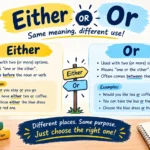
Neither means “not one and not the other” when talking about two choices. Or is often used with neither in the pattern “neither … nor,” not “neither … or.”
Have you ever written a sentence like, “I like neither tea or coffee,” and wondered if it sounds right? This is a very common English mistake. The words are simple, but their grammar can be tricky.
I have seen learners make this mistake in school essays, emails, exams, and everyday messages. The problem often comes from translating sentence patterns from another language. You may know that neither means “not either,” but you may not know which word should follow it.
The good news is that the main rule is easy.
When neither introduces two choices, standard English normally uses nor for the second choice:
I like neither tea nor coffee.
But or is not always wrong. It can appear in sentences with neither when the grammar has a different structure.
This guide explains neither or, neither nor, their meanings, correct sentence patterns, common mistakes, and real-life examples. Once you understand the pattern, you will stop guessing and start choosing the right form with confidence.
neither or – Quick Answer
The standard pair is:
Neither … nor
Use it when you mean not one and not the other.
I want neither tea nor coffee.
This means I do not want tea, and I do not want coffee.
Another example:
Neither Ali nor Sara came to the meeting.
This means Ali did not come, and Sara did not come.
Is “neither … or” correct?
In standard English, neither … or is usually considered incorrect when you are pairing two choices.
❌ I want neither tea or coffee.
✅ I want neither tea nor coffee.
The word or normally pairs with either, not neither.
Either tea or coffee.
Neither tea nor coffee.
That simple pair is one of the best rules to remember.
The Origin and Background of Neither
The word neither has a long history in English.
It comes from older English forms related to the idea of “not either.” The word developed from earlier forms of not and either.
The basic idea has stayed almost the same.
Neither refers to two things and rejects both of them.
For example:
Neither answer is correct.
There are two answers, and both are rejected.
The word nor has also been used in English for centuries. It developed as a negative coordinating word and became closely connected with neither.
That is why English developed the familiar structure:
neither … nor
The pair is so common that many learners now learn it as a fixed grammar pattern.
Why does “neither or” cause confusion?
The confusion usually comes from either … or.
You may already know this structure:
You can choose either tea or coffee.
Because either and or work together, it can feel natural to replace either with neither.
But English changes the second word too:
Either … or
becomes:
Neither … nor
Think of them as two matching pairs.
neither or Explained — Key Differences and Variations
The key difference is the meaning of either and neither.
Either … or
Use either … or when you are giving two choices.
You can have either tea or coffee.
The person can choose one option.
Neither … nor
Use neither … nor when both choices are rejected.
I want neither tea nor coffee.
The person wants neither option.
Either vs. neither
| Term | Meaning | When to Use | Region/Context |
|---|---|---|---|
| Either … or | One of two choices | Giving alternatives | Standard English |
| Neither … nor | Not one and not the other | Rejecting two choices | Standard English |
| Neither | Not either one | Referring to two things | Standard English |
| Nor | Negative alternative | Pairing with neither | Standard English |
| Or | Alternative or choice | Usually paired with either | Standard English |
Example with either
Either John or Mike will call you.
One of them will call.
Example with neither
Neither John nor Mike will call you.
Neither person will call.
The meaning changes completely.
How to Use Neither Correctly
There are several common ways to use neither.
1. Neither + noun
Neither answer is correct.
Here, neither means not one answer and not the other.
Neither option works for me.
Both options are rejected.
2. Neither … nor
This is the most important structure for the neither or question.
She likes neither cats nor dogs.
He speaks neither French nor Spanish.
We visited neither London nor Paris.
The two parts should normally have matching grammar.
3. Neither as a pronoun
You can use neither without repeating the noun.
Which shirt do you want?
Neither.
This means you do not want either shirt.
Another example:
Which answer is correct?
Neither is correct.
Neither … Nor vs. Either … Or
This is the comparison most learners need.
Either … or = choice
You can take either the bus or the train.
There are two choices.
Neither … nor = no choice
You can take neither the bus nor the train.
Both choices are rejected.
Compare:
Either Ahmed or Bilal will attend.
One of them is expected to attend.
Neither Ahmed nor Bilal will attend.
Both are not expected to attend.
The pattern is easy to remember:
Either → or
Neither → nor
Which Version Should You Use?
Your choice depends on what you want to say.
For students → use “neither … nor”
If you are writing an essay, exam answer, or school assignment, use the standard form:
Neither option is suitable.
Neither Ali nor Hamza answered the question.
Avoid neither … or when pairing two alternatives.
For professional writing → use “neither … nor”
Formal writing benefits from clear grammar.
The company accepted neither proposal nor requested a new one.
A clearer version may be:
The company accepted neither proposal nor the revised plan.
Use balanced sentence structures to make your meaning easy to follow.
For everyday conversation → use either pattern correctly
In normal speech, you will often hear:
Neither one.
Neither of them.
Neither John nor Mary.
These are natural and common.
For global English → choose the standard pair
If English is not your first language, the safest rule is:
Neither … nor
This form is understood across British, American, Canadian, Australian, and other standard English contexts.
Common Mistakes with Neither or
Mistake 1: Using “neither … or”
❌ I like neither tea or coffee.
✅ I like neither tea nor coffee.
Why? The standard negative pair is neither … nor.
Mistake 2: Mixing either and nor
❌ You can choose either tea nor coffee.
✅ You can choose either tea or coffee.
Why? The positive choice pattern is either … or.
Mistake 3: Using neither for more than two choices
Traditional grammar uses neither for two people or things.
Neither John nor David came.
If you are rejecting three or more items, none is usually better.
None of the three answers was correct.
Mistake 4: Creating a double negative
❌ I don’t like neither option.
✅ I like neither option.
Or:
✅ I don’t like either option.
Using don’t and neither together can create a nonstandard double negative.
Mistake 5: Forgetting subject agreement
Look at this sentence:
Neither the teacher nor the students were ready.
With neither … nor, verb agreement can depend on the nouns near the verb. In many modern styles, the verb agrees with the closer subject.
Neither the students nor the teacher was ready.
For formal writing, you can often avoid awkward agreement by rewriting the sentence.
The teacher and the students were not ready.
Neither or in Real-World Examples
1. Professional email
Thank you for the two proposals. Neither proposal meets our current requirements, so we would like to discuss another option.
This sounds clear and professional.
Another example:
Neither the manager nor the assistant was available for the call.
2. News headline or article
Neither Team Can Secure a Place in the Final
Here, neither rejects both teams.
A longer news sentence could say:
Neither the government nor opposition leaders supported the proposal.
3. Social media post
I tried both restaurants, but neither one impressed me.
This is natural everyday English.
Another example:
Neither coffee nor tea can fix this Monday mood!
4. Formal report
Neither method produced reliable results during the test.
This sentence rejects both methods.
You could also write:
Neither Method A nor Method B produced reliable results.
Common Expressions with Neither
Learning common phrases can make the word easier to use.
Neither of
Use neither of before a plural noun or pronoun.
Neither of them knows the answer.
Neither of the options is suitable.
Neither of my friends came.
Me neither
In informal conversation, me neither means “I do not either.”
“I don’t like spicy food.”
“Me neither.”
This is very common in casual speech.
Neither do I
You can also use neither do I.
“I don’t like spicy food.”
“Neither do I.”
This is a more complete grammatical structure.
The helping verb can change:
“I don’t understand.”
“Neither do I.”
“I didn’t see him.”
“Neither did I.”
Neither or — Data, Trends & Usage
The search intent behind “neither or” is mainly informational and grammar clarification.
People usually search this phrase because they are unsure whether the correct construction is:
neither … or
or:
neither … nor
This question is especially common among:
- English learners
- Students
- ESL writers
- Bloggers
- Content writers
- People checking formal emails
- People preparing for English tests
The confusion matters because either/or and neither/nor look almost identical. The first expresses a choice. The second rejects both choices.
A useful learning strategy is to memorize the pairs instead of memorizing each word separately:
Either → or
Neither → nor
This gives you a quick grammar check when writing.
If you see neither, your brain should immediately look for nor when two alternatives are being connected.
Standalone Comparison Table
| Term/Variant | Meaning | Region/Context | Best Used When |
|---|---|---|---|
| Neither … nor | Not one and not the other | Standard English | Rejecting two choices |
| Either … or | One choice or the other | Standard English | Offering two choices |
| Neither | Not either | Standard English | Referring to two things |
| Nor | Negative alternative | Standard English | Following neither |
| Either | One of two possibilities | Standard English | Following a positive choice |
| Neither of | Not one of two | Standard English | Talking about two people or things |
| Me neither | I do not either | Informal English | Agreeing with a negative statement |
| Neither do I | I also do not | Standard English | Agreeing with a negative statement |
FAQs About Neither or
Q: Is “neither or” correct?
A: Usually, no. When you connect two alternatives with neither, the standard form is neither … nor.
Q: Which is correct: neither or nor?
A: The correct pair is normally neither … nor. For example, “I like neither tea nor coffee.”
Q: What does neither mean?
A: Neither means not one and not the other when referring to two people or things. For example, “Neither answer is correct.”
Q: What is the difference between either or and neither nor?
A: Either … or gives two choices. Neither … nor rejects both choices.
Q: Can I use neither in formal writing?
A: Yes. Neither is completely acceptable in formal writing. It is common in essays, reports, business documents, and academic writing.
Q: Can neither be used without nor?
A: Yes. You can say, “Neither is correct” or “Neither of them came.” However, when connecting two alternatives, neither … nor is the standard pattern.
Q: Can I say “neither of them”?
A: Yes. Neither of them means that both people or things are excluded. For example, “Neither of them knew the answer.”
Q: Is “neither one” correct?
A: Yes. Neither one means not this one and not the other one. For example, “Neither one fits me.”
Q: Is “me neither” grammatically correct?
A: Me neither is common and natural in informal conversation. In more formal English, neither do I or another complete structure may be better.
Q: Can neither be used for three things?
A: Traditional standard usage uses neither for two things. For three or more, none is usually the better choice.
Conclusion
The neither or question has a simple answer once you remember the matching pairs.
Use either … or when you are giving two choices:
You can choose either tea or coffee.
Use neither … nor when you are rejecting both choices:
I want neither tea nor coffee.
Neither can also stand alone. You can say “Neither is correct” or “Neither of them came.” In casual conversation, “Me neither” is also common.
The biggest mistake is writing neither … or when you mean neither … nor. For school, work, exams, and formal writing, stick to the standard pair.
Keep this memory trick close:
Either goes with or.
Neither goes with nor.
Once this pattern becomes familiar, you will rarely hesitate over neither or again. Bookmark this guide and share it with someone who keeps mixing up either/or and neither/nor.