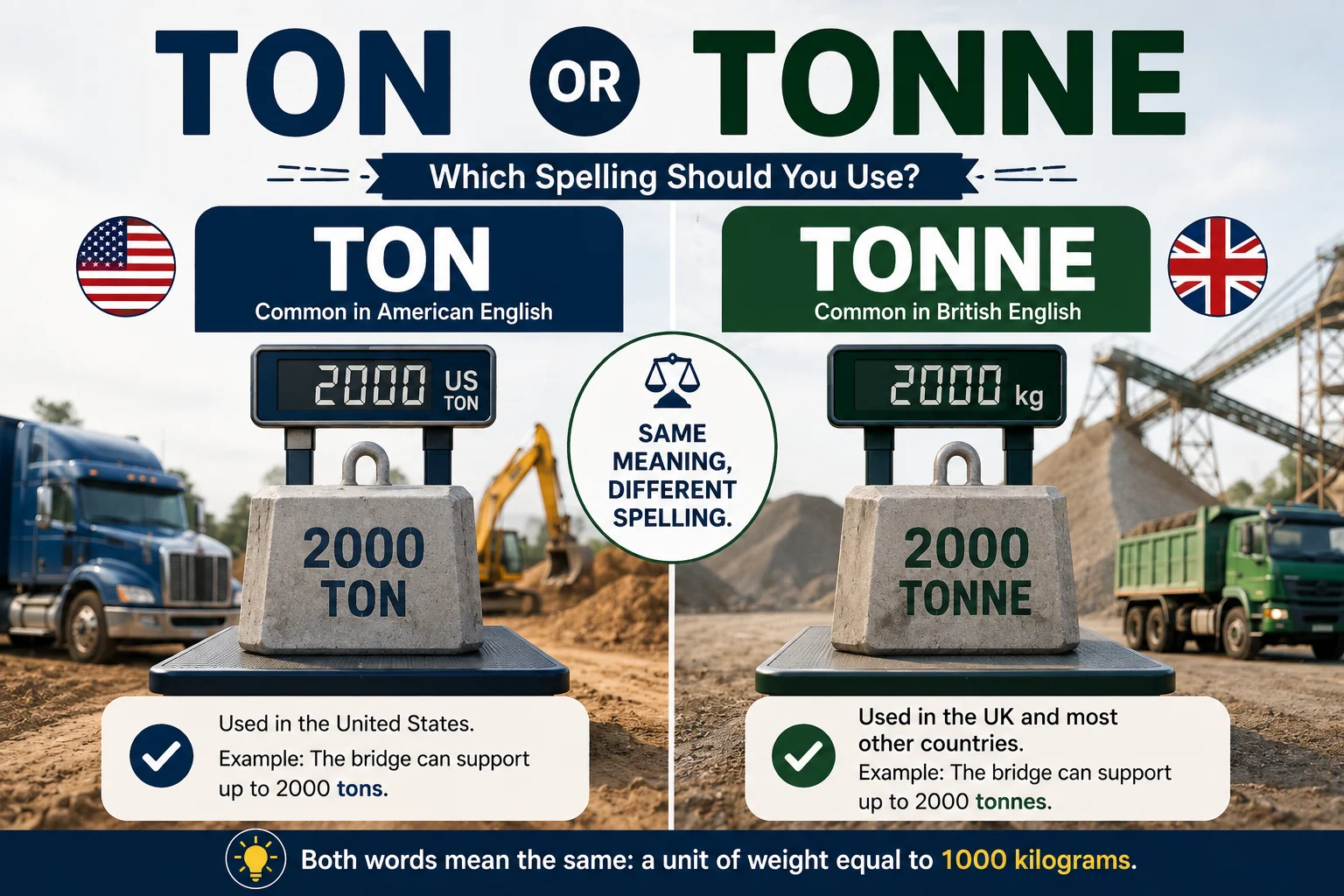
Ton and tonne are both units of weight, but they are not exactly the same. Tonne means 1,000 kilograms, while ton can mean different amounts depending on the measurement system.
Have you ever written ton or tonne and stopped because you were not sure which one looked right? I have seen this small spelling choice cause big confusion, especially when students write about weight, shipping, food, cars, or science.
The problem is not just spelling. Ton and tonne can refer to different weights.
A tonne always means 1,000 kilograms. A ton, however, can mean a short ton or a long ton, depending on the country and context. In the United States, a ton usually means 2,000 pounds. In the United Kingdom, the traditional long ton means 2,240 pounds.
That difference matters when numbers are involved.
Imagine reading that a truck carries “10 tons.” Without knowing the country, you may not know exactly how much weight that means.
In this guide, I will make the difference simple. You will learn where both words come from, how they are used, which form to choose, and how to avoid common mistakes.
Ton or Tonne – Quick Answer
Ton and tonne are both words for large units of weight.
The key difference is their measurement:
- 1 tonne = 1,000 kilograms
- 1 metric tonne = 1,000 kilograms
- 1 US ton = 2,000 pounds, or about 907 kilograms
- 1 UK long ton = 2,240 pounds, or about 1,016 kilograms
So, tonne has one fixed metric meaning.
Ton can have different meanings.
For example:
The factory produced 50 tonnes of steel.
This means 50,000 kilograms.
In American English:
The truck carried 50 tons of material.
This normally means 50 US short tons.
That is why choosing the right word can matter in technical or business writing.
The Origin / Background of Ton or Tonne
The word ton is much older than tonne.
Ton comes from an old word related to a large container or cask. Over time, the word became associated with a large amount or weight of goods.
The exact value of a ton changed across places and periods.
This created different systems of measurement.
For example, Britain traditionally used the long ton. It equals 2,240 pounds.
The United States commonly uses the short ton. It equals 2,000 pounds.
Later, countries using the metric system adopted the tonne.
The tonne was designed to fit neatly into the metric system:
1 tonne = 1,000 kilograms.
The spelling also helps distinguish the metric unit from the older ton.
This is why you may see ton in American writing and tonne in British, Australian, Canadian, and other metric contexts.
The difference is not simply British versus American spelling. It can also be a difference in measurement systems.
Ton or Tonne Explained — Key Differences
The easiest way to understand the two words is to look at their values.
What Is a Tonne?
A tonne is a metric unit of mass.
It equals:
1 tonne = 1,000 kilograms
It is also equal to:
1 tonne = 1,000,000 grams
A tonne is commonly used for heavy objects and materials.
Examples include:
- cars
- trucks
- steel
- coal
- grain
- waste
- construction materials
Example:
The bridge can support 20 tonnes of weight.
The meaning is clear because a tonne has a fixed metric value.
What Is a Ton?
A ton can mean different things.
The most common meanings are:
US short ton:
1 ton = 2,000 pounds
UK long ton:
1 ton = 2,240 pounds
This means you should consider the context before converting a number.
For example, 10 US tons and 10 UK long tons are not exactly the same weight.
What About the Metric Ton?
You may also see the term metric ton.
A metric ton means the same thing as a tonne:
1 metric ton = 1 tonne = 1,000 kilograms
The spelling tonne is often preferred when the writer wants to make the metric meaning clear.
Comparison Table
| Term | Meaning | When to Use | Region/Context |
|---|---|---|---|
| Tonne | 1,000 kg | Metric measurements | UK, Europe, Australia, and many metric countries |
| Metric ton | 1,000 kg | Metric measurements | International and technical contexts |
| Ton | Usually 2,000 lb | US weight system | United States |
| Long ton | 2,240 lb | Traditional British measurement | UK and historical contexts |
| Short ton | 2,000 lb | US measurement | United States |
The important point is simple: tonne is fixed, while ton can vary.
Which Version Should You Use?
The best choice depends on your audience.
For American English
Use ton when you mean the US short ton.
For example:
The company shipped 30 tons of steel.
In US writing, readers usually understand ton as 2,000 pounds.
If you mean 1,000 kilograms, you can write metric ton or tonne.
For British English
Use tonne for the metric unit.
For example:
The lorry carried five tonnes of sand.
The UK uses the metric system for most modern measurements, so tonne is common in current technical and everyday writing.
The traditional long ton may still appear in historical, maritime, or specialized contexts.
For Students
If your teacher asks about metric measurements, use tonne when you mean 1,000 kilograms.
This is especially useful in science and geography.
For example:
One tonne is equal to 1,000 kilograms.
For International Writing
Use tonne when you mean exactly 1,000 kilograms.
This avoids confusion.
For example:
The plant produces 100 tonnes of cement each year.
If you use ton, state the system when accuracy matters:
The shipment weighs 100 US tons.
For Technical and Business Writing
Be precise.
Do not assume that every reader understands ton in the same way.
If the measurement is important, write:
- tonnes
- metric tons
- US short tons
- UK long tons
This small detail can prevent major errors.
Common Mistakes with Ton or Tonne
1. Treating Ton and Tonne as Exactly the Same
Mistake:
A tonne is always the same as a US ton.
Correction:
A tonne equals 1,000 kg, while a US ton equals 2,000 lb.
The two units are close in size, but they are not equal.
2. Assuming “Ton” Always Means 1,000 Kilograms
Mistake:
The machine weighs 2 tons, so it weighs exactly 2,000 kg.
Correction:
The machine weighs 2 tonnes.
Or specify the system:
The machine weighs 2 US tons.
The word ton needs context.
3. Using Tonne When You Mean a US Ton
Mistake:
The American company shipped 500 tonnes.
This may be correct if the company is reporting metric weight. But if the source uses US short tons, changing the unit to tonnes changes the measurement.
Always check the original unit before converting.
4. Confusing Tonnes With Kilograms
Mistake:
One tonne equals 100 kilograms.
Correction:
One tonne equals 1,000 kilograms.
A useful memory trick is:
tonne → thousand kilograms
5. Forgetting the Plural Form
Both words usually take a plural s.
Correct:
five tonnes
ten tons
Incorrect:
five tonne
ten ton
However, singular forms can appear before another noun:
a five-ton truck
a five-tonne load
The hyphenated form acts as a compound adjective.
Ton or Tonne in Real-World Examples
Seeing these words in natural sentences makes them easier to remember.
Professional Email
Subject: Shipment Weight Confirmation
Please confirm whether the shipment weighs 25 tonnes or 25 US tons. We need the exact unit before completing the shipping documents.
This is a good business example because the unit affects the actual weight.
News Headline
Factory Produces 50,000 Tonnes of Steel
A news report about metric production may use tonnes.
The number tells readers how much material the factory produced.
Social Media Post
Our new truck can carry more than 10 tonnes of equipment!
The word works naturally when the writer is using metric measurements.
Formal Document
The facility is expected to process 200 tonnes of waste per year.
This wording is clear and suitable for a report.
American Example
The construction project requires 500 tons of concrete.
In a US context, tons normally means short tons.
If the writer means metric tons, the document should make that clear.
Ton or Tonne — Data, Trends & Usage
People often search for ton or tonne because they see both spellings online.
The search is especially useful for students, writers, translators, editors, engineers, and people working with international measurements.
The confusion comes from two separate issues:
- Spelling
- Measurement
If this were only a spelling difference, the answer would be easy. But ton can refer to different units.
That makes context very important.
Search intent for “ton or tonne” is mainly informational. People usually want to know which word is correct and whether the two measurements are equal.
This topic also matters more when information crosses borders.
A US company may report weight in tons. A European company may report the same type of information in tonnes.
If you copy the number without checking the unit, you could report the wrong weight.
For international reports, science writing, shipping documents, and trade information, unit accuracy matters as much as spelling accuracy.
Ton vs Tonne: Quick Comparison
| Term/Variant | Meaning | Region/Context | Best Used When |
|---|---|---|---|
| tonne | 1,000 kg | Metric system | You need a clear metric measurement |
| metric ton | 1,000 kg | International/technical | You want to explain the metric unit |
| ton | Usually 2,000 lb | United States | Writing about US short tons |
| short ton | 2,000 lb | US | Maximum precision in US technical writing |
| long ton | 2,240 lb | Traditional UK system | Historical or specialized contexts |
Easy Memory Rule
Remember this:
Tonne = 1,000 kilograms.
If you see ton, check the context before assuming its exact weight.
That one habit can save you from many measurement mistakes.
Ton or Tonne in British and American English
One of the biggest reasons people search for ton or tonne is the difference between British and American English.
In modern British English, tonne is commonly used for the metric unit.
Example:
The ship carries 2,000 tonnes of cargo.
In American English, ton is commonly used for the short ton.
Example:
The truck carries 2,000 tons of cargo.
But do not think of this as a simple spelling rule like colour/color.
The difference between ton and tonne can change the actual measurement.
That makes it more important than many ordinary British-American spelling differences.
Is Ton or Tonne More Correct?
Neither word is automatically more correct.
The correct choice depends on what unit you mean.
Use tonne when you mean:
1,000 kilograms
Use ton when your context uses the ton system.
For US measurements, ton normally means:
2,000 pounds
If your reader may be confused, give the exact unit.
For example:
The shipment weighs 15 tonnes (15,000 kg).
Or:
The shipment weighs 15 US short tons.
Clear writing removes doubt.
FAQ: Ton or Tonne
Q: What does tonne mean?
A: A tonne is a metric unit of mass equal to 1,000 kilograms. It is also called a metric ton.
Q: What does ton mean?
A: Ton can refer to different units. In the United States, it usually means a short ton of 2,000 pounds. A traditional UK long ton is 2,240 pounds.
Q: Are ton and tonne the same?
A: No. A tonne equals 1,000 kilograms, while a US ton equals about 907 kilograms. They are similar but not identical.
Q: Which is correct, ton or tonne?
A: Both are correct. Use tonne for 1,000 kilograms. Use ton when the context uses the short-ton or another ton system.
Q: Is tonne British or American?
A: Tonne is widely used in British English and other countries that use the metric system. American English commonly uses ton for the short ton.
Q: Is tonne acceptable in formal writing?
A: Yes. Tonne is fully acceptable in formal writing. It is often useful in technical, scientific, business, and international documents.
Q: How many kilograms are in a ton?
A: It depends on the type of ton. A US short ton is about 907 kilograms, while a UK long ton is about 1,016 kilograms. A tonne is exactly 1,000 kilograms.
Conclusion
The difference between ton or tonne is simple once you separate spelling from measurement.
A tonne is a fixed metric unit. It always equals 1,000 kilograms.
A ton can mean different amounts. In the United States, it usually means 2,000 pounds. A traditional UK long ton means 2,240 pounds.
For most international and metric writing, tonne is the clearest choice when you mean 1,000 kilograms. For American writing, use ton when you mean the US short ton.
Remember one key rule: never assume that ton and tonne are identical. Check the measurement system when accuracy matters.
If you are writing for a global audience, consider stating the unit clearly. This makes your writing easier to understand and prevents costly measurement errors.
Now you know exactly when to use ton or tonne. Bookmark this guide so you never second-guess these two units again.