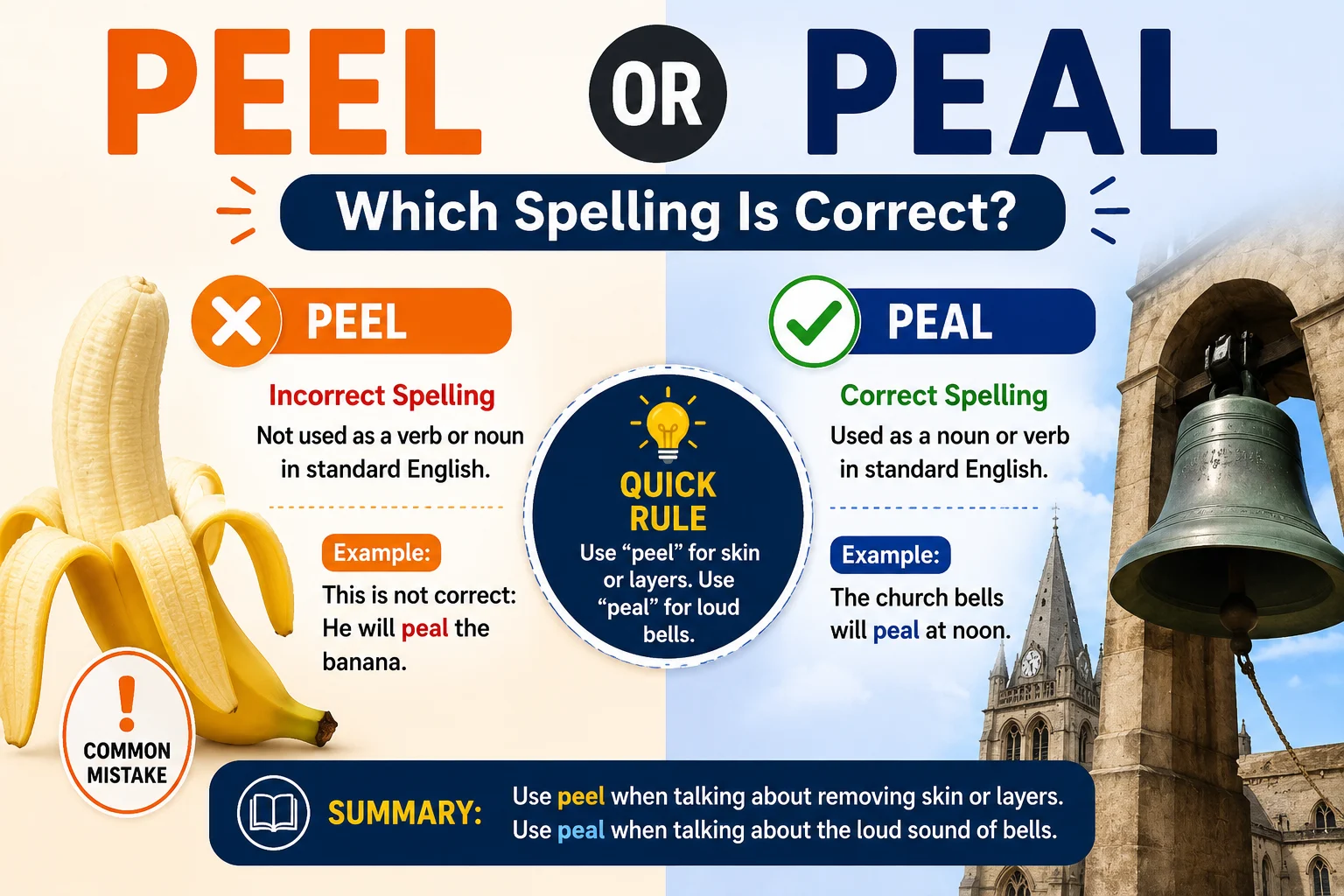
Peel means to remove the outer layer of something, while peal refers to a loud ringing sound, especially of bells.
Have you ever wondered whether to use peel or peal? You’re not alone. These two words sound exactly the same, making them a common source of confusion for English learners and even native speakers. Because they are homophones, many people accidentally choose the wrong spelling when writing emails, school assignments, articles, or social media posts.
The good news is that the difference is easy to understand. Peel usually refers to removing the outer layer of something, such as a banana or an orange. It can also refer to the skin or outer covering itself. Peal, on the other hand, refers to a loud ringing of bells or a loud burst of sound, such as laughter or thunder. Although both words are correct, they are used in completely different situations.
In this guide, you’ll learn the difference between peel or peal, where the words come from, how they are used in British and American English, common mistakes to avoid, and practical examples. By the end, you’ll know exactly which spelling to choose every time.
## Peel or Peal – Quick Answer
Both peel and peal are correct English words, but they have different meanings.
- Peel means to remove the outer layer of something or refers to that outer layer.
- Peal means a loud ringing of bells or a loud burst of sound.
Examples
- Please peel the potatoes before cooking.
- She threw the banana peel into the bin.
- A joyful peal of laughter filled the room.
## The Origin of Peel or Peal
Although peel and peal sound the same, they come from different origins.
Peel comes from the Old French word peler, meaning “to strip the skin from.” It entered English hundreds of years ago and has always referred to removing an outer layer.
Peal comes from Middle English and Old French words related to loud ringing or repeated sounds. It became associated with church bells, thunder, laughter, and other powerful noises.
Since both words are pronounced the same way, they are often confused in writing.
## British English vs American English Spelling
There is no spelling difference between British and American English.
Both varieties use peel and peal with the same meanings.
| Version | Spelling | Region | Example Sentence |
|---|---|---|---|
| Standard English | Peel | United States & United Kingdom | Peel the apple before eating it. |
| Standard English | Peal | United States & United Kingdom | A peal of bells echoed through the town. |
The spellings and meanings are the same worldwide.
## Which Spelling Should You Use?
US Audience
Use peel for removing skin or describing the outer layer. Use peal when talking about loud ringing or bursts of sound.
UK/Commonwealth Audience
The same rule applies. Both spellings are standard and have different meanings.
Global/SEO Audience
Choose the spelling that matches your meaning:
- Peel = remove skin or outer layer.
- Peal = loud ringing or loud sound.
## Common Mistakes with Peel or Peal
These homophones are often mixed up because they sound identical.
Incorrect vs Correct
❌ Please peal the orange.
✅ Please peel the orange.
❌ A loud peel of laughter echoed through the hall.
✅ A loud peal of laughter echoed through the hall.
❌ Throw the banana peal away.
✅ Throw the banana peel away.
❌ The church peeled its bells.
✅ The church bells rang in a joyful peal.
## Peel or Peal in Everyday Examples
Emails
“Please peel and slice the apples before the meeting.”
News Headlines
“Church Bells Ring in Joyful Peal to Celebrate Festival”
Social Media
“I can never peel a mango without making a mess!”
Formal Writing
“A sudden peal of thunder interrupted the outdoor ceremony.”
## Peel or Peal – Google Trends & Usage
Across English-speaking countries, peel is searched much more often than peal.
People commonly search for peel because it is used in cooking, skincare, gardening, fruit preparation, and household tasks.
The word peal is less common and usually appears in:
- Literature
- News stories
- Religious contexts
- Weather reports
- Descriptions of laughter or bells
Both words are correct, but peel is far more common in everyday English.
## Comparison Table
| Feature | Peel | Peal |
|---|---|---|
| Dictionary Word | Yes | Yes |
| Means Remove Skin | Yes | No |
| Means Outer Layer | Yes | No |
| Means Loud Ringing | No | Yes |
| Common in Everyday Writing | Yes | Less Common |
| Best for SEO | Yes | Only for sound-related topics |
## FAQs
Is it peel or peal?
Both are correct. Peel refers to removing skin or the outer layer, while peal refers to a loud ringing or burst of sound.
What does peel mean?
Peel means to remove the outer skin of something or refers to that outer layer.
What does peal mean?
Peal means a loud ringing of bells or a loud burst of laughter, thunder, or similar sound.
Is there a British and American spelling difference?
No. Both British and American English use peel and peal with the same spellings and meanings.
How can I remember the difference between peel and peal?
Think of peel for fruit peels and peal for bell peals.
Can peal be used for laughter?
Yes. A peal of laughter is a common English expression meaning a loud burst of laughter.
## Conclusion
Knowing the difference between peel or peal is simple once you understand their meanings. Peel is the correct word when talking about removing the outer layer of fruit, vegetables, or other objects. It can also refer to the skin itself, such as a banana peel or orange peel. This is the word you’ll use most often in everyday conversations, recipes, and household instructions.
Peal, however, has a completely different meaning. It describes a loud ringing of bells or a powerful burst of sound, such as laughter or thunder. Although it is less common than peel, it frequently appears in literature, news writing, and descriptive language.
A simple way to remember the difference is this: peel belongs in the kitchen, while peal belongs to sounds. Keeping this easy memory trick in mind will help you choose the correct spelling and avoid a common homophone mistake in English writing.